 Due to
unfavorable weather conditions in Florida, the Space Shuttle
Discovery was diverted to Edwards Air Force Base at the
conclusion of mission STS-92 on Tuesday, October 24.
Due to
unfavorable weather conditions in Florida, the Space Shuttle
Discovery was diverted to Edwards Air Force Base at the
conclusion of mission STS-92 on Tuesday, October 24.
Space Shuttle Discovery at Edwards Air Force Base
|
Due to
unfavorable weather conditions in Florida, the Space Shuttle
Discovery was diverted to Edwards Air Force Base at the
conclusion of mission STS-92 on Tuesday, October 24.
The departure of the Discovery on the 747 Shuttle Carrier Aircraft was initially scheduled for sunrise on Tuesday, October 31.
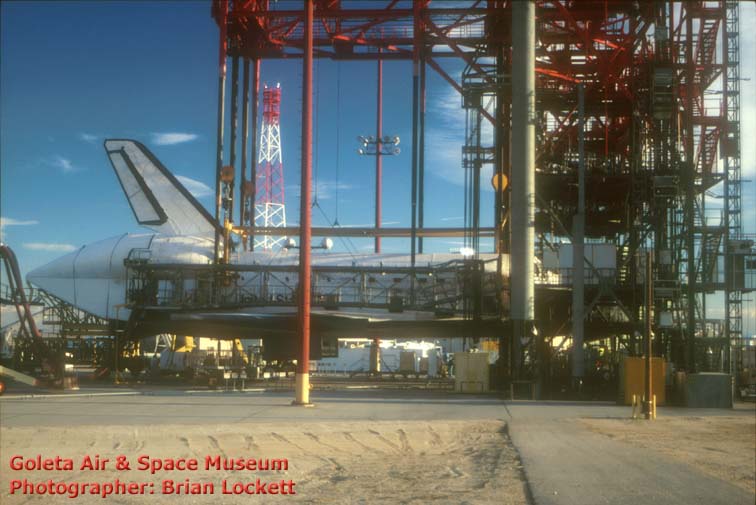 As of Monday afternoon, the shuttle was sitting on its
landing gear under the Mate/Demate Device. The yellow
cradle of the crane was attached to Discovery at the hoist points
on the sides of its fuselage. NASA technicians were working
to install the large cone on the tail that smooths the airflow
around the orbiter while it is being carried on the 747.
As of Monday afternoon, the shuttle was sitting on its
landing gear under the Mate/Demate Device. The yellow
cradle of the crane was attached to Discovery at the hoist points
on the sides of its fuselage. NASA technicians were working
to install the large cone on the tail that smooths the airflow
around the orbiter while it is being carried on the 747.
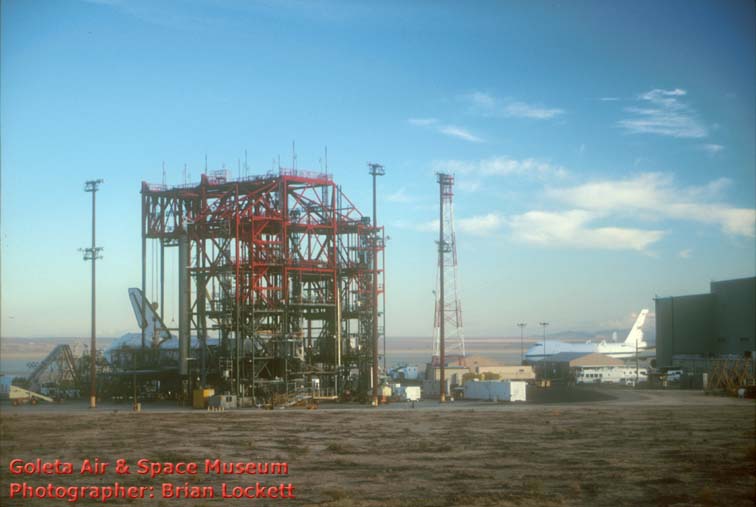 The first 747
Shuttle Carrier Aircraft, N905NA was waiting next to the Shuttle
maintenance hangar. It was modified from American Airlines
747-123, N9668, which first flew on October 15, 1970. It can be
distinguised from the other Shuttle Carrier Aircraft, N911NA by
the number of windows on the upper deck. There are only two
windows on the upper deck of N905NA. N911NA is ex-Japan Airlines
747-146SR, JA8117.
The first 747
Shuttle Carrier Aircraft, N905NA was waiting next to the Shuttle
maintenance hangar. It was modified from American Airlines
747-123, N9668, which first flew on October 15, 1970. It can be
distinguised from the other Shuttle Carrier Aircraft, N911NA by
the number of windows on the upper deck. There are only two
windows on the upper deck of N905NA. N911NA is ex-Japan Airlines
747-146SR, JA8117.
 That evening
technicians began to encounter problems with the alignment of the
tail cone.
That evening
technicians began to encounter problems with the alignment of the
tail cone.
Twenty-three
years earlier, 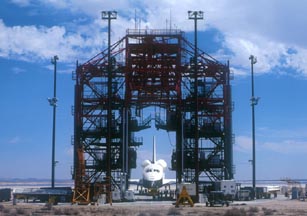 the Space
Shuttle Enterprise, OV-101 is towed into the Mate/Demate Device
on August 12, 1977 following its first Approach and Landing Test
flight.
the Space
Shuttle Enterprise, OV-101 is towed into the Mate/Demate Device
on August 12, 1977 following its first Approach and Landing Test
flight.
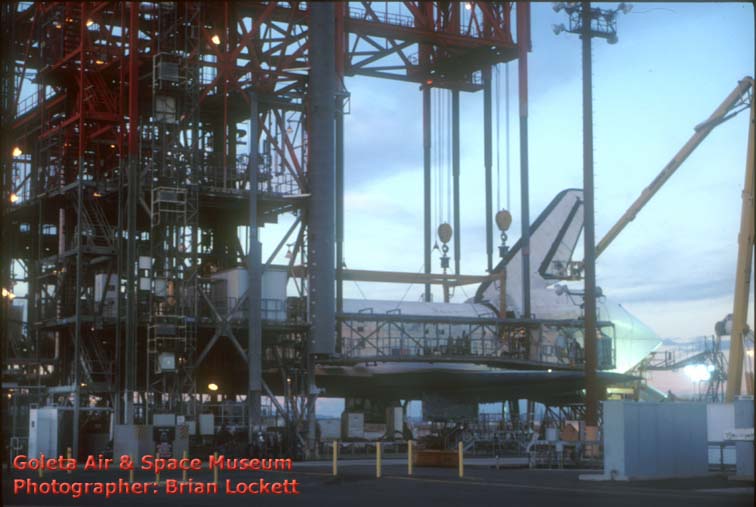 After sunset, the first of the work
lights were coming on.
After sunset, the first of the work
lights were coming on.
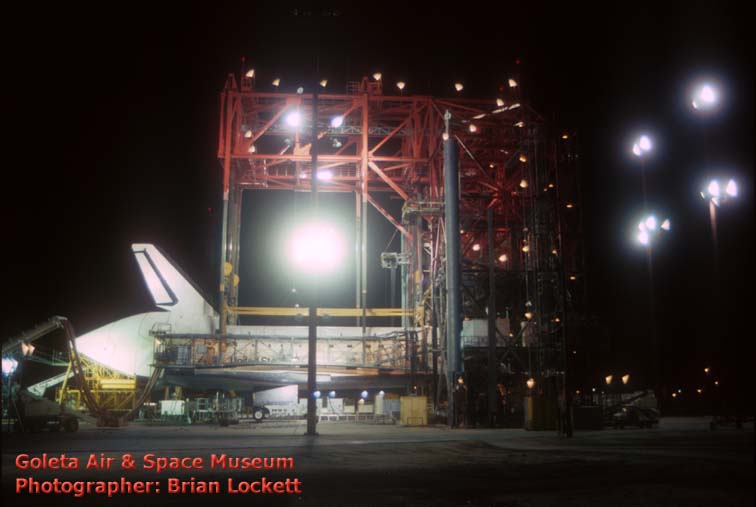 Later, the scene was entirely lit up under flood
lights.
Later, the scene was entirely lit up under flood
lights.
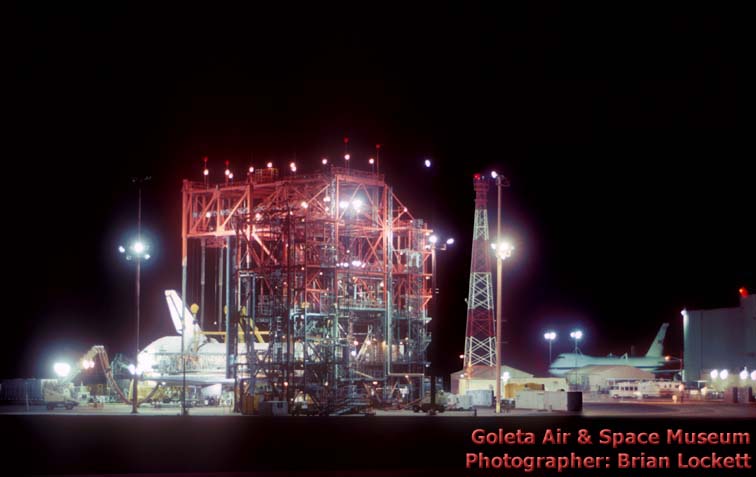 Space Shuttle
Discovery in Mate/Demate Device and the 747 Shuttle Carrier
Aircraft.
Space Shuttle
Discovery in Mate/Demate Device and the 747 Shuttle Carrier
Aircraft.
 Space Shuttle
Discovery in Mate/Demate Device.
Space Shuttle
Discovery in Mate/Demate Device.
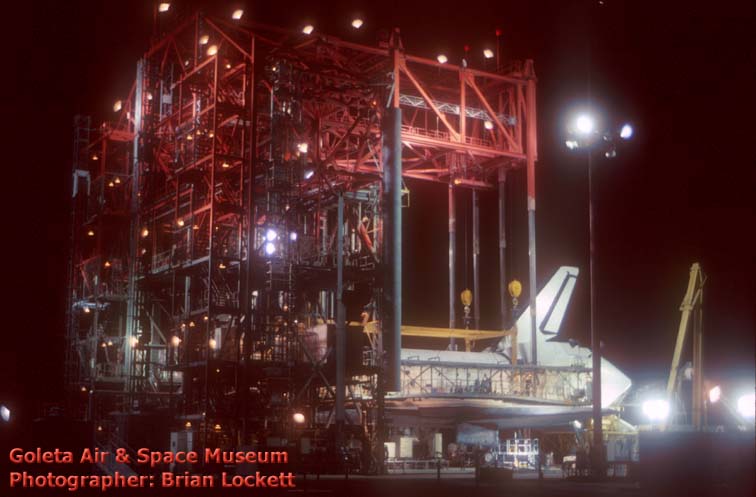 Space Shuttle
Discovery in Mate/Demate Device.
Space Shuttle
Discovery in Mate/Demate Device.
As a result of problems attaching the tail cone to the Discovery, its departure was postponed until Thursday. Initially, it was scheduled for 6:00 AM. Coincidentally, a test flight of the X-38 Space Station Lifeboat parachute recovery system demonstrator was scheduled to take-off at 8:00 AM. The X-38 is carried by NASA's Boeing NB-52B Stratofortress mothership, 52-0008.
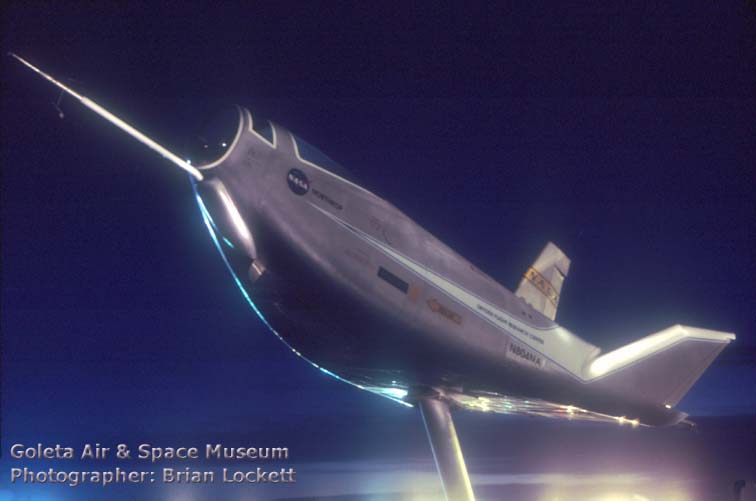 The Northrop
HL-10 lifting body, N804NA is mounted on a pylon at the
intersection leading to the NASA Dryden Flight Research Center.
The Northrop
HL-10 lifting body, N804NA is mounted on a pylon at the
intersection leading to the NASA Dryden Flight Research Center.
Visit the NASA Dryden HL-10 Home Page.
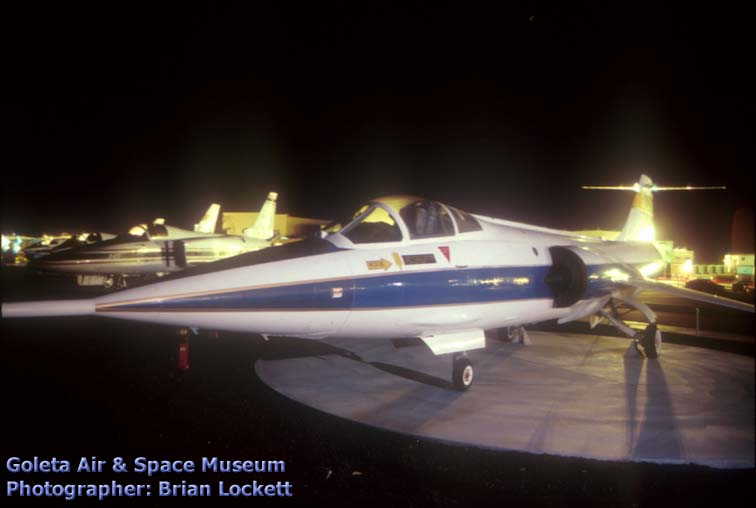 Display airplanes at the NASA Dryden Flight Research
Center include Lockheed F-104G Starfighter chase plane, N826NA;
the second Grumman X-29 forward-swept wing demonstrator, 82-0049;
the digital fly-by-wire Vought F-8 Crusader, N802NA; and the
supercritical wing F-8 Crusader, N810NA.
Display airplanes at the NASA Dryden Flight Research
Center include Lockheed F-104G Starfighter chase plane, N826NA;
the second Grumman X-29 forward-swept wing demonstrator, 82-0049;
the digital fly-by-wire Vought F-8 Crusader, N802NA; and the
supercritical wing F-8 Crusader, N810NA.
Visit the NASA Dryden F-104 Starfighter Photo Gallery.
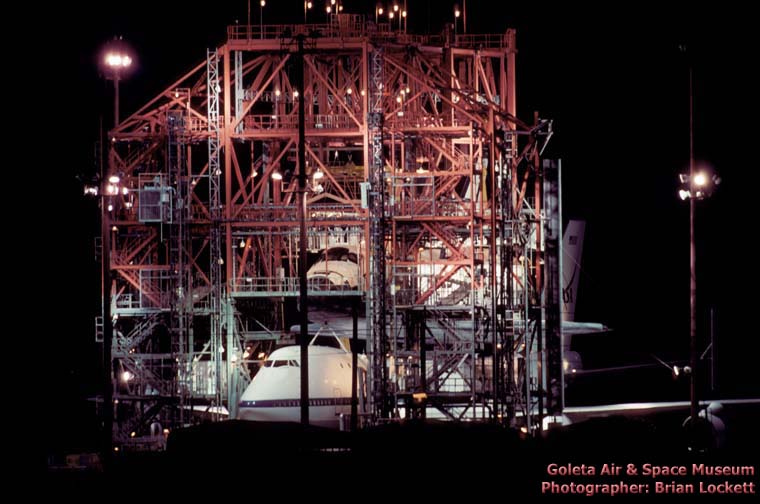 The 747
Shuttle Carrier Aircraft had been moved into position under the
Discovery.
The 747
Shuttle Carrier Aircraft had been moved into position under the
Discovery.
Twenty-three
years earlier,  the Space Shuttle Enterprise, OV-101 and 747-SCA,
N905NA wait in the Mate/Demate Device for the fourth Approach and
Landing Test flight before dawn on October 12, 1977.
the Space Shuttle Enterprise, OV-101 and 747-SCA,
N905NA wait in the Mate/Demate Device for the fourth Approach and
Landing Test flight before dawn on October 12, 1977.
 Space Shuttle Discovery on 747-123 Shuttle Carrier Aircraft N905NA in the Mate/Demate Device. There is a short period in the early morning when the artificial light on the Mate/Demate Device and the natural light of the sky in the background are nicely balanced.
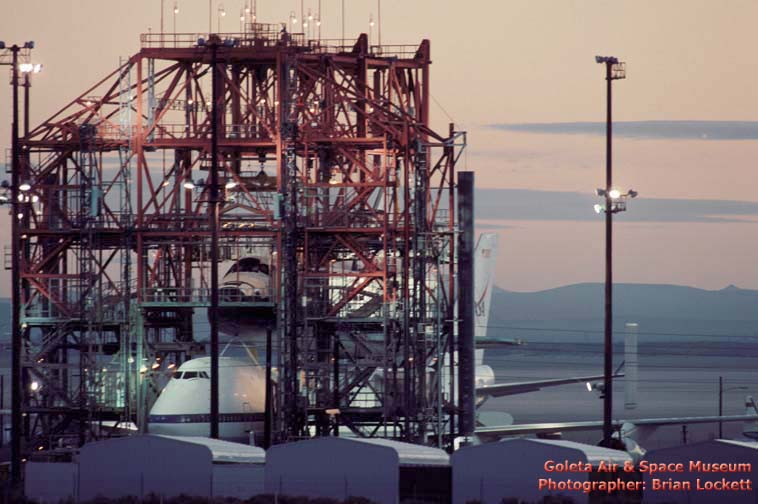 Soon the
light of day overwhelms the aritificial lights of the Mate/Demate Device.
Soon the
light of day overwhelms the aritificial lights of the Mate/Demate Device.
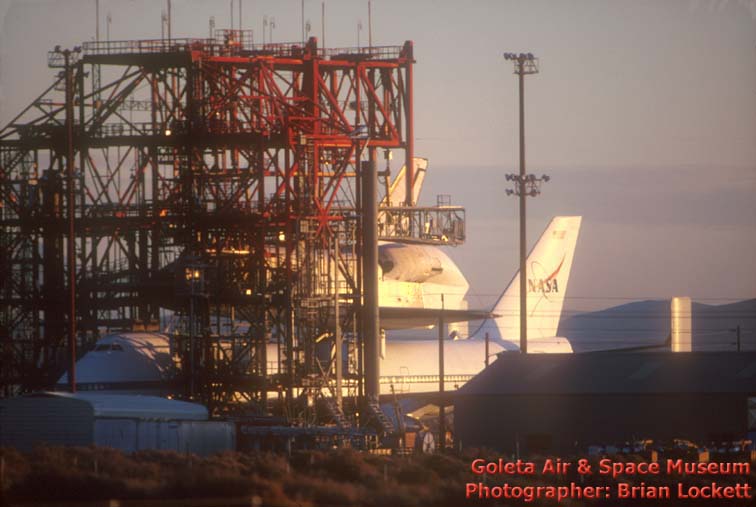 The first rays of the rising sun illuminate the piggyback pair as final preparations for their departure are concluded.
The take-off time of the Shuttle continued to slip. Eventually it fell behind the take-off of the NB-52B.
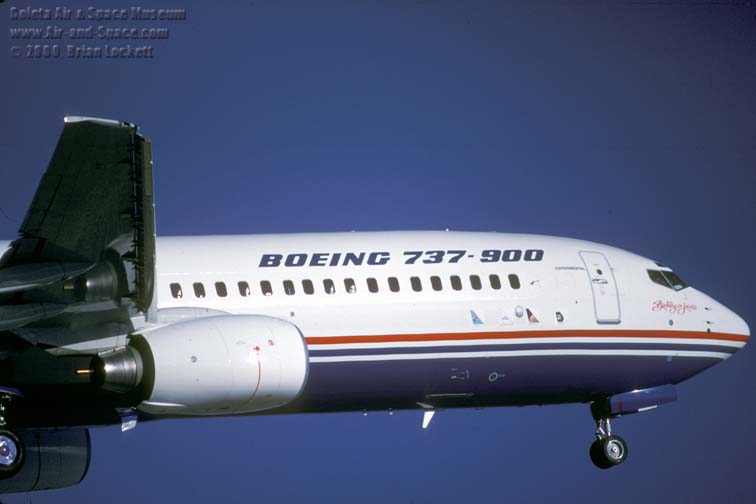 The Boeing 737-900 prototype, N737X took off to the
east as we arrived at the shooting location on the south side of the main runway. The 900 model has been stretched to a length of 138 feet, 2 inches. The 737-900 Prototype carries construction number 30017. It first flew on August 3, 2000. A short while later, the 737-900 landed going the opposite direction from its take-off. It turned around on the runway and departed to the east again.
The Boeing 737-900 prototype, N737X took off to the
east as we arrived at the shooting location on the south side of the main runway. The 900 model has been stretched to a length of 138 feet, 2 inches. The 737-900 Prototype carries construction number 30017. It first flew on August 3, 2000. A short while later, the 737-900 landed going the opposite direction from its take-off. It turned around on the runway and departed to the east again.
Over on the main flightline, the tail of the NB-52B began to move. Several miles away the Discovery and 747 could be seen being pushed back out of the Mate/Demate Device. They were towed to the Dryden flightline to start the engines of the 747.
A variety of airplanes were using the main runway. After the number one F-22 Raptor took off, an Air Force Beech C-12 Super King Air made a mid-field take-off.
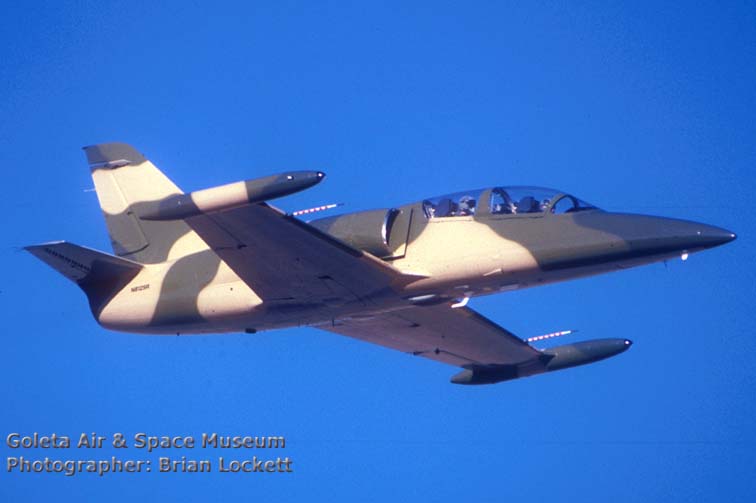 A
brown and green camouflaged Czech Aero L-39 Dolphin, N8125R
registered to Jet Team LLC took off.
A
brown and green camouflaged Czech Aero L-39 Dolphin, N8125R
registered to Jet Team LLC took off.
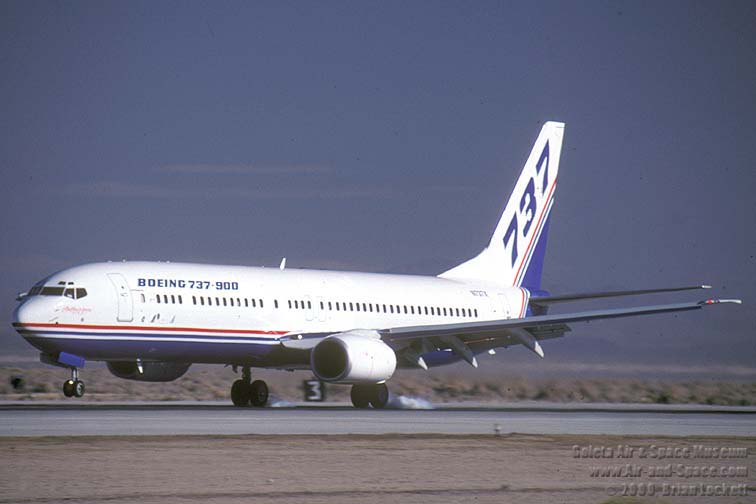 The Boeing 737-900 Prototype made several more
landings, take-offs, and a low pass over the runway without
touching down.
The Boeing 737-900 Prototype made several more
landings, take-offs, and a low pass over the runway without
touching down.
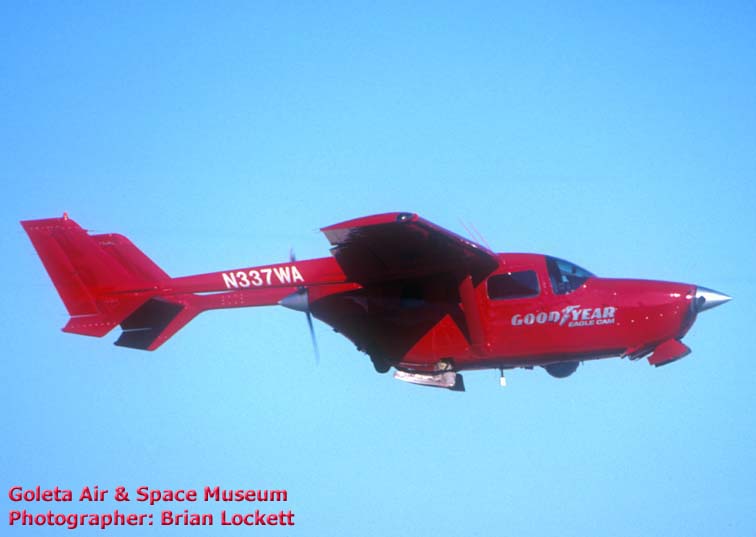 The red Eagle Cam Cessna
337 Skymaster, N337WA with a Gyron 935 gyro-stabilized video
system took off from mid-field. It transmitted live television of
the parachute descent of the X-38. It is registered to Gyron
Eagle, Ltd of Pasadena, California. It is operated by Wolfe Air
and is regularly scheduled for MTV’s ‘Senseless Acts
of Video.
The red Eagle Cam Cessna
337 Skymaster, N337WA with a Gyron 935 gyro-stabilized video
system took off from mid-field. It transmitted live television of
the parachute descent of the X-38. It is registered to Gyron
Eagle, Ltd of Pasadena, California. It is operated by Wolfe Air
and is regularly scheduled for MTV’s ‘Senseless Acts
of Video.
Link to Wolfe Air's fleet page.
Shortly before 8:00 the NB-52B lined up with the main runway.
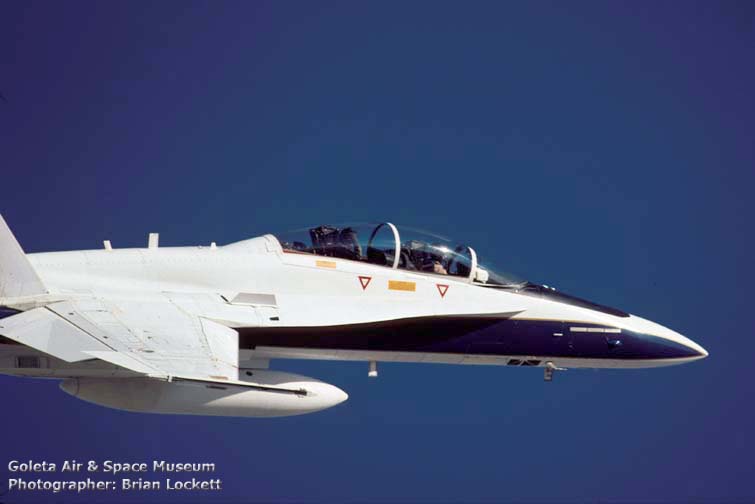 A white and blue NASA F/A-18B Hornet chase plane,
N846NA took off. It made one circuit of the pattern and lined up
with the runway to catch the NB-52B as it took off.
A white and blue NASA F/A-18B Hornet chase plane,
N846NA took off. It made one circuit of the pattern and lined up
with the runway to catch the NB-52B as it took off.
Visit the NASA Dryden F-18 chase aircraft Fact Page and F-18 chase aircraft Photo Gallery.
The tower radioed clearance for the NB-52B to take-off. The shrill whine of the eight J57 turbojets increased in volume and a dense cloud of black smoke billowed up behind the Stratofortress.
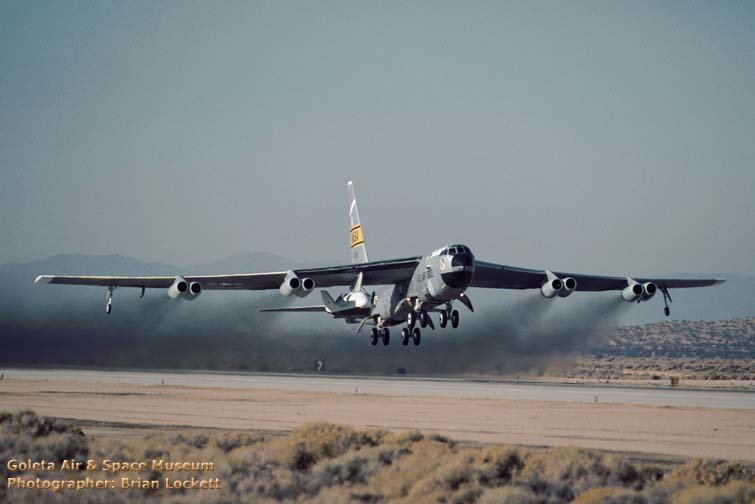 The NB-52B
lifted off after rolling nearly 8,000 feet.
The NB-52B
lifted off after rolling nearly 8,000 feet.
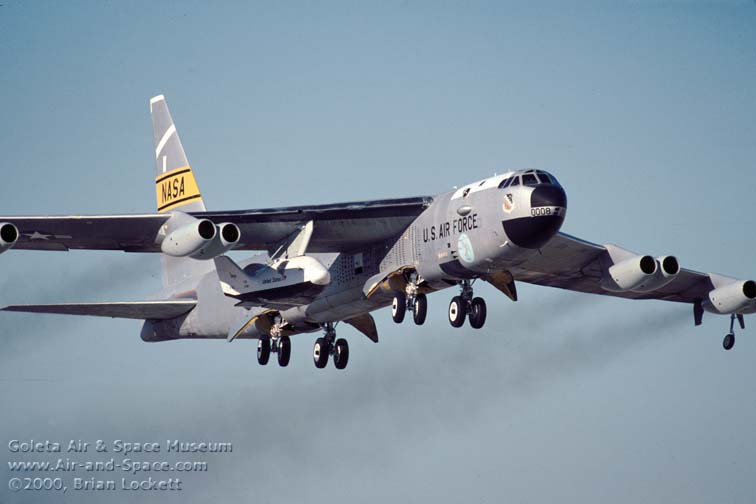
You can buy framed prints or greeting cards of this photograph.
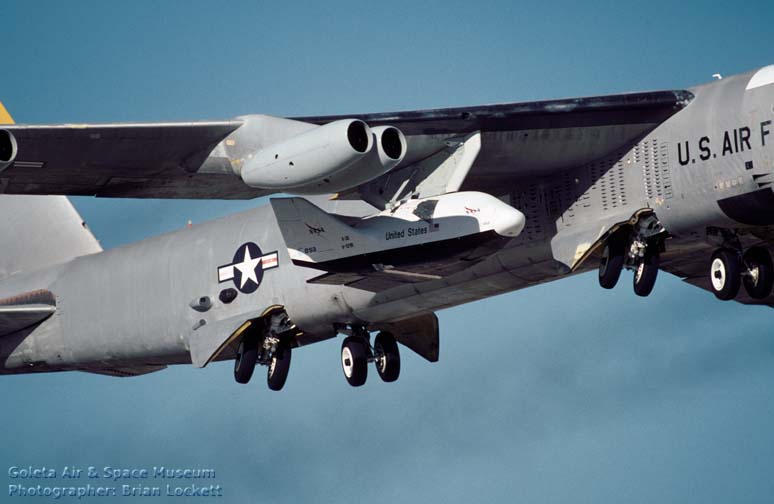 X-38, V-131R
is an 80%-scale testbed of the Space Station Crew Return Vehicle.
X-38, V-131R
is an 80%-scale testbed of the Space Station Crew Return Vehicle.
Forty years earlier,
 the NB-52B takes off with
the X-15-1 from runway 04 in September 1960. Photo courtesy
AFFTC/HO.
the NB-52B takes off with
the X-15-1 from runway 04 in September 1960. Photo courtesy
AFFTC/HO.
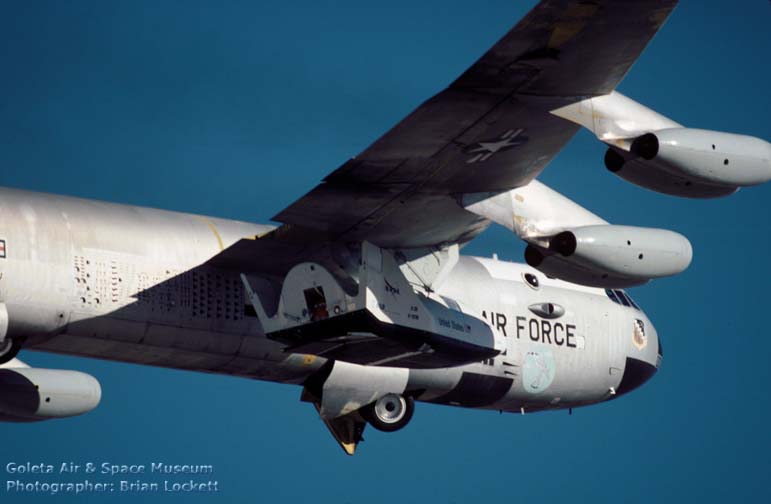 Mission
symbols for the five previous X-38 parachute recovery system
tests can be seen on the side of the fuselage of the Boeing
NB-52B Stratofortress mothership.
Mission
symbols for the five previous X-38 parachute recovery system
tests can be seen on the side of the fuselage of the Boeing
NB-52B Stratofortress mothership.

Visit the NASA Dryden B-52 Stratofortress Mothership Fact Page.
The tails of the 747 and Discovery could be seen moving past the contractor's area. A gray Lockheed C-141B Starlifter taxied out ahead of the Shuttle. It would serve as the pathfinder, checking the flight path ahead of the Shuttle for rain.
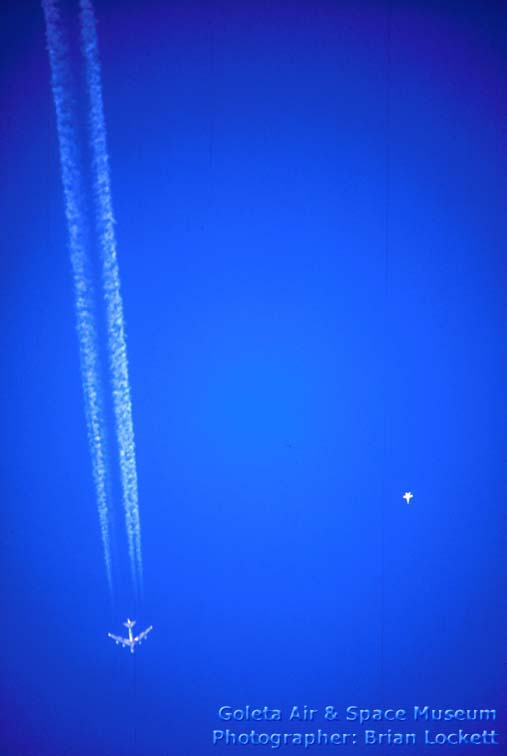 High
overhead, contrails streamed from the engines of the NB-52B as it
flew around a racetrack pattern with its F/A-18A chase plane.
High
overhead, contrails streamed from the engines of the NB-52B as it
flew around a racetrack pattern with its F/A-18A chase plane.
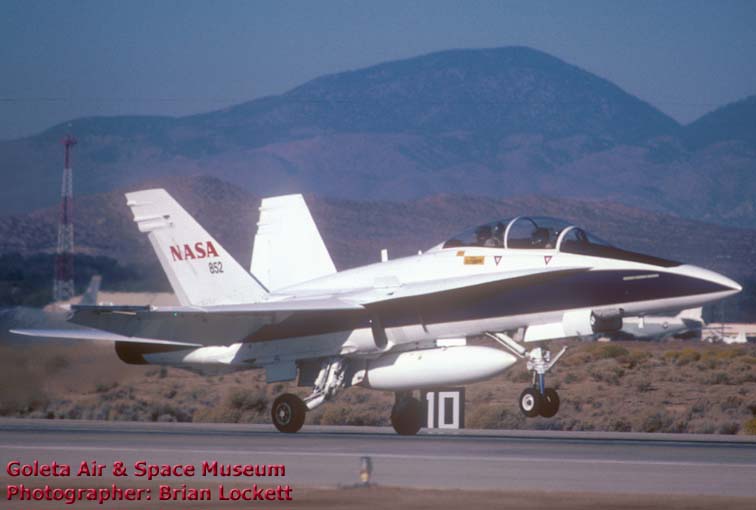 A second NASA F/A-18B Hornet chase plane, N852NA took
off shortly before the 747 carrier airplane.
A second NASA F/A-18B Hornet chase plane, N852NA took
off shortly before the 747 carrier airplane.
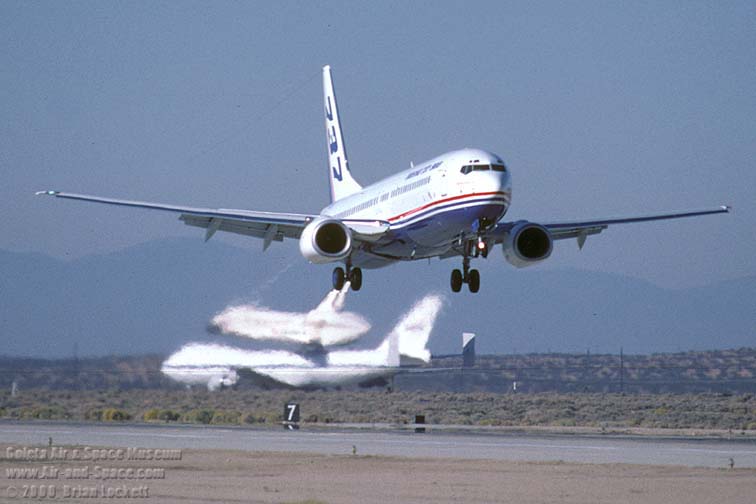 Boeing 737-900 Prototype makes a low pass over Runway
04 as the 747 Shuttle Carrier Aircraft carrying the Space Shuttle
Discovery taxis out.
Boeing 737-900 Prototype makes a low pass over Runway
04 as the 747 Shuttle Carrier Aircraft carrying the Space Shuttle
Discovery taxis out.
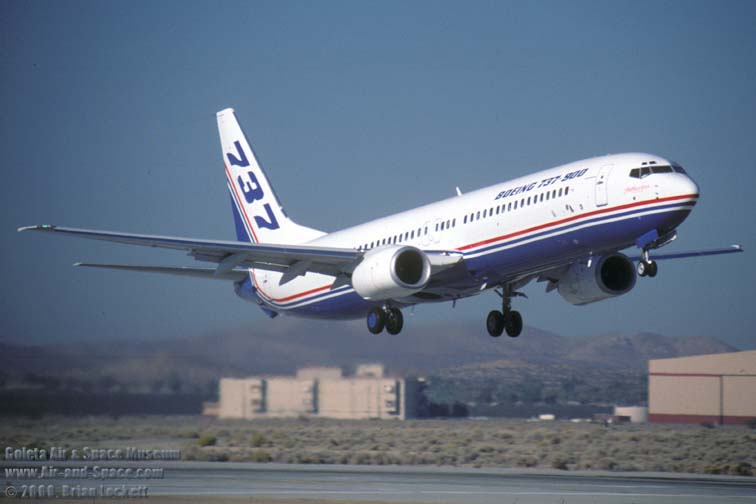
The 737-900 Prototype was delivered to Alaska Airlines as N302AS on April 29, 2003. Alaska Airlines Boeing 737-990, N302AS flight ASA292 to Los Cabos, Mexico departing Los Angeles International Airport on March 2, 2006.
It was going on 9:00 when the 747 turned onto the main runway.
 The radio
crackled with clearance from the tower and the 747 began to roll.
The radio
crackled with clearance from the tower and the 747 began to roll.
Twenty-three
years earlier,  the Space Shuttle Enterprise, OV-101 and 747-SCA,
N905NA take off on the fourth Approach and Landing Test flight on
October 12, 1977. This was the first of two glide flights that
the Enterprise made without the streamlined tailcone. A taller
mount supported the front end of the shuttle to increase the rate
of separation of the two airplanes when the shuttle was released
for its glide flight. NASA used Northrop T-38A Talons as chase
planes in those days.
the Space Shuttle Enterprise, OV-101 and 747-SCA,
N905NA take off on the fourth Approach and Landing Test flight on
October 12, 1977. This was the first of two glide flights that
the Enterprise made without the streamlined tailcone. A taller
mount supported the front end of the shuttle to increase the rate
of separation of the two airplanes when the shuttle was released
for its glide flight. NASA used Northrop T-38A Talons as chase
planes in those days.
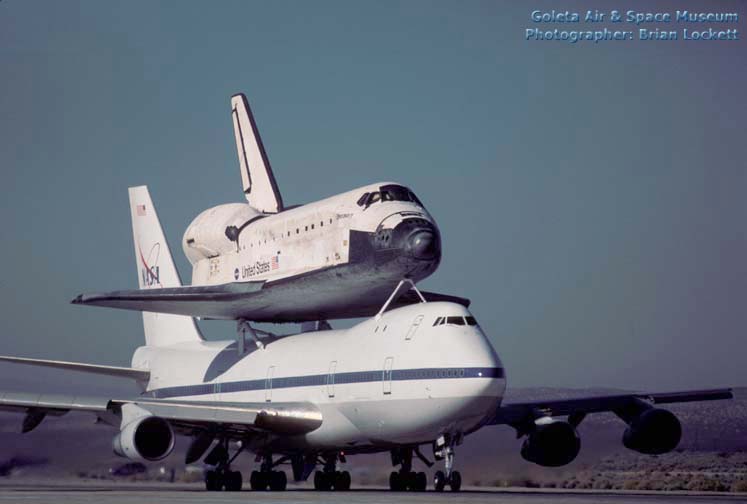
 The 747 with
the Discovery lifted off after a roll of nearly two miles.
The 747 with
the Discovery lifted off after a roll of nearly two miles.
You can buy framed prints or greeting cards of this photograph.

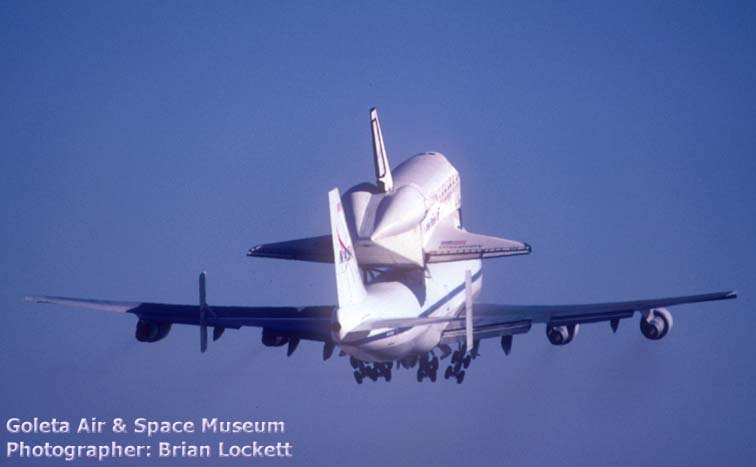
Discovery was delivered to Orbiter Processing Facility bay 1 at the Kennedy Space Center, Florida.
A short while after the departure of the Discovery, the X-38 was dropped from the NB-52B at an altitude of 36,500 feet. It made an unplanned 360-degree roll after launch. After twenty-four seconds of gliding flight, it deployed an 80-foot diameter drogue chute. It deployed the 7,000 square foot parafoil at an altitude of 19,000 feet.
 A smoke generator has
been installed on the left wing of the Boeing NB-52B
Stratofortress mothership to assist in tracking the airplane.
A smoke generator has
been installed on the left wing of the Boeing NB-52B
Stratofortress mothership to assist in tracking the airplane.
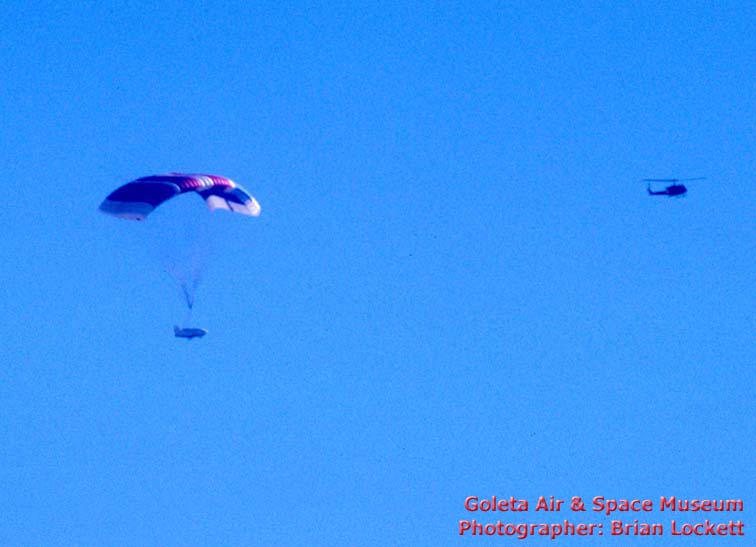 A Bell UH-1
Huey helicopter flew near the X-38 to transmit live television of
the test. The parafoil turned slowly in a half circle as it
descended to the lakebed.
A Bell UH-1
Huey helicopter flew near the X-38 to transmit live television of
the test. The parafoil turned slowly in a half circle as it
descended to the lakebed.
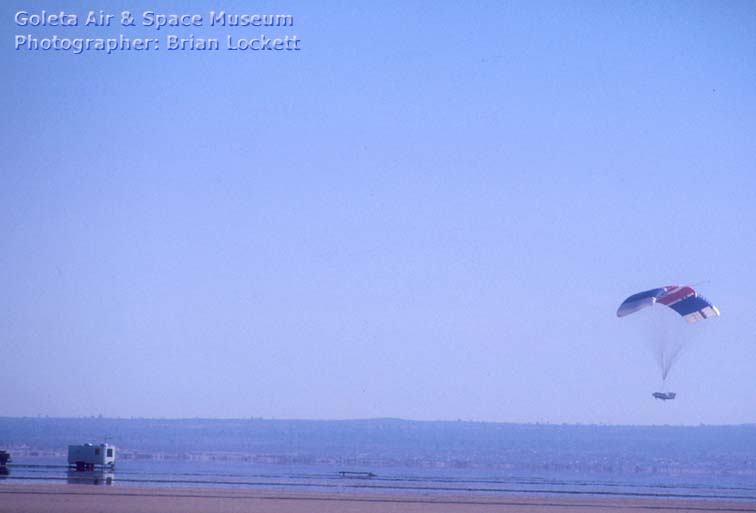 The trailing
edge of the parachute curled downward to flare the chute for
landing.
The trailing
edge of the parachute curled downward to flare the chute for
landing.
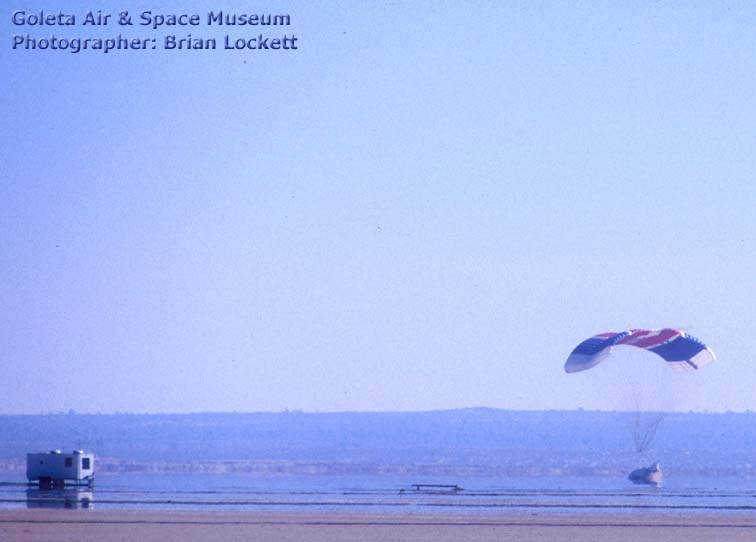 The skids of
the X-38 hit the lakebed and kicked up a cloud of brown dust as
the lifting body pitched forward for a moment.
The skids of
the X-38 hit the lakebed and kicked up a cloud of brown dust as
the lifting body pitched forward for a moment.
 The parafoil
settled to the ground alongside the X-38, reflected in the
lakebed mirage.
The parafoil
settled to the ground alongside the X-38, reflected in the
lakebed mirage.
Link to the NASA Dryden press release about the X-38 parachute test.
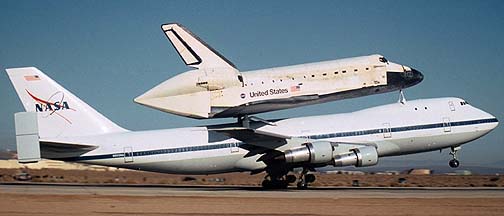 More pictures from Space Shuttle events.
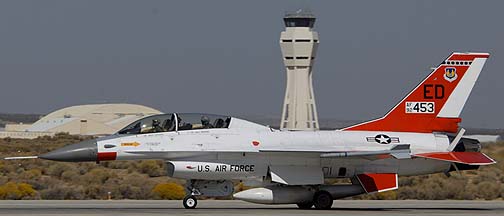 Edwards AFB displays.
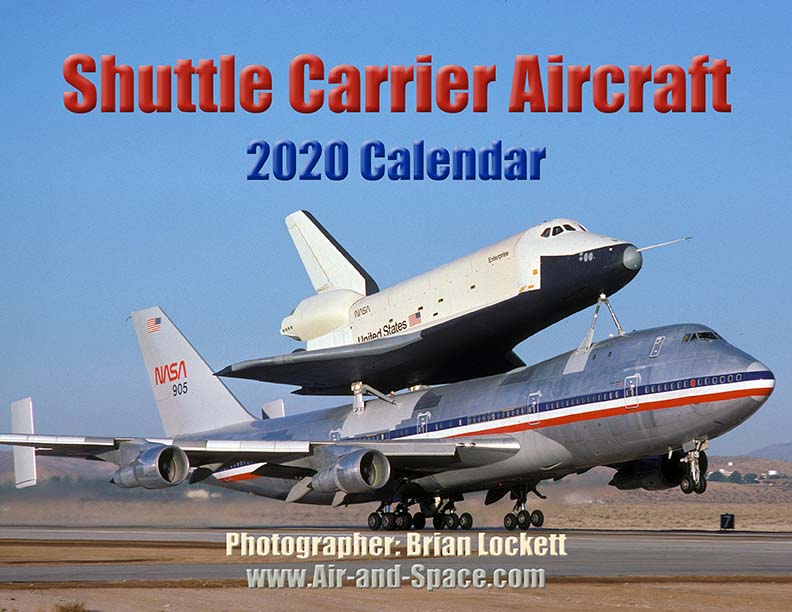
You can buy a 2020 calendar featuring my photographs of Space Shuttle Carrier Aircraft.
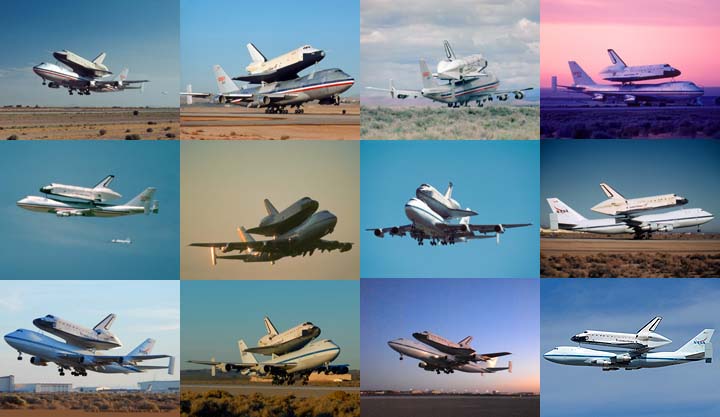
A dozen photos of 747 Shuttle Carrier Aircraft. Events depicted include:
747-SCA N905NA/Enterprise Approach and Landing Test 1 take-off on August 12, 1977.
747-SCA N905NA/Enterprise Approach and Landing Test 4 take-off on October 12, 1977.
747-SCA N905NA/Columbia delivery take-off on March 20, 1979.
747-SCA N905NA/Challenger static and departure take-off on July 4, 1982.
747-SCA N911NA/Endeavor delivery take-off from Palmdale on May 2, 1991.
747-SCA N905NA/Columbia landing at Palmdale on September 25, 1999.
747-SCA N905NA/Discovery take-off on November 2, 2000.
747-SCA N905NA/Atlantis take-off on July 1, 2007.
747-SCA N911NA/Endeavor take-off on December 10, 2008.
747-SCA N911NA/Discovery take-off on September 20, 2009.
747-SCA N905NA/Endeavor flyover at LAX, September 21, 2012.
 Put a copy of the Shuttle Carrier Aircraft 2020 calendar in your Lulu.com shopping cart for $14.95.
You can buy a 2020 calendar featuring my photographs of Space Shuttle Endeavour at Edwards Air Force Base.
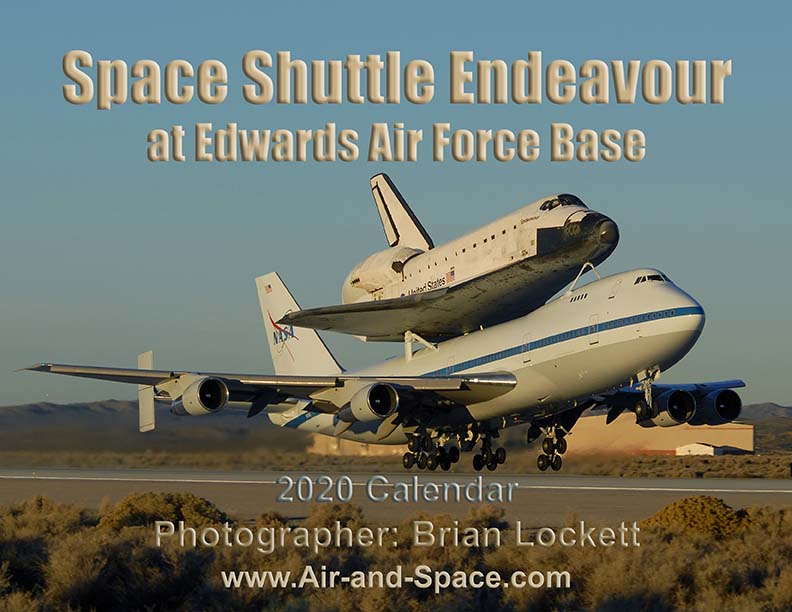
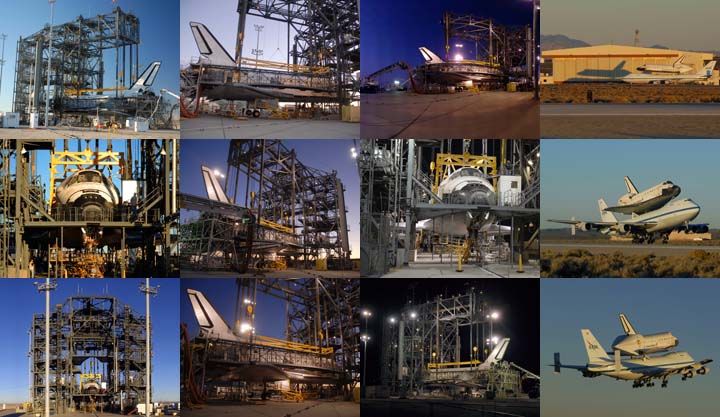
Bad weather caused the Space shuttle Endeavour to divert to Edwards Air Force Base at the conclusion of STS-126 on November 30, 2007. Following servicing in the Mate/Demate Device, it departed from Edwards on the back of 747 Carrier Aircraft N911NA on December 10.
Put a copy of the Space Shuttle Endeavour at Edwards Air Force Base: 2020 calendar in your Lulu.com shopping cart for $14.95.
You can buy a 2020 calendar featuring my photographs of Space Shuttle Discovery at Edwards Air Force Base.
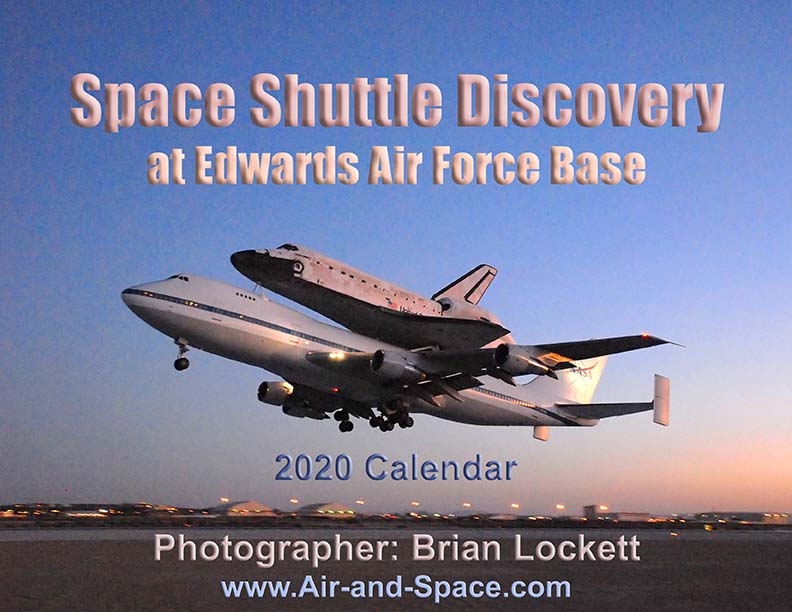
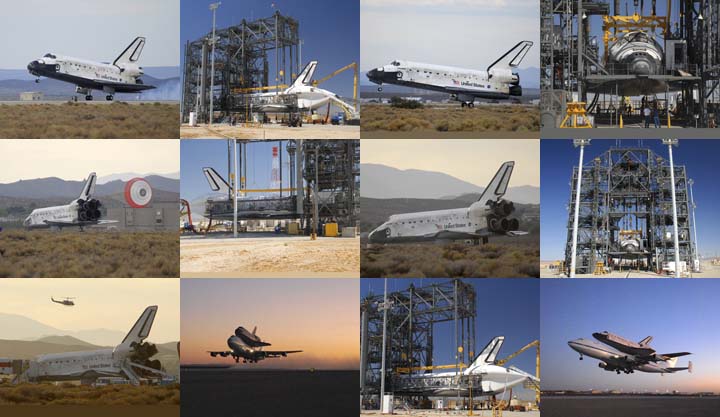
A dozen photographs of the Space Shuttle Discovery at Edwards Air Force Base. Bad weather at the Kennedy Space Center caused the Space shuttle Discovery to divert to Edwards Air Force Base at the conclusion of mission STS-128 on September 11, 2009. Following servicing in the Mate/Demate Device, it departed from Edwards on the back of 747 Carrier Aircraft N911NA on September 20.
Put a copy of the Space Shuttle Discovery at Edwards Air Force Base: 2020 calendar in your Lulu.com shopping cart for $14.95.
You can buy a 2020 calendar featuring my photographs of Space Shuttle Endeavour's Final Flights.
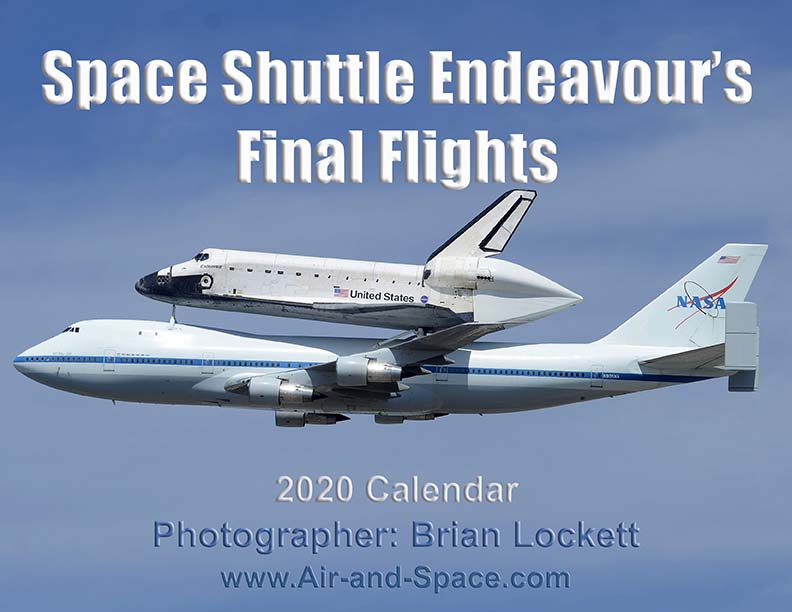
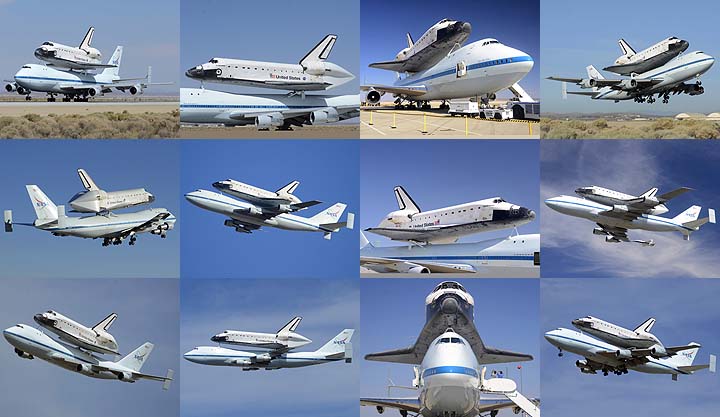
A dozen photos of Space Shuttle Endeavour's Final Flights. Boeing 747-Shuttle Carrier Aircraft N905NA and Space Shuttle Endeavour arrived at Edwards Air Force Base from Biggs Army Airfield on September 20, 2012. The pair were placed on static display at the NASA Dryden Flight Research Center that afternoon. The 747/Shuttle stack departed from Edwards Air Force Base on the morning of September 21. It toured California and several landmarks in the LA Basin. It made two low passes over Los Angeles International Airport before making its final landing. The 747-SCA was flown to Edwards Air Force Base on September 24 where it was retired. The Endeavour ison display at the California Science Center.
Put a copy of the Space Shuttle Endeavour's Final Flights 2020 calendar in your Lulu.com shopping cart for $14.95.
Books and Videos about the Space Shuttle from Amazon.com |
||||||
Books |
||||||
DVDs |
||||||
Visit the Lockett Books Amazon Webstore for a selection of aviation and space related books and DVDs. |
||||||
More pictures from Space Shuttle events.
Go to the home page of the Goleta Air and Space Museum.
Send a message to Brian.