(Download a higher resolution picture by clicking on any
picture below. The photographs on the right side of the page were
taken by the photographers of the NASA
Dryden Flight Research Center.)
The Hyper-X flight was conducted out of the NASA Dryden Flight
Research Center at Edwards Air Force Base in California's Mojave Desert.
The weather at Edwards Air Force Base could not have been more perfect for the second flight of the X-43A Hyper-X. There was almost no wind and the air temperature was in the seventies.
A pair of NASA's Boeing-McDonnell-Douglas F/A-18B Hornet chase planes took off before the NB-52B. They were piloted by Frank Batteas and James Smolka.
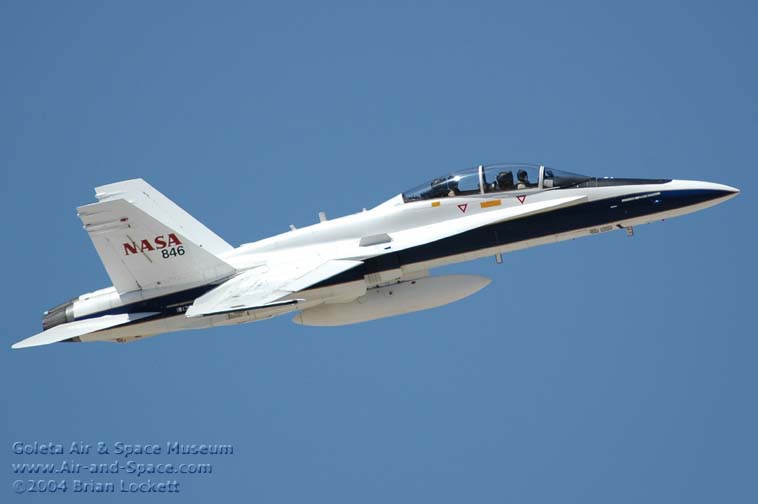 NASA 846, Boeing-McDonnell-Douglas F/A-18B Hornet chase plane.
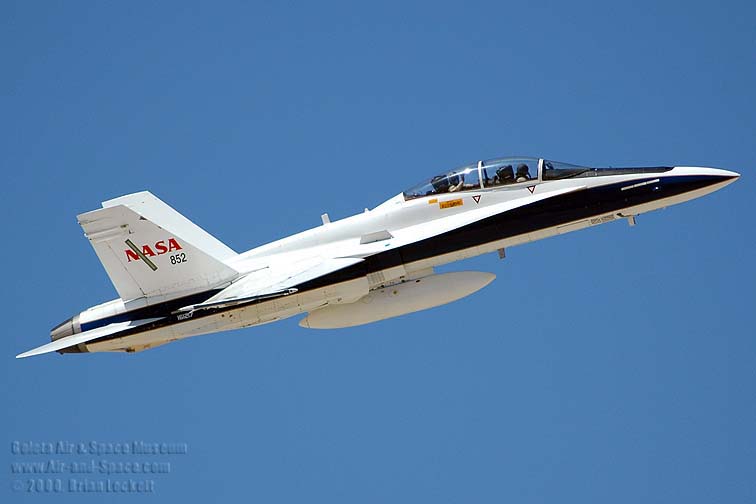 NASA photographer Jim Ross rode in the back set of
NASA 852, a Boeing-McDonnell-Douglas F/A-18B Hornet, to shoot still photographs.
NASA photographer Jim Ross rode in the back set of
NASA 852, a Boeing-McDonnell-Douglas F/A-18B Hornet, to shoot still photographs.
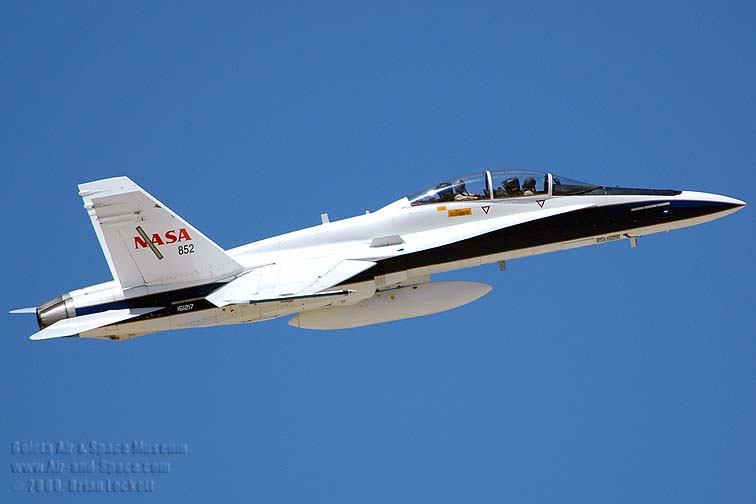 NASA 852.
The Hornets circled and lined up behind the NB-52B to join up with
it as it took off.
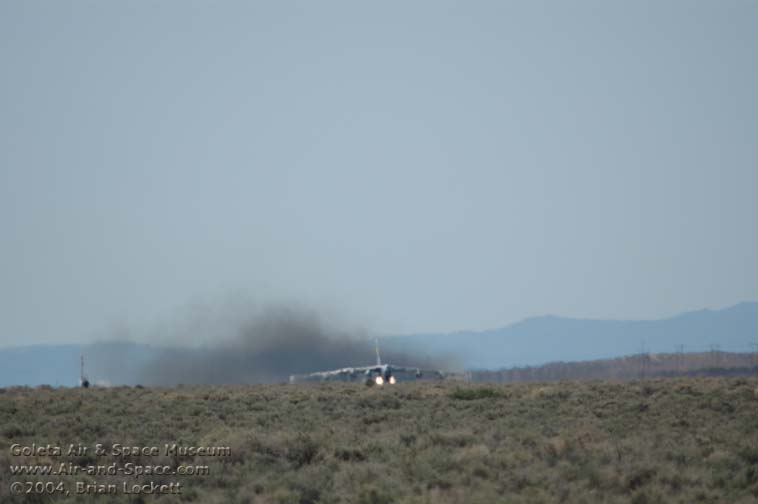 Two
miles away, NASA 008, Boeing NB-52B Stratofortress, 52-0008 emits
clouds of smoke as the water injection is applied.
Two
miles away, NASA 008, Boeing NB-52B Stratofortress, 52-0008 emits
clouds of smoke as the water injection is applied.
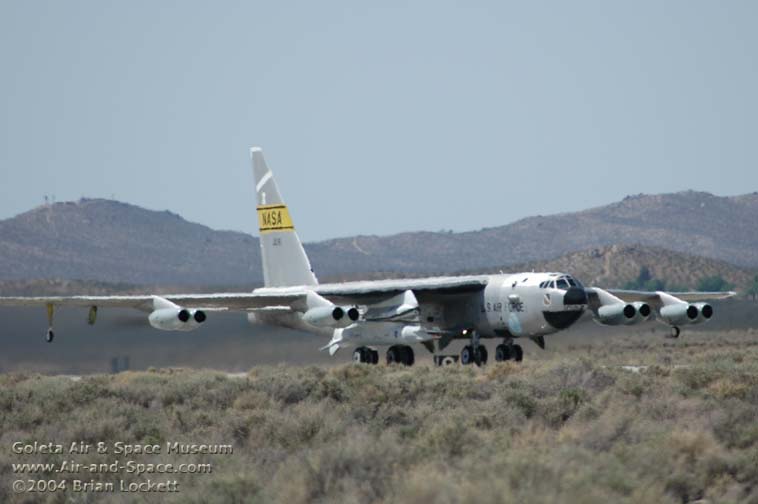 NASA 008, Boeing NB-52B Stratofortress, 52-0008 rolling on Runway
04.
NASA 008, Boeing NB-52B Stratofortress, 52-0008 rolling on Runway
04.
The NB-52B was piloted by Dana Purifoy. Former Space Shuttle pilot Gordon Fullerton was in the co-pilot's seat.
 NASA 008, Boeing NB-52B Stratofortress, 52-0008 starts to rotate at a
much higher airspeed than a standard B-52 because it cannot use its
flaps. They were permanently disabled when it was modified to
launch the X-15 in 1959.
NASA 008, Boeing NB-52B Stratofortress, 52-0008 starts to rotate at a
much higher airspeed than a standard B-52 because it cannot use its
flaps. They were permanently disabled when it was modified to
launch the X-15 in 1959.
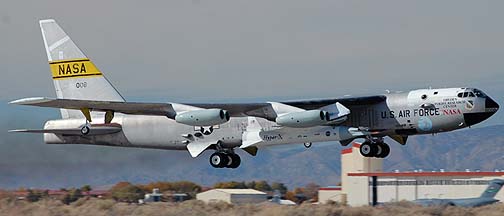
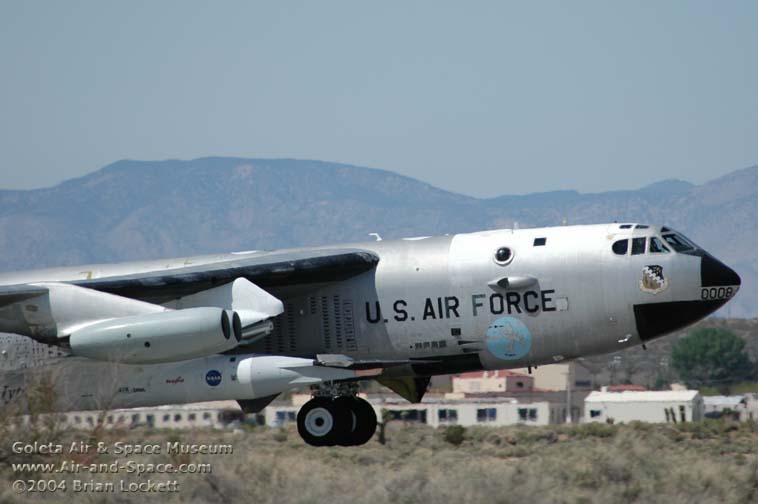 NASA 008, Boeing NB-52B Stratofortress, 52-0008 lifts off
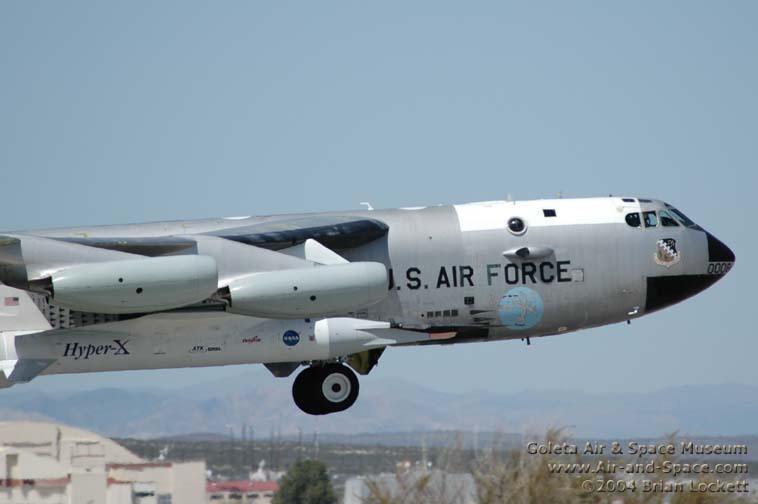 NASA
008, Boeing NB-52B Stratofortress, 52-0008 lifts off. The Pegasus
booster has been modified by the removal of 3,300 pounds of excess
propellant. The propellant was machined out, removing the star
shaped fins commonly found in solid fuel rockets. In order to
compensate for weight and center of gravity changes, its rocket engine
bell was built of steel instead of aluminum to increase its weight.
NASA
008, Boeing NB-52B Stratofortress, 52-0008 lifts off. The Pegasus
booster has been modified by the removal of 3,300 pounds of excess
propellant. The propellant was machined out, removing the star
shaped fins commonly found in solid fuel rockets. In order to
compensate for weight and center of gravity changes, its rocket engine
bell was built of steel instead of aluminum to increase its weight.
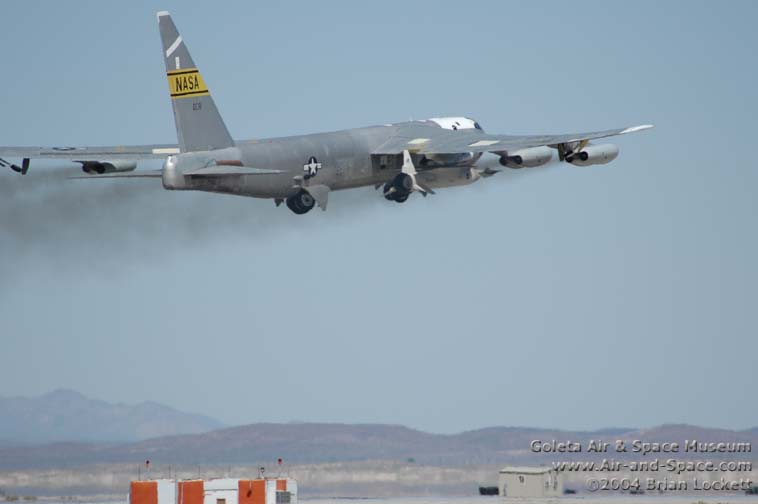 NASA
008, Boeing NB-52B Stratofortress, 52-0008 retracts its landing gear.
NASA
008, Boeing NB-52B Stratofortress, 52-0008 retracts its landing gear.
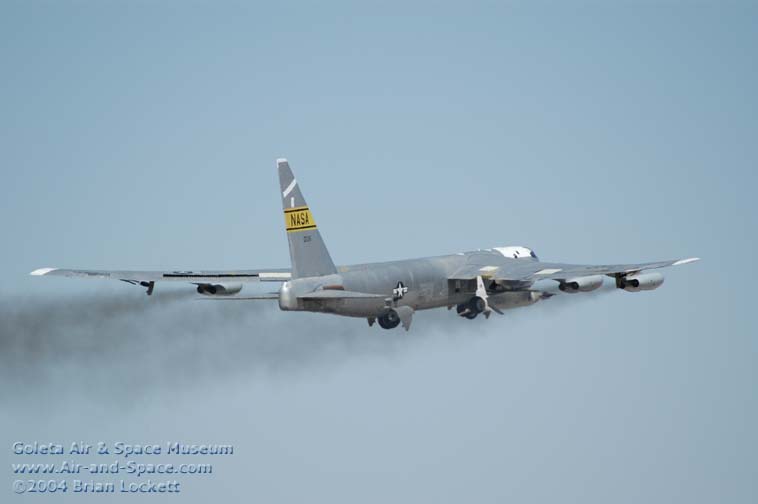 NASA
008, Boeing NB-52B Stratofortress, 52-0008.
NASA
008, Boeing NB-52B Stratofortress, 52-0008.
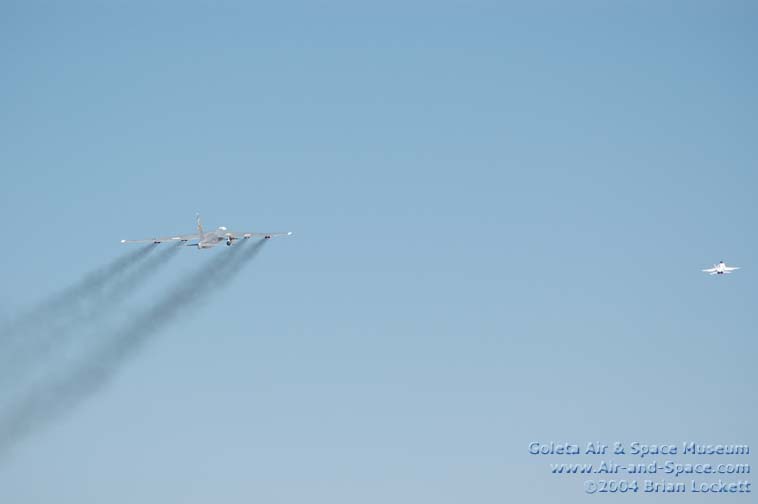 NASA
008, Boeing NB-52B Stratofortress, 52-0008 climbs out on the power of
eight J57-P43-WB turbojets.
NASA
008, Boeing NB-52B Stratofortress, 52-0008 climbs out on the power of
eight J57-P43-WB turbojets.
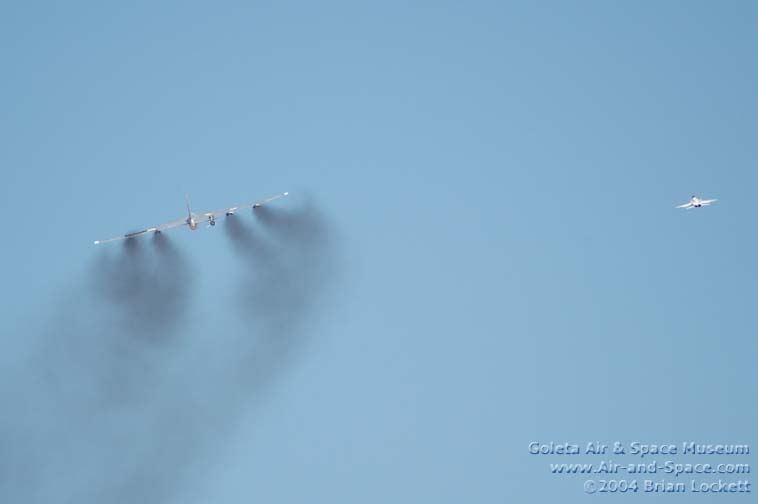 NASA
008, Boeing NB-52B Stratofortress, 52-0008.
NASA
008, Boeing NB-52B Stratofortress, 52-0008.
The NB-52B and its two chase planes flew to a position 50 miles off the California coast.
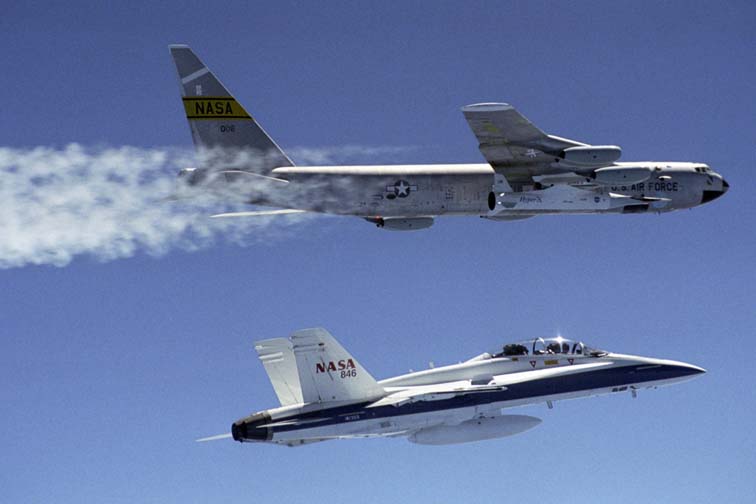
F/A-18B Hornet, NASA 846 flies chase off the wing tip of NB-52B, NASA
008 with the Hyper-X stack on the way to the launch site (NASA Photo
EC04-0092-18).
The formation adopted a heading of 270 degrees, due
west at an altitude of 40,000 feet. Shortly before launch the
NB-52B entered a shallow dive. At five seconds before 2:00 P.M.,
as the NB-52B descended through
38,900 feet, the launch panel operator in the NB-52B triggered the
launch of the X-43A. According to the control room staff, all
launch parameters were "within one sigma" of the desired values.
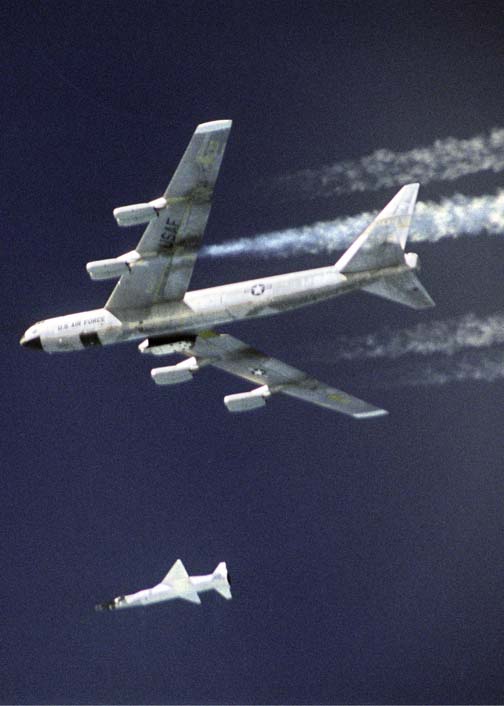
The Hyper-X stack falls away from the NB-52B (NASA photo EC04-0092-28).

Link to the NASA Dryden X-43A Hyper-X Photo Gallery.
The booster rapidly accelerated through the
transonic range and pulled up into a climb. It pitched downward
to level flight at 100,000 feet.
This was the first time that a Pegasus had flown at "negative alpha",
pitching the nose down to make the wing generate downward lift.
The Pegasus booster burned out going seven times the speed of sound about ninety seconds after launch. The separation of the X-43A vehicle was triggered a few seconds later. Four explosive bolts detonated and a pair of pushrods shoved the vehicle forward at ten feet per second. The fins of the Pegasus booster were moved to pitch the nose of the booster down to rapidly move it away from the X-43A. The X-43A was trimmed for slightly positive lift to move it upward and away from the tumbling booster.
When it was established that the research vehicle was in stable
flight, the cowl door that protected the inlet to the combustion
chamber opened and a hypergolic hydrogen/Silane mixture was injected to
initiate combustion. Then the fuel mixture was switched to pure
hydrogen.
Supersonic combustion was sustained, first at a lean fuel/air
ratio. The fuel/air ratio was adjusted to rich and back to lean
during the ten seconds of propulsion data collection. The vehicle
accelerated in a climb as it propelled itself for fifteen miles.
The X-43A continued to transmit telemetry as it glided to the
surface of the Pacific Ocean, about 400 miles from the coast. It
impacted and sank in deep water. Perhaps someday a deep sea
submersible will recover it as a historic relic.
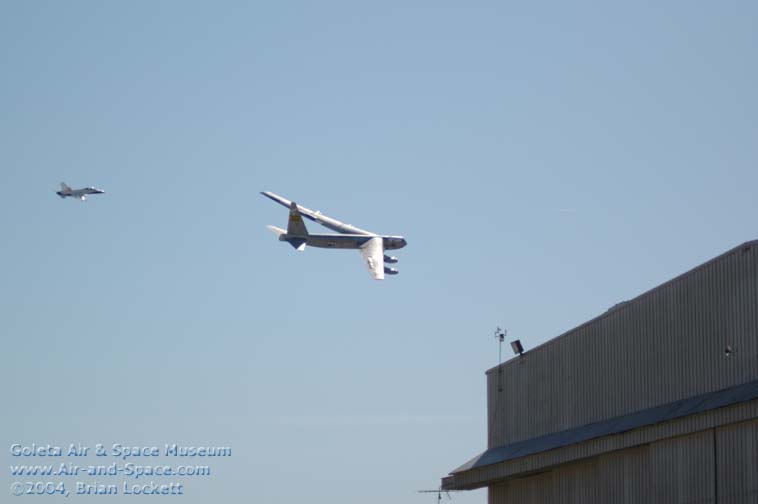 NASA
008, Boeing NB-52B Stratofortress, 52-0008 flies past the NASA Dryden
Flight Research Center at the conclusion of a successful mission.
There is only one more mission planned for the NB-52B mothership, the
third flight of the X-43A Hyper-X, which is scheduled for this coming
fall.
NASA
008, Boeing NB-52B Stratofortress, 52-0008 flies past the NASA Dryden
Flight Research Center at the conclusion of a successful mission.
There is only one more mission planned for the NB-52B mothership, the
third flight of the X-43A Hyper-X, which is scheduled for this coming
fall.
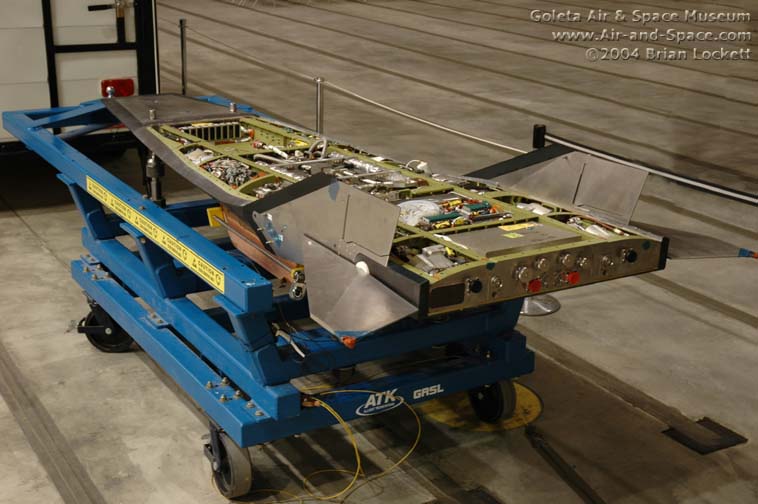 X-43A Hyper-X vehicle 3 is expected to fly at mach-10. It will
get twice as hot as vehicle 2 did while flying at mach-7. The copper
combustion chamber can be seen below and forward of the vertical
stabilizer.
X-43A Hyper-X vehicle 3 is expected to fly at mach-10. It will
get twice as hot as vehicle 2 did while flying at mach-7. The copper
combustion chamber can be seen below and forward of the vertical
stabilizer.
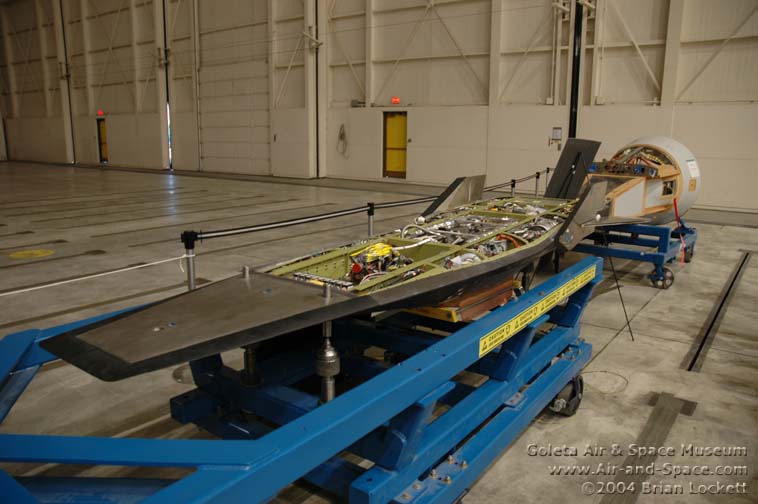 The Pegasus booster of the third X-43A Hyper-X vehicle will contain the
full propellant load of the standard model in order to reach
mach-10.
The booster adapter in the background has been manufactured from
aluminum instead of
steel to reduce the weight of the stack.
The Pegasus booster of the third X-43A Hyper-X vehicle will contain the
full propellant load of the standard model in order to reach
mach-10.
The booster adapter in the background has been manufactured from
aluminum instead of
steel to reduce the weight of the stack.
The X-43A Hyper-X Supersonic Combustion Ramjet testbed is designed to demonstrate a new air-breathing engine technology that will allow flight in the atmosphere at speeds several times faster than the Lockheed SR-71A Blackbird. All current jet engines slow the air moving through the combustion chamber to subsonic velocity by compressing it into a much smaller volume. As the air is compressed, it gets hotter.
As airspeed increases to 3,000 miles per hour and above, the air entering the inlet has to be compressed so much that it is heated to temperatures that will melt the engine. The solution is to allow the air to go through the combustion chamber at supersonic velocity. That way, it does not need to be compressed as much and its temperature isn't as high.
The Supersonic Combustion Ramjet gets its oxygen from the
atmosphere, allowing great savings in propellant weight compared to
rocket engines. SCRamjet propelled vehicles could serve as the first
stage of satellite launching boosters. They could transport passengers,
packages, or other payloads halfway around Earth in just a few hours.
 Boeing NB-52B
Stratofortress Mothership.
Boeing NB-52B
Stratofortress Mothership.
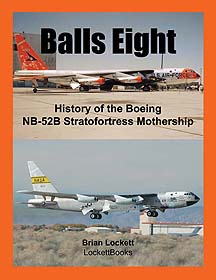
eBook edition of Balls Eight: History of the Boeing NB-52B Stratofortress Mothership |
||
|
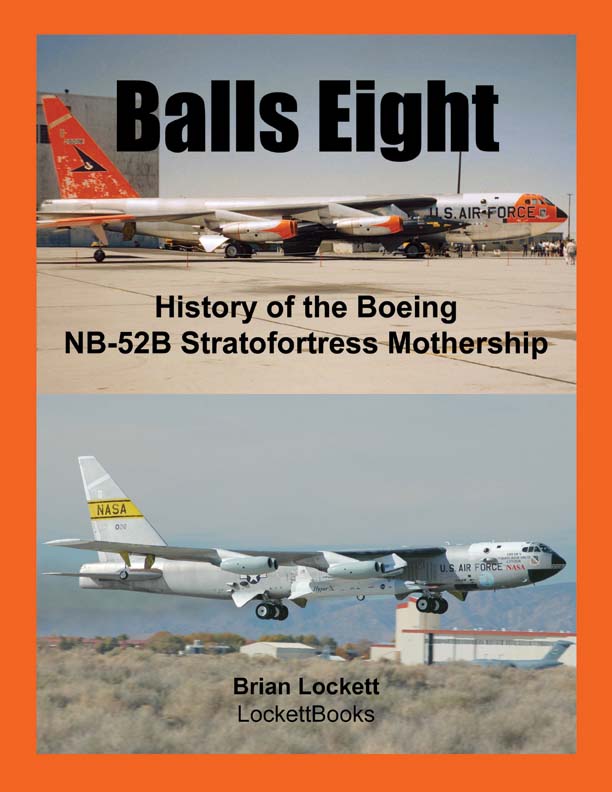
My book Balls Eight: History of the Boeing NB-52B Stratofortress Mothership is now available as an eBook for just $10.99, a considerably reduced price compared to the print edition. It has been asserted that the Boeing NB-52B Stratofortress, carrying Air Force serial 52-0008, can lay claim to being the airplane that has seen and participated in more history than any other single airplane. For forty-five years, the NB-52B was a fixture at Edwards Air Force Base. While the NB-52B is most famous for launching the three North American X-15 rocket planes, it continued to serve in the role of launch platform for a multitude of programs until its final mission, launching the Mach-10 X-43A Hyper-X, on November 16, 2004. It was the oldest flying B-52 by nearly ten years. The eBook edition is profusely illustrated with vintage photographs and diagrams and has more pictures than the print edition. It can be dowloaded directly from Lulu.com. It will soon be available from Apple iBookstore, Amazon, Barnes & Noble, and Kobo. | ||
|
|
||
|
Balls Eight: History of the Boeing NB-52B Stratofortress Mothership |
||
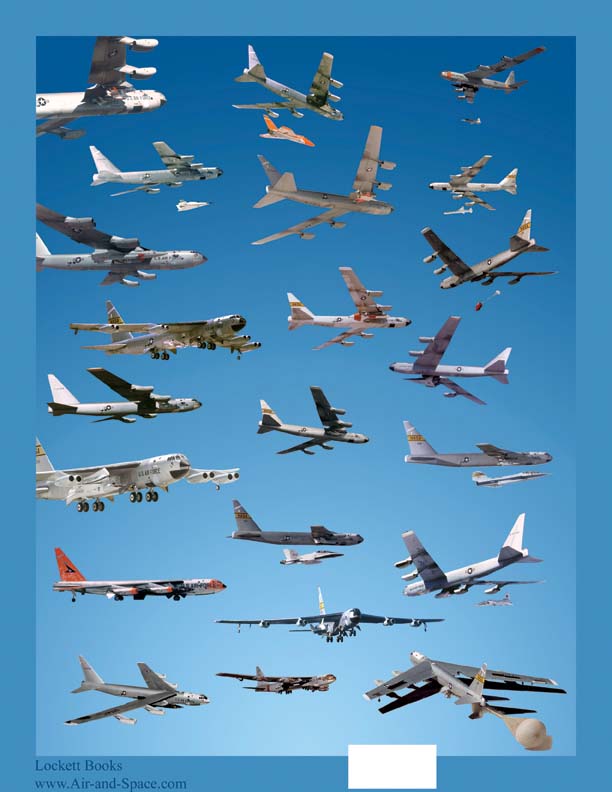
It has been asserted that the Boeing NB-52B Stratofortress, carrying Air Force serial 52-0008, can lay claim to being the airplane that has seen and participated in more history than any other single airplane. For forty-five years, the NB-52B was a fixture at Edwards Air Force Base. While the NB-52B is most famous for launching the three North American X-15 rocket planes, it continued to serve in the role of launch platform for a multitude of programs until its final mission on November 16, 2004. It was the oldest flying B-52 by nearly ten years.The NB-52B launched the three X-15 hypersonic rocket planes.
It launched the Northrop HL-10, Northrop M2-F2/F3, Martin Marietta X-24A and Martin Marietta X-24B lifting bodies.
It simulated the steep, power off approach to landing used by the Space Shuttles.
It assisted in the collection of data about wake turbulence from large aircraft.
It served as an air-to-air gunnery target.
It launched 3/8-scale F-15 Remotely Piloted Research Vehicles (RPRV) and Spin Research Vehicles (SRV).
It launched a Ryan Firebee II drone and the Ryan Firebee based Drones for Aeroelastic Structures Testing (DAST).
It launched the Highly Maneuverable Aircraft Technology (HiMAT) RPRVs.
It dropped the 48,000-pound Space Shuttle Reusable Booster Drop Test Vehicle (SRB/DTV).
It released a simulated F-111 crew module from its bomb bay to evaluate new parachute recovery systems.
It was the first airplane to launch a satellite into orbit on the Orbital Sciences Pegasus booster.
It tested the drag chute used to decelerate space shuttle orbiters.
It tested pollution reducing fuel additives with a pair of jet engines mounted under its bomb bay.
It launched the X-38 Space Station Crew Return Vehicles.
It launched the X-43A Hyper-X Supersonic Combustion Ramjets.
The book is 200 pages long. It contains 246 color photographs, 89 black and white photographs, and 2 other illustrations.
You can preview the first several pages of the book.
Books are printed on demand by Lulu.com. When you order one, it is placed in your Lulu.com shopping cart. Lulu.com prints, packages, and ships the book direct to you.

Put a copy of the softcover edition of Balls Eight: History of the Boeing NB-52B Stratofortress Mothership in your Lulu.com shopping cart for $74.95.
Put a copy of the hardcover edition of Balls Eight: History of the Boeing NB-52B Stratofortress Mothership in your Lulu.com shopping cart for $79.95.
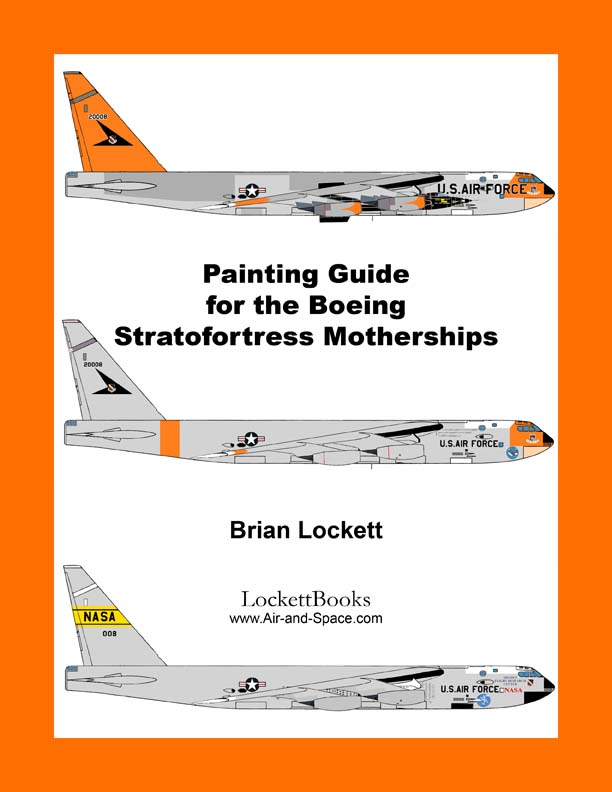
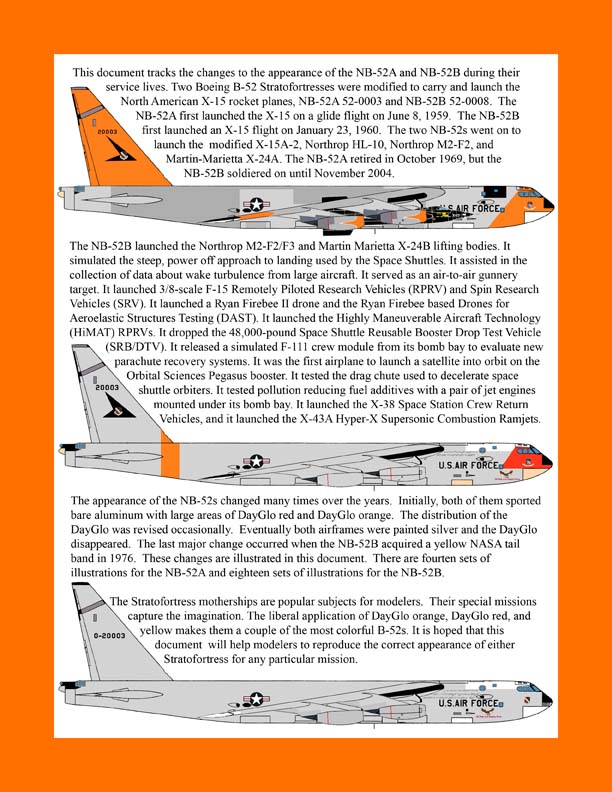
Revell has re-released Monogram's 1/72-scale Boeing NB-52B Stratofortress with X-15A-2 kit. You need this book to help you establish the appropriate paint scheme for any particular NB-52B mission that you want to model.
The book is 96 pages long.
You can preview the first several pages of the book.
Books are printed on demand by Lulu.com. When you order one, it is placed in your Lulu.com shopping cart. Lulu.com prints, packages, and ships the book direct to you.
Put a copy of the softcover edition of Painting Guide for the Boeing Stratofortress Motherships in your Lulu.com shopping cart for $44.95.
You can buy a 2020 calendar featuring photographs of the Boeing NB-52B Stratofortress Mothership that launched the X-15s in the 1960s and continued launching research vehicles until 2004.
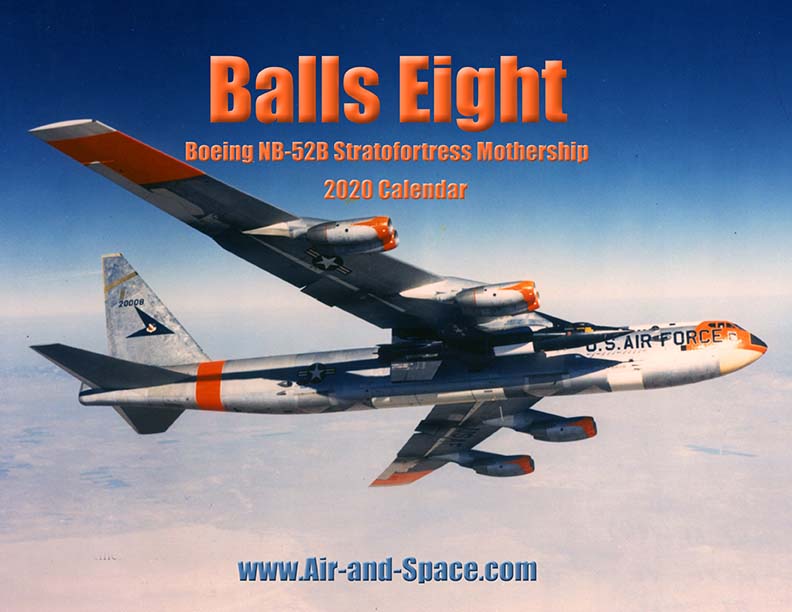
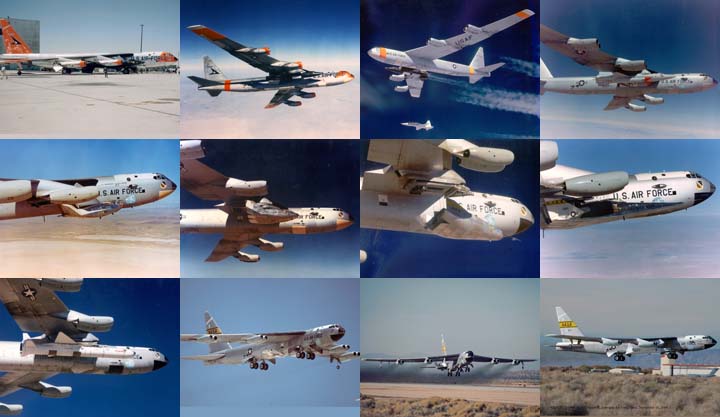
It has been asserted that the Boeing NB-52B Stratofortress, carrying Air Force serial 52-0008, can lay claim to being the airplane that has seen and participated in more history than any other single airplane. This calendar features a dozen pictures of the NB-52B carrying some of the research vehicles that it launched over the years. Photo sources: Air Force, NASA, Richard Lockett, Brian Lockett:
North American X-15-1, 1960
North American X-15-3, 1963
North American X-15A-2, 1967
Northrop HL-10, 1969
Martin-Mariettta X-24A, 1970
Northrop M2-F3, 1972
Martin-Mariettta X-24B, 1973
Orbital Sciences Pegasus, 1989
Supersonic Supercruise, 1995
X-38 V-131R, 2000
X-43A Hyper-X, 2004
 Put a copy of the Balls Eight: Boeing NB-52B Stratofortress Mothership: 2020 calendar in your Lulu.com shopping cart for $14.95.
 Books about
Lifting Bodies, Edwards Air Force Base, and the X-43 available
from
Books about
Lifting Bodies, Edwards Air Force Base, and the X-43 available
from 
 The X-Planes: X-1 to X-45: 3rd Edition
by Jay Miller
The X-Planes: X-1 to X-45: 3rd Edition
by Jay Miller
 Flying Without Wings : Nasa Lifting
Bodies and the Birth of the Space Shuttle by Milton O. Thompson
Flying Without Wings : Nasa Lifting
Bodies and the Birth of the Space Shuttle by Milton O. Thompson
 Test Colors: The Aircraft of Muroc Army Airfield
and Edwards Air Force Base by Rene Francillon
Test Colors: The Aircraft of Muroc Army Airfield
and Edwards Air Force Base by Rene Francillon
 X-Planes at Edwards (Enthusiast Color
Series) by
Steve Pace
X-Planes at Edwards (Enthusiast Color
Series) by
Steve Pace
 Edwards Air Force Base : Open House at the USAF
Flight Test Center 1957-1966 : A Photo Chronicle of
Aircraft Displayed (Schiffer Military History) by Robert D. Archer
Edwards Air Force Base : Open House at the USAF
Flight Test Center 1957-1966 : A Photo Chronicle of
Aircraft Displayed (Schiffer Military History) by Robert D. Archer
 Angle of Attack : Harrison Storms and the Race to
the Moon by Mike Gray. The biography of Harrison Storms, who
was instrumental in the development and operation of the X-15.
Angle of Attack : Harrison Storms and the Race to
the Moon by Mike Gray. The biography of Harrison Storms, who
was instrumental in the development and operation of the X-15.
 At the Edge of Space : The X-15 Flight Program
by Milton O. Thompson. The story of test flying the X-15 from the
point of view of the pilot.
At the Edge of Space : The X-15 Flight Program
by Milton O. Thompson. The story of test flying the X-15 from the
point of view of the pilot.
Send a message to Brian.
Go to home page of the Goleta Air and Space Museum.