(Download a higher resolution picture by clicking on any
picture below. The photographs on the right side of the page were
taken by the photographers of the NASA Dryden Flight Research Center.)
I was at Edwards AFB on Saturday, June 2 to get pictures of the NB-52B taking off for the first launch of the X-43A Hyper-X supersonic combustion ramjet testbed.
The media entourage set up early and waited with our tripods set up in a row along a dirt road just to the north side of the main runway. Fortunately, I don't think it was over 90 degrees out. There was a refreshing wind blowing, too.
After a while we could see the tail and the top of the fuselage of the NB-52B moving past the control tower in the distance. The hot, June air made the image of the tall, silver tail with its yellow stripe shimmer as if it were reflected off the ripples of a pond.
 Blue and white NASA F/A-18B Hornet chase planes
take-off as the NB-52B holds short of Runway 22.
Blue and white NASA F/A-18B Hornet chase planes
take-off as the NB-52B holds short of Runway 22.
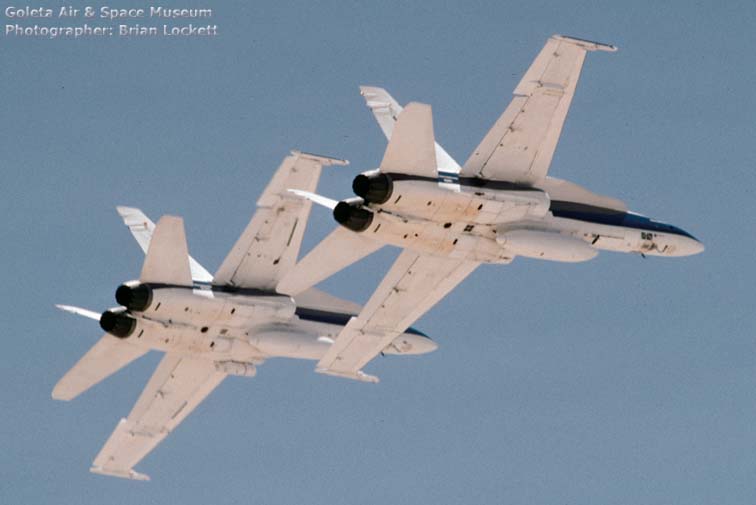 The Hornets circled the field and lined up with
the runway again to catch the NB-52B as it took off.
The Hornets circled the field and lined up with
the runway again to catch the NB-52B as it took off.
A black cloud billowed from the eight J57 turbojets of the NB-52B as it started rolling toward us.
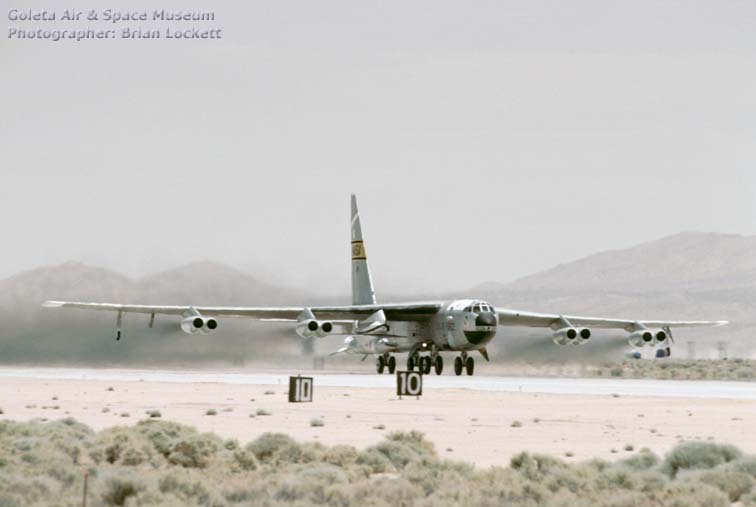 We were near the 11,000 foot marker of the
runway.
We were near the 11,000 foot marker of the
runway.
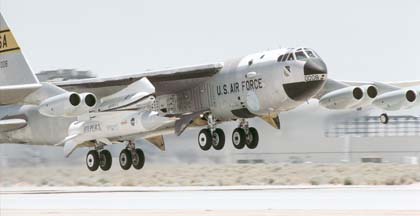 The NB-52B was just lifting off the ground as
it went past us.
The NB-52B was just lifting off the ground as
it went past us.
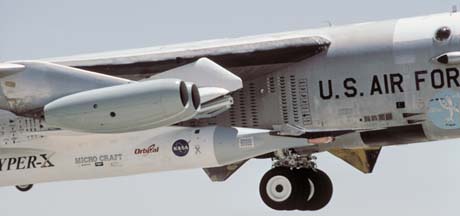 I have a vague recollection of looking directly
at the side of the X-43A close-up for a brief moment through my
viewfinder.
I have a vague recollection of looking directly
at the side of the X-43A close-up for a brief moment through my
viewfinder.
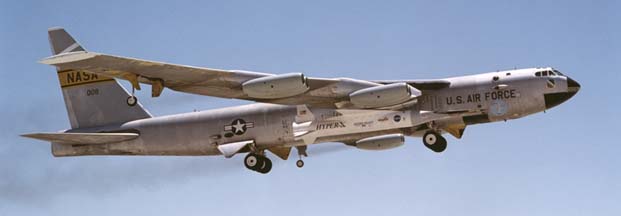
NASA photograph ec01-0182-01.
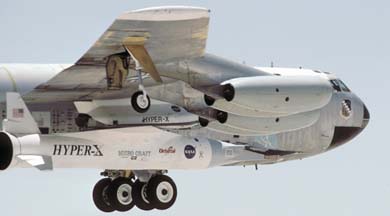 At the same instant, the Hornet on our side of
the runway passed directly overhead at very, very low altitude.
The shriek of its engines was even louder than the NB-52B taking
off in front of us. It would have been a fabulous picture if I
hadn't been otherwise occupied just at that moment.
At the same instant, the Hornet on our side of
the runway passed directly overhead at very, very low altitude.
The shriek of its engines was even louder than the NB-52B taking
off in front of us. It would have been a fabulous picture if I
hadn't been otherwise occupied just at that moment.
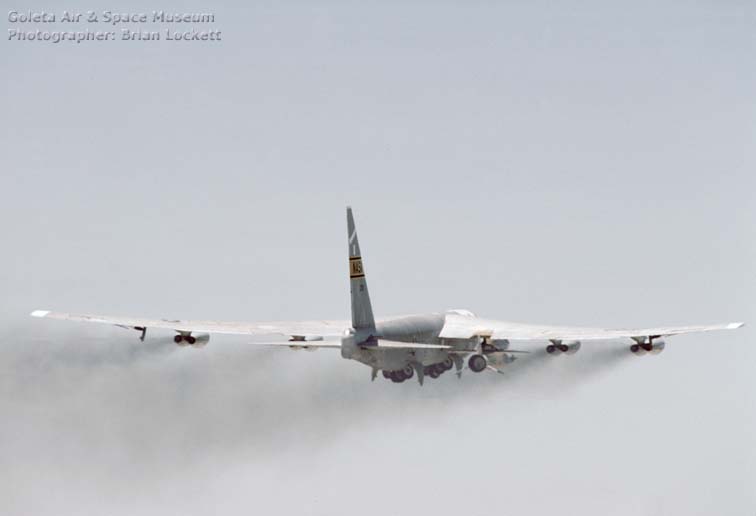 The gear of the NB-52B is retracting.
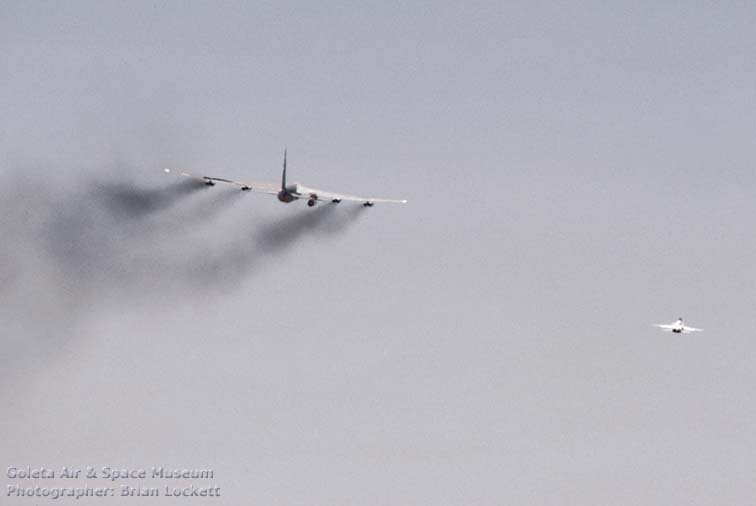 Although NB-52B and its chase planes were going
to head offshore just west of Goleta, they turned to the north
and back to the east to gain altitude in the relatively uncrowded
airspace over the Mojave desert.
Although NB-52B and its chase planes were going
to head offshore just west of Goleta, they turned to the north
and back to the east to gain altitude in the relatively uncrowded
airspace over the Mojave desert.
We piled back into the white NASA vans and were driven back to Dryden to watch the television transmission from the NB-52B. In the auditorium they were showing closed circuit TV from the chase plane and the NB-52B on several monitors around the room and on a big screen at the front of the room. The video signal from the Hornet chase plane was relayed through the NB-52B. I aimed my video camera at the big screen to make a rough record of the events.
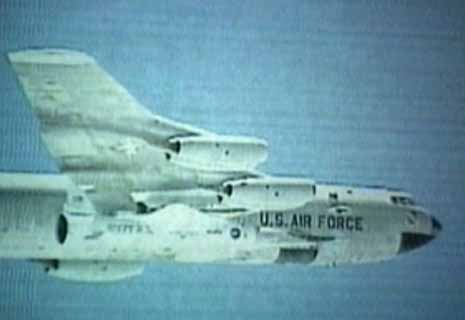
Sometimes they showed the view from the chase plane. The chase plane had the call sign NASA Two. The video camera operator in the back seat of the chase plane adjusted the zoom to show wide views of the NB-52B and close-ups of the X-43A.
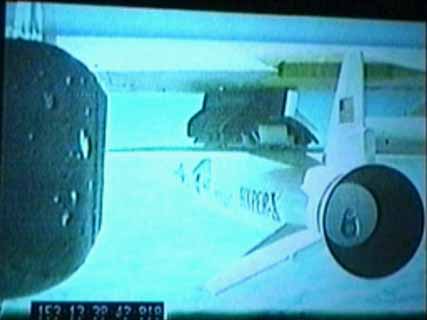
Sometimes the view switched to extreme close-up shots of the Hyper-X stack from the forward and aft video cameras on the side of the NB-52B.
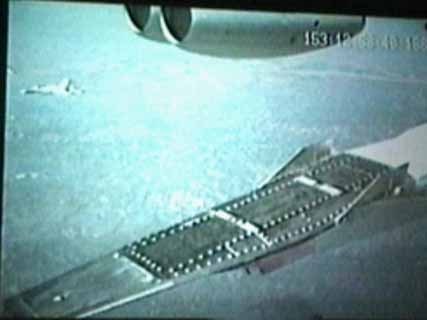
At first we could see the Santa Barbara County back country in the background. Later we saw Point Arguello and Point Conception pass under the wing. Then there was just unidentifiable cloudy ocean below.
We could hear the radio transmissions from the aircraft as they checked out and set up the systems for the launch.
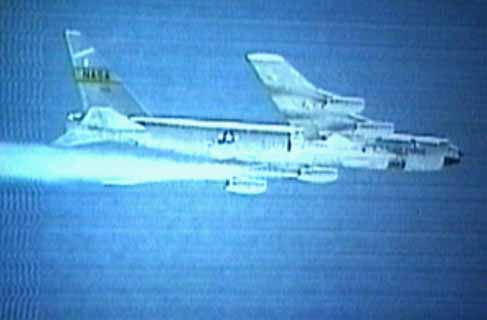
The launch panel operator turned on a smoke trail to aid the tracking of the NB-52B. Finally they counted down the seconds to launch. The X-43A on its Orbital Sciences Pegasus booster dropped from the NB-52B.
I transcribed the following audio transmissions from a videotape that I shot of the big screen during the launch (the numbers are a rough estimate of the seconds after launch):
00 Ground: Launch...launch...launch
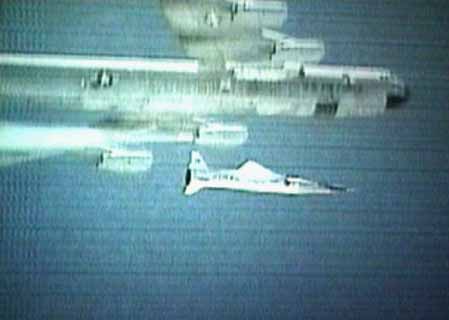
The Hyper-X stack fell for a few seconds.
X-43A drops from the NB-52B. NASA photograph
ec01-0182-20.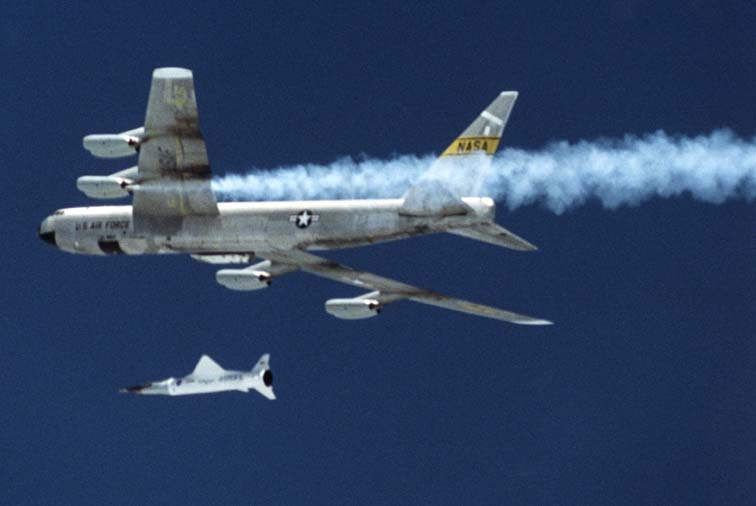
03 NASA2: stable
04 NASA2: ignition
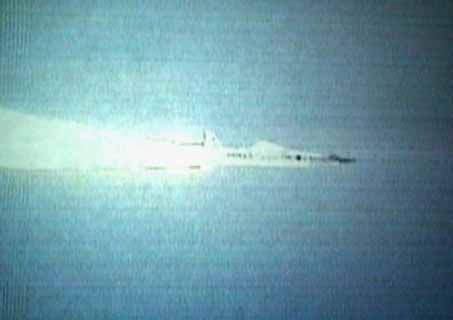
Orbital Sciences Pegasus booster ignites to propel the X-43A its first flight. NASA photograph ec01-0182-20.
The X-43A stack accelerated quickly away from the Hornet chase plane.
10 NASA2: OK. It's bottomed out. It's starting to climb. Looking good.
14 NASA2: Now it's...uh...yawing
We could see the Hyper-X stack turn sharply to the left, then the transmission of the image broke up for several seconds.
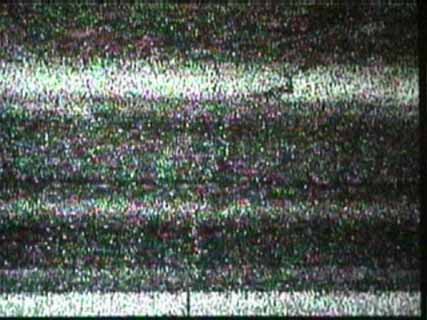
16 NASA2: It's out of control
20 NASA2: wild gyrations...uh..We'll try to stay with it here
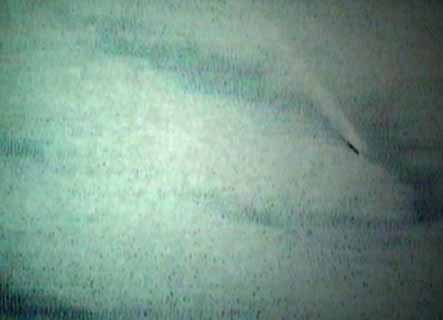
Every few seconds the image would clear up and we could see the booster spinning and spewing flame as it fell toward the Pacific.
25 NASA2: Uh...tumbling end over end...now uh...
30 NASA2: Now dropping. Still yawing left

X-43A stack spins to destruction over the Pacific Ocean. NASA photograph EC01-0182-11.
34 Ground: NASA Two, we're going to have to terminate
37 NASA2: NASA Two copies
38 Ground: The aircraft clear?
43 NASA2: All are clear
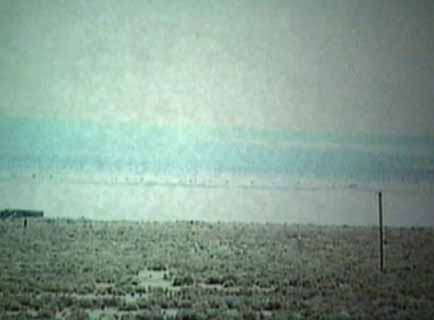
The picture on the screen changed to a telephoto view of the desert from a camera on base.
45 Ground: OK the aircraft are clear. We are going to arm...
48 Ground: and terminate.
The flight was terminated by explosive destruct charges fifty seconds after the launch.
(Note that the above transcript is not official and contains some inaccuracies. The sound quality was not the best, so I definitely don't have all the words exactly right.)
There was no chance to get any data from the first X-43A. No conclusions about supersonic combustion ramjet technology, either positive or negative, can be inferred from the failure of the mission. There are two more vehicles under construction. The next X-43A launch was nominally scheduled for six months from this attempt. That date will probably slip somewhat as the loss of this mission is investigated.
Link to NASA's June 2, 2001 press release about the first free flight launch.
Link to a NASA Langley paper model of the X-43A that you can print and assemble.
Link to the NASA Dryden X-43A Hyper-X Photo Gallery.
Link to NASA Dryden's X-43 Fact Sheet.
Link to NASA Dryden's X-43 Project Page.
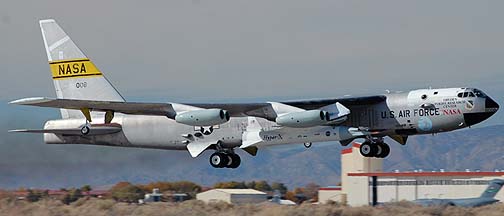 Boeing NB-52B
Stratofortress Mothership.
Boeing NB-52B
Stratofortress Mothership.
eBook edition of Balls Eight: History of the Boeing NB-52B Stratofortress Mothership |
||
|
My book Balls Eight: History of the Boeing NB-52B Stratofortress Mothership is now available as an eBook for just $10.99, a considerably reduced price compared to the print edition. It has been asserted that the Boeing NB-52B Stratofortress, carrying Air Force serial 52-0008, can lay claim to being the airplane that has seen and participated in more history than any other single airplane. For forty-five years, the NB-52B was a fixture at Edwards Air Force Base. While the NB-52B is most famous for launching the three North American X-15 rocket planes, it continued to serve in the role of launch platform for a multitude of programs until its final mission, launching the Mach-10 X-43A Hyper-X, on November 16, 2004. It was the oldest flying B-52 by nearly ten years. The eBook edition is profusely illustrated with vintage photographs and diagrams and has more pictures than the print edition. It can be dowloaded directly from Lulu.com. It will soon be available from Apple iBookstore, Amazon, Barnes & Noble, and Kobo. | ||
|
|
||
|
Balls Eight: History of the Boeing NB-52B Stratofortress Mothership |
||

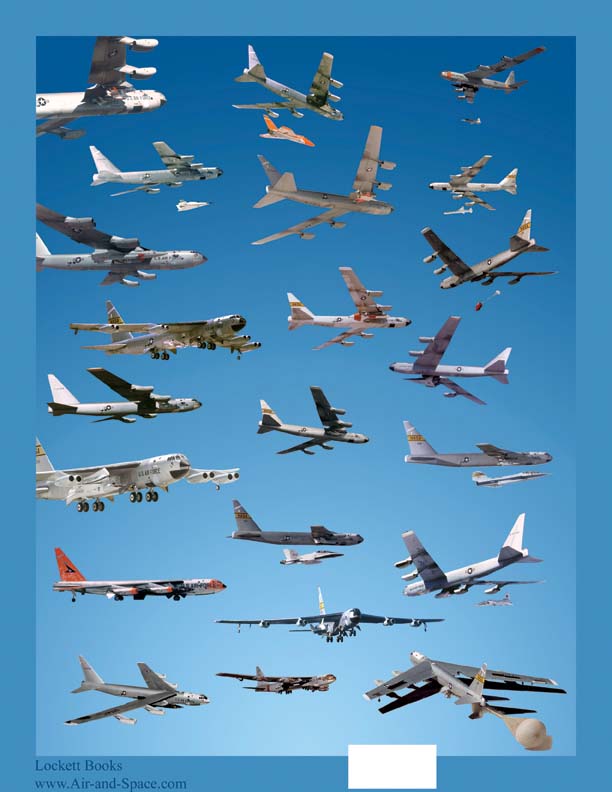
It has been asserted that the Boeing NB-52B Stratofortress, carrying Air Force serial 52-0008, can lay claim to being the airplane that has seen and participated in more history than any other single airplane. For forty-five years, the NB-52B was a fixture at Edwards Air Force Base. While the NB-52B is most famous for launching the three North American X-15 rocket planes, it continued to serve in the role of launch platform for a multitude of programs until its final mission on November 16, 2004. It was the oldest flying B-52 by nearly ten years.The NB-52B launched the three X-15 hypersonic rocket planes.
It launched the Northrop HL-10, Northrop M2-F2/F3, Martin Marietta X-24A and Martin Marietta X-24B lifting bodies.
It simulated the steep, power off approach to landing used by the Space Shuttles.
It assisted in the collection of data about wake turbulence from large aircraft.
It served as an air-to-air gunnery target.
It launched 3/8-scale F-15 Remotely Piloted Research Vehicles (RPRV) and Spin Research Vehicles (SRV).
It launched a Ryan Firebee II drone and the Ryan Firebee based Drones for Aeroelastic Structures Testing (DAST).
It launched the Highly Maneuverable Aircraft Technology (HiMAT) RPRVs.
It dropped the 48,000-pound Space Shuttle Reusable Booster Drop Test Vehicle (SRB/DTV).
It released a simulated F-111 crew module from its bomb bay to evaluate new parachute recovery systems.
It was the first airplane to launch a satellite into orbit on the Orbital Sciences Pegasus booster.
It tested the drag chute used to decelerate space shuttle orbiters.
It tested pollution reducing fuel additives with a pair of jet engines mounted under its bomb bay.
It launched the X-38 Space Station Crew Return Vehicles.
It launched the X-43A Hyper-X Supersonic Combustion Ramjets.
The book is 200 pages long. It contains 246 color photographs, 89 black and white photographs, and 2 other illustrations.
You can preview the first several pages of the book.
Books are printed on demand by Lulu.com. When you order one, it is placed in your Lulu.com shopping cart. Lulu.com prints, packages, and ships the book direct to you.

Put a copy of the softcover edition of Balls Eight: History of the Boeing NB-52B Stratofortress Mothership in your Lulu.com shopping cart for $74.95.
Put a copy of the hardcover edition of Balls Eight: History of the Boeing NB-52B Stratofortress Mothership in your Lulu.com shopping cart for $79.95.

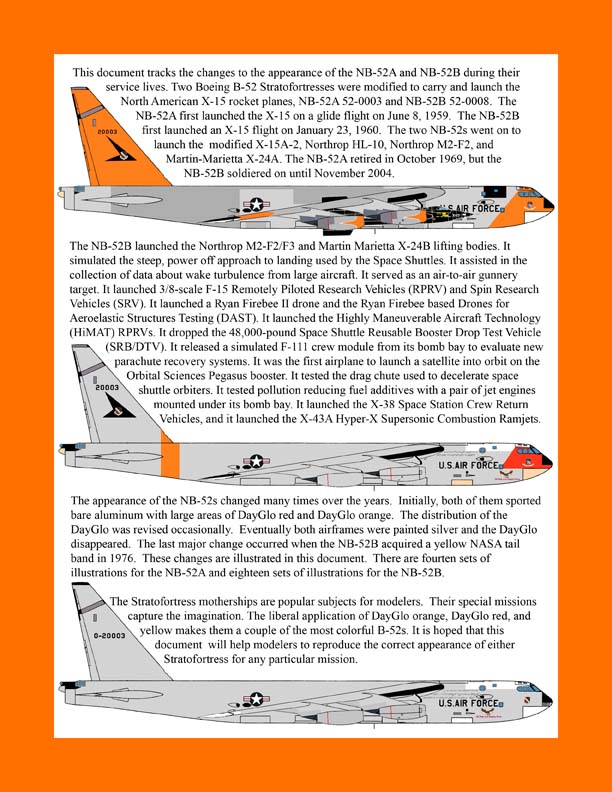
Revell has re-released Monogram's 1/72-scale Boeing NB-52B Stratofortress with X-15A-2 kit. You need this book to help you establish the appropriate paint scheme for any particular NB-52B mission that you want to model.
The book is 96 pages long.
You can preview the first several pages of the book.
Books are printed on demand by Lulu.com. When you order one, it is placed in your Lulu.com shopping cart. Lulu.com prints, packages, and ships the book direct to you.
Put a copy of the softcover edition of Painting Guide for the Boeing Stratofortress Motherships in your Lulu.com shopping cart for $44.95.
You can buy a 2020 calendar featuring photographs of the Boeing NB-52B Stratofortress Mothership that launched the X-15s in the 1960s and continued launching research vehicles until 2004.

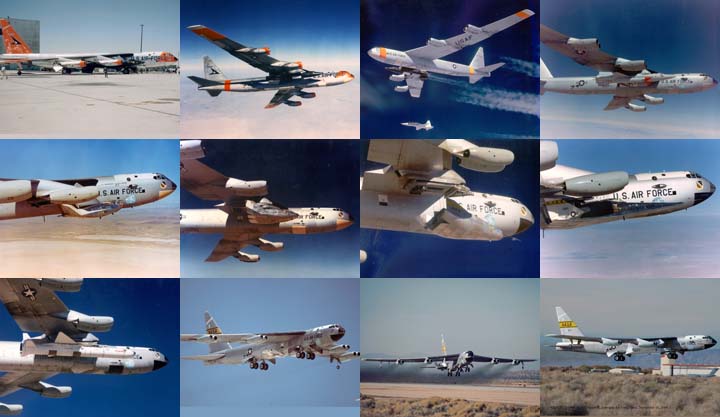
It has been asserted that the Boeing NB-52B Stratofortress, carrying Air Force serial 52-0008, can lay claim to being the airplane that has seen and participated in more history than any other single airplane. This calendar features a dozen pictures of the NB-52B carrying some of the research vehicles that it launched over the years. Photo sources: Air Force, NASA, Richard Lockett, Brian Lockett:
North American X-15-1, 1960
North American X-15-3, 1963
North American X-15A-2, 1967
Northrop HL-10, 1969
Martin-Mariettta X-24A, 1970
Northrop M2-F3, 1972
Martin-Mariettta X-24B, 1973
Orbital Sciences Pegasus, 1989
Supersonic Supercruise, 1995
X-38 V-131R, 2000
X-43A Hyper-X, 2004
 Put a copy of the Balls Eight: Boeing NB-52B Stratofortress Mothership: 2020 calendar in your Lulu.com shopping cart for $14.95.
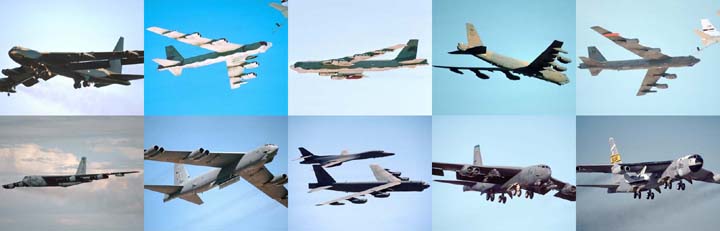
The card set includes a photo of the NB-52B, 52-0008 taking off with X-38 Crew Return Vehicle, V-131R.

- advertisement -
 Books about
Edwards Air Force Base and the X-planes available from
Books about
Edwards Air Force Base and the X-planes available from 
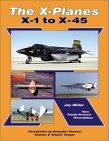 The X-Planes: X-1 to X-45: 3rd Edition
by Jay Miller
The X-Planes: X-1 to X-45: 3rd Edition
by Jay Miller
 Test Colors: The Aircraft of Muroc Army Airfield
and Edwards Air Force Base by Rene Francillon
Test Colors: The Aircraft of Muroc Army Airfield
and Edwards Air Force Base by Rene Francillon
 X-Planes at Edwards (Enthusiast Color
Series) by
Steve Pace
X-Planes at Edwards (Enthusiast Color
Series) by
Steve Pace
 Edwards Air Force Base : Open House at the USAF
Flight Test Center 1957-1966 : A Photo Chronicle of
Aircraft Displayed (Schiffer Military History) by Robert D. Archer
Edwards Air Force Base : Open House at the USAF
Flight Test Center 1957-1966 : A Photo Chronicle of
Aircraft Displayed (Schiffer Military History) by Robert D. Archer
Send a message to Brian.
Go to home page of the Goleta Air and Space Museum.