Aircraft Types |
 The pictures below link to displays
describing each type of aircraft.
The pictures below link to displays
describing each type of aircraft.
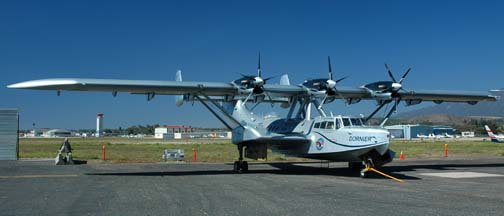 The unique Dornier Do-24ATT turbo-prop, tri-motor amphibian visited the Santa Barbara Airport in September 2005.
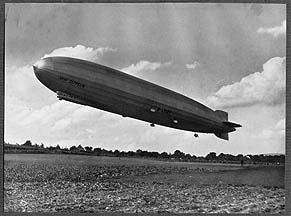 Airships, blimps, and Zeppelins are the biggest flying things of all.
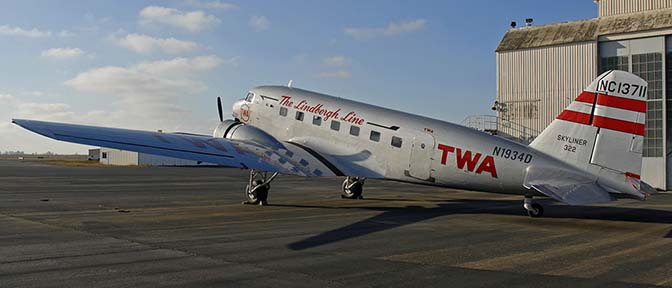 Douglas DC-2-118B NC1934D is one of two airworthy DC-2s in the United States.
 In 1949 the Wright Air Development Center conducted wing tip coupling experiments with a Douglas C-47A Skytrain and a Culver Q-14B Cadet at Wright-Patterson Air Force Base.
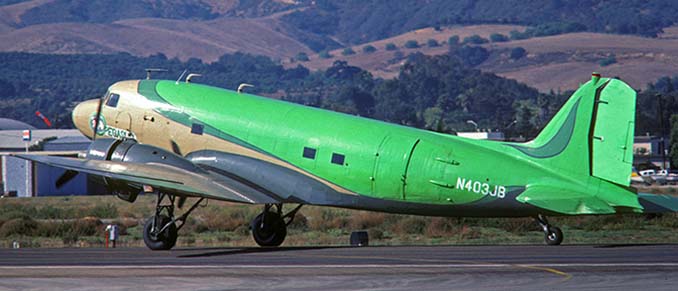 December 17, 2005 was the 70th Anniversary of the first flight of the Douglas DC-3 at the Santa Monica Airport. Here's a collection of photos of DC-2 and DC-3 variants spanning the years 1972 to 1989.
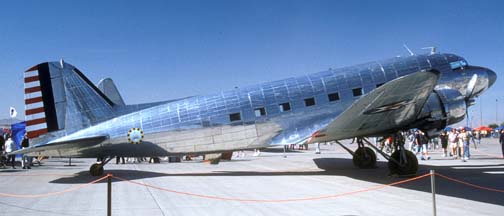 Here's a collection of photos of DC-2 and DC-3 variants taken between 1990 and 2005.
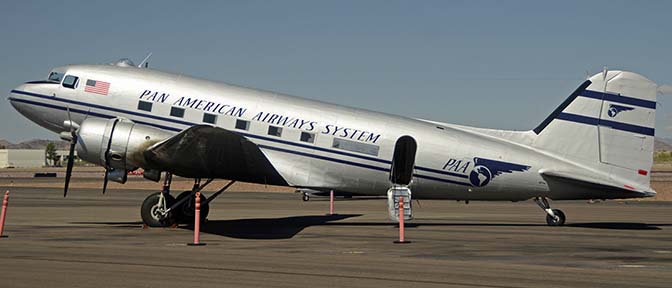 Here's a collection of photos of DC-2 and DC-3 variants taken between 2006 and the present.
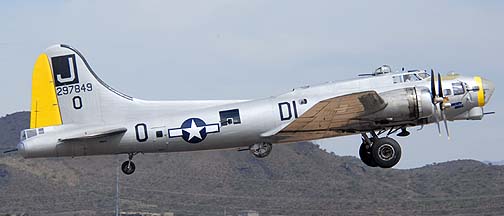 Boeing B-17G Flying Fortresses were used to fight fires until the 1980s. Subsequently, the tankers were restored to stock configuration. The restored Flying Fortresses tour the country, taking aviation enthusiasts aloft on nostalgia flights.
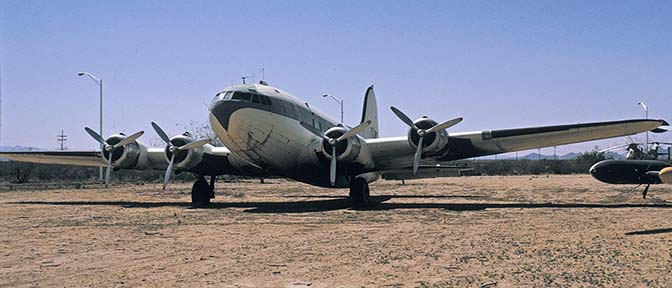 In the 1970s Boeing 307 Stratoliner,
N19903 Clipper Flying Cloud was sitting nearly forgotten under
the Arizona sun. Over seven years, it was restored by a Boeing
crew in Seattle. It flew for several months, but on March 28,
2002 the sole surviving Boeing 307 was severely damaged when it
was ditched near Seattle. The Stratoliner was carefully hoisted
from the water on March 29. On June 14, 2002 Boeing announced
that they intend to restore the Stratoliner to flightworthy
condition within a year. Boeing rolled out the restored
Stratoliner on June 13, 2003.
In the 1970s Boeing 307 Stratoliner,
N19903 Clipper Flying Cloud was sitting nearly forgotten under
the Arizona sun. Over seven years, it was restored by a Boeing
crew in Seattle. It flew for several months, but on March 28,
2002 the sole surviving Boeing 307 was severely damaged when it
was ditched near Seattle. The Stratoliner was carefully hoisted
from the water on March 29. On June 14, 2002 Boeing announced
that they intend to restore the Stratoliner to flightworthy
condition within a year. Boeing rolled out the restored
Stratoliner on June 13, 2003.
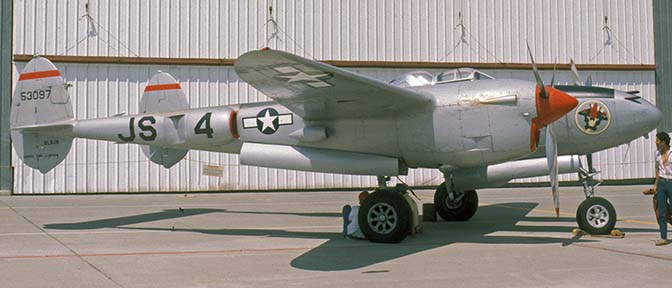 Lockheed P-38 and F-5 Lightnings are relatively uncommon warbirds. Over the years I have photographed only 10.
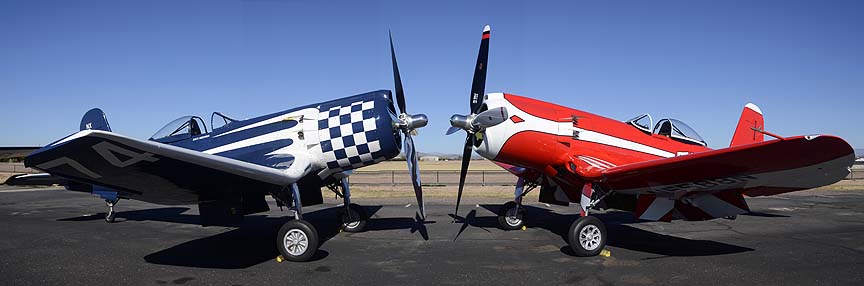 During World War II and again in the 1980s, engineers sought to increase the performance of the Vought F4U Corsair by installing a 4,360-cubic-inch, 28-cylinder engine in place of the standard 2,800-cubic-inch, 18-cylinder engine. The Pratt & Whitney R-4360 engine generated nearly twice the horsepower of the Pratt & Whitney R-2800 that equipped the standard Corsair. The R-4360 is the most powerful reciprocating engine ever installed in a single engine airplane.
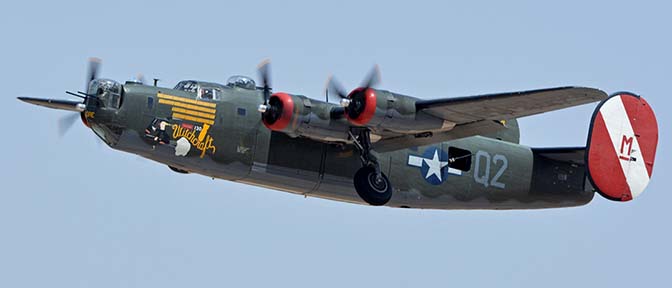 There is one airworthy Consolidated B-24 Liberator. B-24J, N224J Witchcraft is operated by the Collings Foundation. It tours the country with Boeing B-17G Flying Fortress, N93012 Nine-o-Nine.
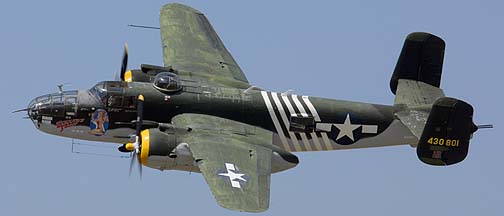 North American B-25J Mitchell, N30801 Executive Sweet has been a regular participant at airshows around southern California for over thirty years.
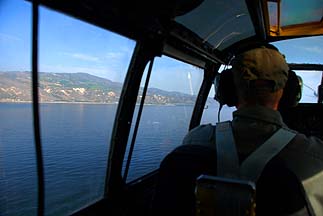 I flew aboard North American B-25J Mitchell, N30801 Executive Sweet from Camarillo to Santa Barbara and back on Sunday, October 28.
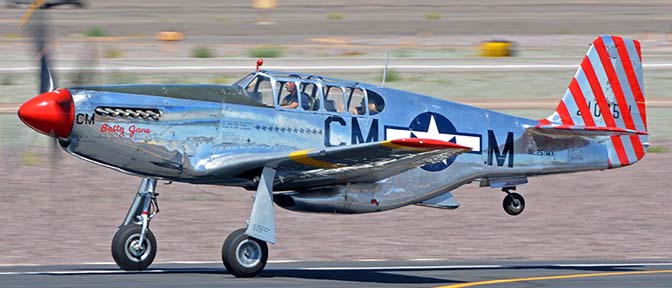 The North American A-36 Apache and early model P-51 Mustangs had a very different profile from the familiar P-51D. Here's a retrospective gallery of some surviving A-36A Apaches and P-51A, P-51B, and P-51C Mustangs.
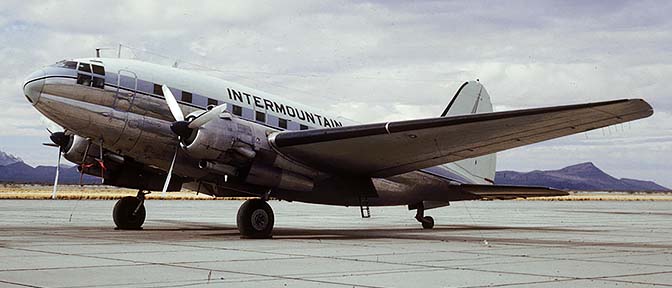 Curtiss C-46 Commando
survivors.
Curtiss C-46 Commando
survivors.
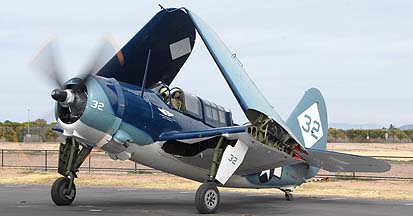 The only airworthy Curtiss SB2C Helldiver, NX92879 belongs to the Commemorative Air Force and is based in Texas.
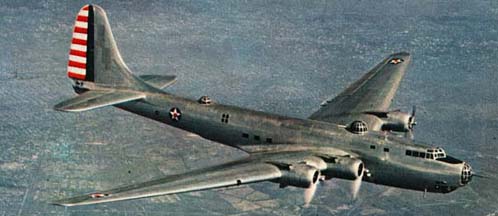 The Douglas XB-19, carrying Army
serial number 38-471, was the largest airplane in the United
States when it first flew in 1941. Only the Maxxim Gorky of the
Tupolev design bureau in the Soviet Union had been larger. These
illustrations of the XB-19 appeared in magazines in the 1940s.
The Douglas XB-19, carrying Army
serial number 38-471, was the largest airplane in the United
States when it first flew in 1941. Only the Maxxim Gorky of the
Tupolev design bureau in the Soviet Union had been larger. These
illustrations of the XB-19 appeared in magazines in the 1940s.
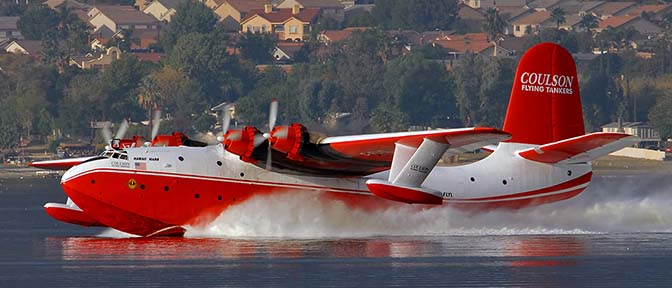 Coulson Flying Tankers sent Martin JRM C-FLYL Hawaii Mars to California on October 24, 2007 to help fight the numerous wildfires. It was temporarily based at Lake Elsinore.
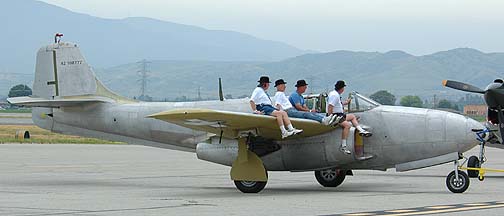 The Bell P-59 Airacomet was the first jet fighter to be put into production in the United States. Sixty-six were built. Six Airacomets survive. YP-59A 42-108777 is being restored to airworthy condition at Chino.
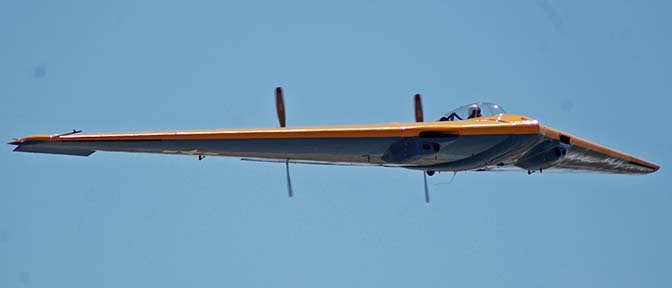 Tragically, the last surviving Norhrop N9M was destroyed in a crash near Chino on April 22, 2019. Its pilot, David Michael Vopat, was killed in the crash. It was the only Northrop flying wing from the 1940s which was still flying.
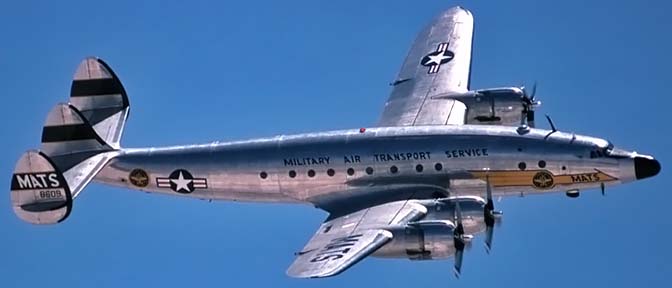 Lockheed designed the Model L-049 Constellation as an airliner
for Transcontinental and Western Air and Pan American Airlines.
The L-049 featured a pressurized fuselage and four Wright R-3350
eighteen-cylinder radial engines. The initial production run was
requisitioned by the Army Air Corps in 1942 and designated C-69.
After World War II, Lockheed produced the L-649, and L-749
Constellations for the airlines and the C-121A for the Air Force.
There are
Lockheed designed the Model L-049 Constellation as an airliner
for Transcontinental and Western Air and Pan American Airlines.
The L-049 featured a pressurized fuselage and four Wright R-3350
eighteen-cylinder radial engines. The initial production run was
requisitioned by the Army Air Corps in 1942 and designated C-69.
After World War II, Lockheed produced the L-649, and L-749
Constellations for the airlines and the C-121A for the Air Force.
There are ten seven surviving Lockheed
Constellations in the United States. Six
four of them can be found in Arizona. I have
photographed all of the Constellations currently residing in
Arizona. Two of them are potentially airworthy.
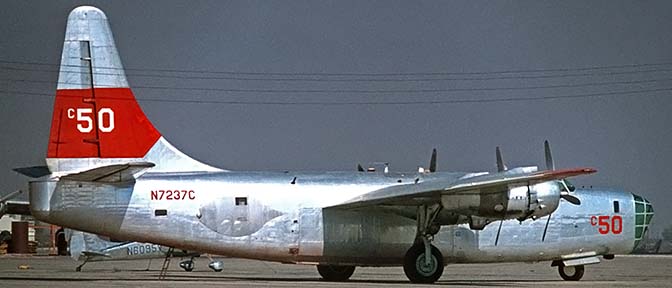 Hawkins & Powers of Greybull, Wyoming maintained five Privateer tankers in airworthy condition until
2002. Tragically, tanker #123 shed a wing and crashed near Estes Park, Colorado on July 18, 2002, killing its crew of two. This page has been updated with photos of P4Y-2 Privateer N2871G at Casas Grande, Arizona on October 23, 2010.
Hawkins & Powers of Greybull, Wyoming maintained five Privateer tankers in airworthy condition until
2002. Tragically, tanker #123 shed a wing and crashed near Estes Park, Colorado on July 18, 2002, killing its crew of two. This page has been updated with photos of P4Y-2 Privateer N2871G at Casas Grande, Arizona on October 23, 2010.
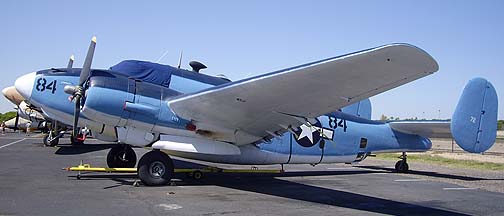 Lockheed PV-2 Harpoon N7670C Attu Warrior visited the Arizona Wing of the Commemorative Air Force in March 2011.
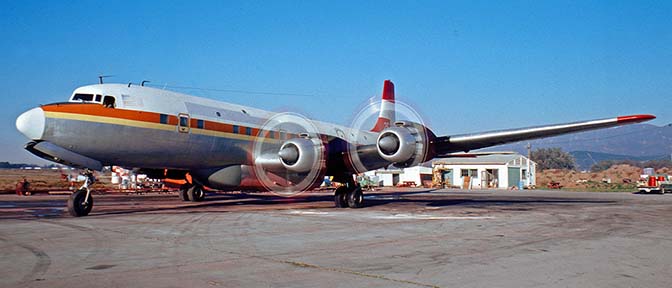 Numerous DC-6s and DC-7s have been converted to fight wild fires
over the years.
Numerous DC-6s and DC-7s have been converted to fight wild fires
over the years.
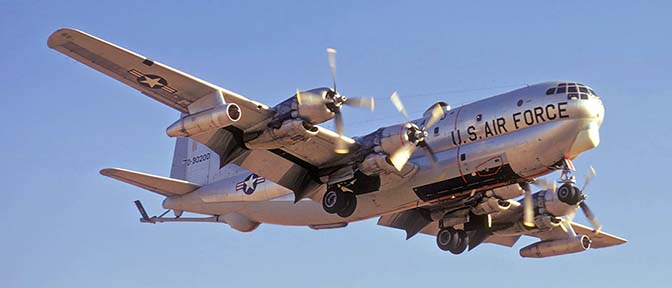 Boeing C-97 Stratofreighters and Stratotankers were still flying with the Arizona Air Guard when I was growing up in Phoenix in the 1970s. There were many C-97s stored at the Military Aircraft Storage and Disposition Center (MASDC) at Davis-Monthan Air Force Base. Several examples were retired to museums in the 1980s.
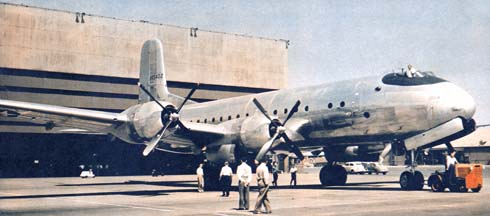 The Douglas C-74 Globemaster was
the largest U. S. landplane next to the Douglas XB-19 when it
flew for the first time on September 5, 1945.
The Douglas C-74 Globemaster was
the largest U. S. landplane next to the Douglas XB-19 when it
flew for the first time on September 5, 1945.
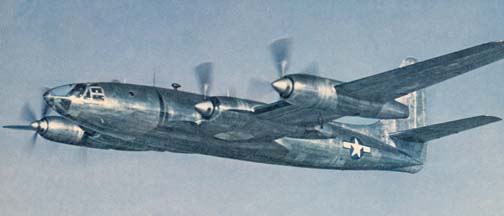 The Republic XF-12 Rainbow was a high
speed, high altitude reconnaissance airplane powered by four
3,000 horsepower R-4360 radial engines that first flew in 1946.
It was able to cruise at over 450 miles per hour with a service
ceiling of 45,000 feet.
The Republic XF-12 Rainbow was a high
speed, high altitude reconnaissance airplane powered by four
3,000 horsepower R-4360 radial engines that first flew in 1946.
It was able to cruise at over 450 miles per hour with a service
ceiling of 45,000 feet.
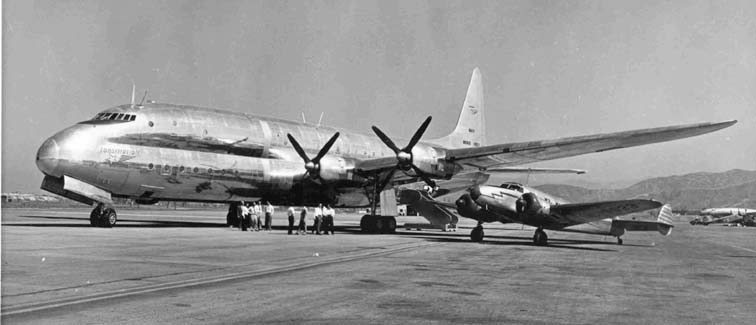 The
Lockheed R6V
Constitution was a giant transport airplane that was built
for the U. S. Navy.
The
Lockheed R6V
Constitution was a giant transport airplane that was built
for the U. S. Navy.
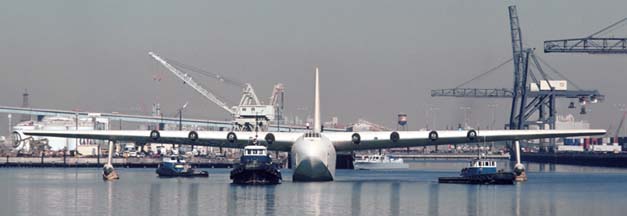 Howard Hughes' giant flying boat, the HK-1
Hercules, also known as the Spruce Goose,
was moved from its hangar to a temporary onshore site in October
1980,
Howard Hughes' giant flying boat, the HK-1
Hercules, also known as the Spruce Goose,
was moved from its hangar to a temporary onshore site in October
1980,
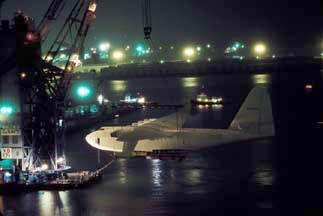 It was then moved to its former
display location on Pier J in Long
Beach in February 1982.
It was then moved to its former
display location on Pier J in Long
Beach in February 1982.
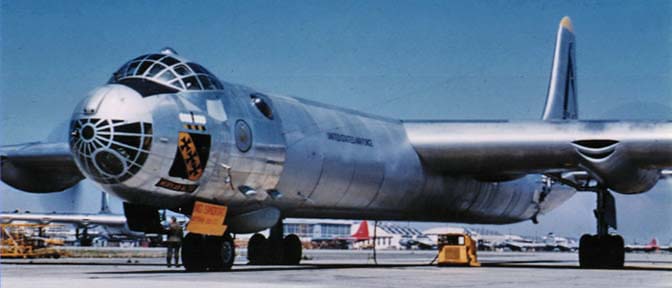 The Convair B-36 Peacemaker was the big stick of the Strategic Air Command in the early fifities.
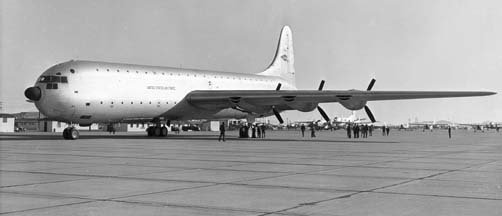 The XC-99 Transport and Model 37 Airliner
Display. The XC-99, serial 43-52436 was the double deck
transport variant of the B-36. The Model 37 was a proposed
204-seat transatlantic airliner version of the XC-99.
The XC-99 Transport and Model 37 Airliner
Display. The XC-99, serial 43-52436 was the double deck
transport variant of the B-36. The Model 37 was a proposed
204-seat transatlantic airliner version of the XC-99.
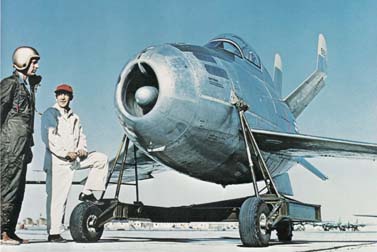 The
McDonnell XF-85 Goblin was intended to fit inside the bomb bay of
the Convair B-36 bomber to serve as a self contained escort
fighter. In 1948-49, a pair of XF-85
Goblins were test flown from a Boeing EB-29B at Edwards Air
Force Base.
The
McDonnell XF-85 Goblin was intended to fit inside the bomb bay of
the Convair B-36 bomber to serve as a self contained escort
fighter. In 1948-49, a pair of XF-85
Goblins were test flown from a Boeing EB-29B at Edwards Air
Force Base.
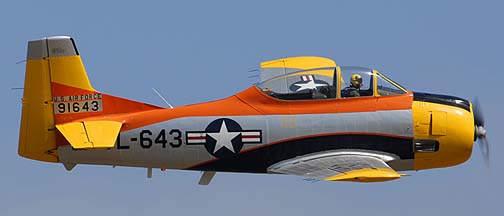 North American T-28A Trojan, N81643 is based at the Santa Barbara Airport. Over the summer of 2005, it was restored in the colors of a T-28A that was flown by the Air Force Test Pilot School at Edwards Air Force Base in the 1950s. It will appear at the upcoming Edwards Air Force Base Open house in late October.
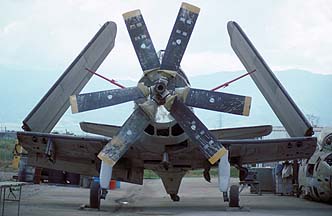 The Douglas A2D Skyshark evolved from the AD (A-1) Skyraider. The airframe was enlarged to accept a 5,100 shaft-horsepower Allison XT40-A-2 turbo-prop engine. Douglas A2D Skyshark, BuNo 125485 is the sole survivor of the type.
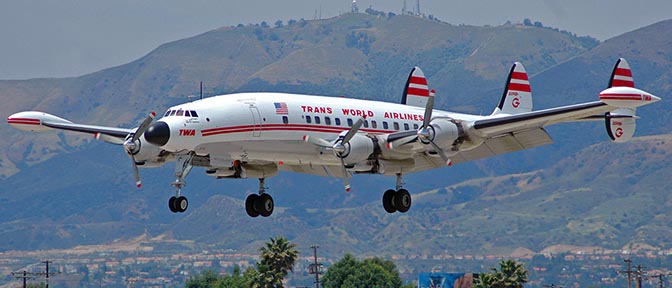 Lockheed introduced the Model 1049 Super Constellation in 1951. The fuselage was stretched 21 feet over the length of the original Constellation. More powerful R-3350-34 and -91 turbo-compound engines were installed. There are
 twenty nineteen surviving Lockheed Super Constellations in the United States. I have photographed nine eight of them. Three One of them is currently airworthy.
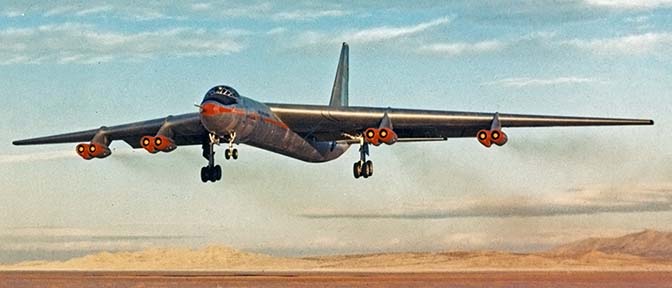 The YB-60 page
shows Convair's all-jet competitor to the Boeing B-52
Stratofortress.
The YB-60 page
shows Convair's all-jet competitor to the Boeing B-52
Stratofortress.
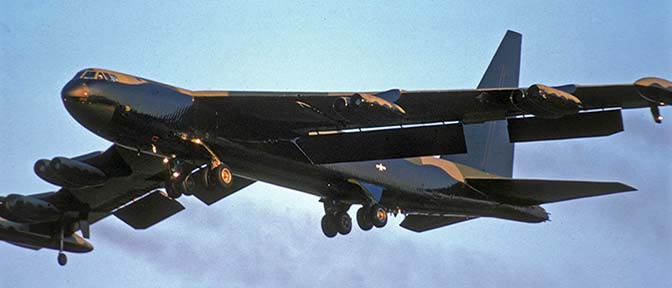 > Boeing B-52
Stratofortresses.
> Boeing B-52
Stratofortresses.
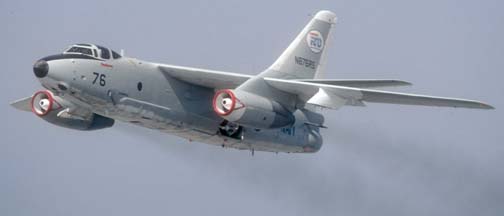 The Douglas A-3 Skywarrior was a giant
among the airplanes deployed on aircraft carriers. It was the
largest airplane ever designed to operate from an aircraft
carrier. After being retired from their primary role of nuclear
bomber, the large airframes lent themselves to a variety of
missions.
The Douglas A-3 Skywarrior was a giant
among the airplanes deployed on aircraft carriers. It was the
largest airplane ever designed to operate from an aircraft
carrier. After being retired from their primary role of nuclear
bomber, the large airframes lent themselves to a variety of
missions.
A celebration of the 50th anniversary of the
first flight of the Douglas XA3D-1 Skywarrior was held at the Van
Nuys Airport in October 2002. Check out the announcement of the event on the A-3 Skywarrior
Association web site. 
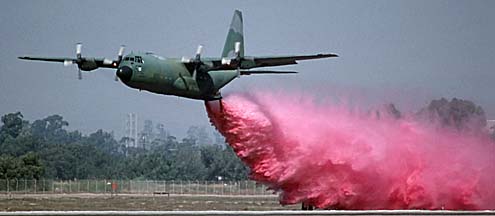 For over two decades, Air National Guard and Air Force Reserve Lockheed C-130 Hecules have fought wildfires with the Mobile Airborne Fire Fighting System (MAFFS). In the late 1980s, former Air Force C-130As were transferred to civilian owners and modified with tanks to carry 3,000 gallons of fire retardent slurry. On June 17, 2002, Hawkins Powers C-130A N130HP, Tanker 130 suffered a main wing box failure and crashed as it was fighting a fire near Walker, California. The civilian C-130A tanker fleet was immediately grounded. Only military C-130s continue to be used in the role of firefighting tanker.
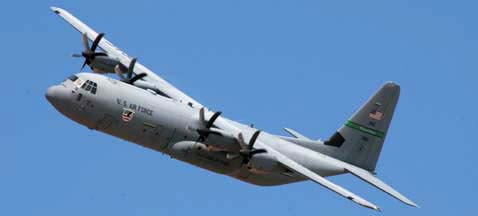 Since 1988, the 146th Airlift Wing has been located at the Channel Islands Air National Guard Station, across the runway from Naval Air Station Pt Mugu. The 146th AW operates Lockheed C-130E and C-130J Hercules. In addition to cargo operations, the wing's C-130s fight wildfires with the Mobile Airborne Fire Fighting System (MAFFS).
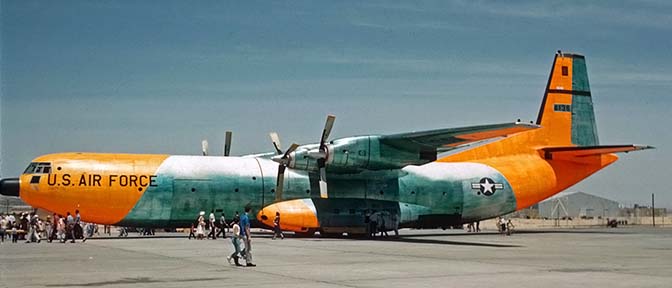 Douglas built 50 turboprop powered C-133 Cargomasters
from 1956 to 1961. They were superceded fairly quickly by the
faster Lockheed C-141 Starlifter and Lockheed C-5 Galaxy.
Douglas built 50 turboprop powered C-133 Cargomasters
from 1956 to 1961. They were superceded fairly quickly by the
faster Lockheed C-141 Starlifter and Lockheed C-5 Galaxy.
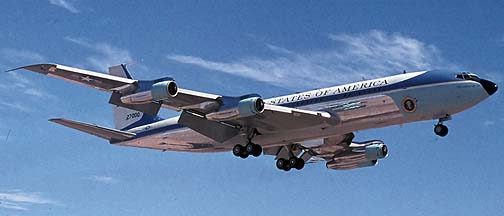 Over the years, a variety of airplanes have served as presidential transports including a Lockheed Constellation, Lockheed Super Constellation, Boeing 707s, and Boeing 747s.
Boeing's 367-80 is the first of all Boeing jetliners. It is not a 707. It is a jet-powered development of the model 367 Stratofreighter (C-97). It carries construction number 17158. It has always been registered as N70700. It first flew on July 15, 1954. After serving as a testbed for a multitude of projects, it was retired to the Military Aircraft Storage and Disposition Center (MASDC) at Davis-Monthan Air Force Base, Arizona in 1969.
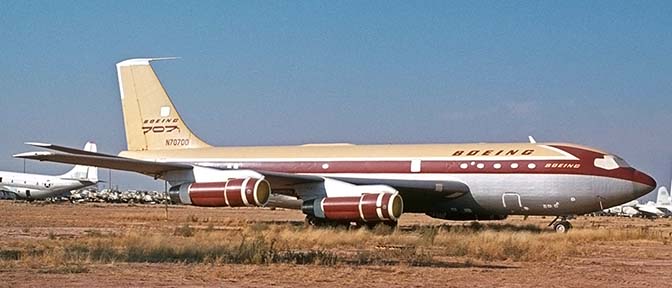 367-80 Stratoliner Prototype, N70700 in storage at MASDC on November 12, 1973.
The 367-80 flew from Davis-Monthan Air Force Base to Boeing Field, Seattle, Washington on January 27, 1990. It was restored by Boeing staff and placed into storage until it was delivered to the National Air and Space Museum. It made its final flight on August 27, 2003.
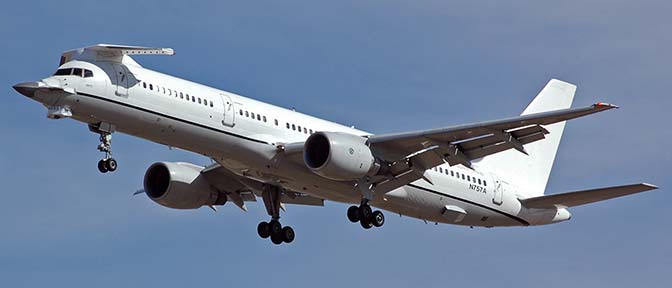 Boeing jetliner prototypes and testbeds. Several Boeing jetliners have been converted to test engines and to carry radar and infra-red sensors.
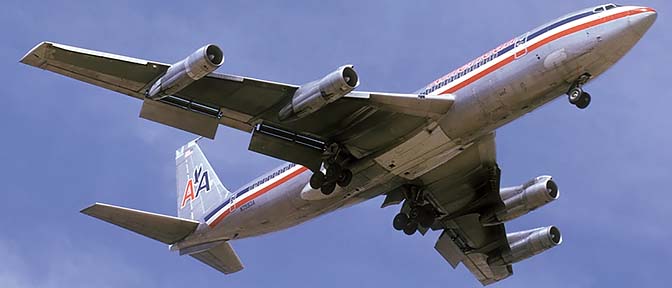 Early Boeing four-engine jet airliners, beginning with the 367-80 prototype, shared a 130-foot 10-inch wingspan. Boeing's first production jet airliner, the 707-120, was 144 feet 6 inches long. To suit QANTAS need for a longer range, the 707-138 was ten feet shorter than the standard 707-120 but kept the same take-off weight. Boeing built the 720 with a shorter, lighter fuselage for short range operations.
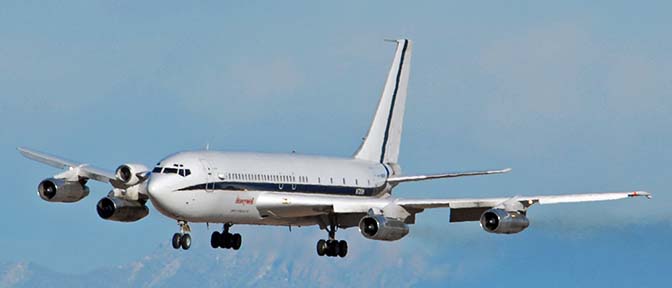 Allied Signal modified a 720-051B to test the TFE731-40 turbofan engine. It was the oldest Boeing jet airliner that still flew when it was retired in December 2007.
Allied Signal's TFE731-40 Testbed wears construction number 18384. It first flew on September 15, 1961. TWA leased it as N794TW beginning on August 27, 1961. Northwest leased it as N733US on October 26, 1962 and then bought it on July 1, 1968. Maersk Air registered it as OY-APZ in January 1973 and leased it to Nigeria Airways in December 1974. TEA leased it as OO-TYA on November 6, 1979 and returned it to Maersk on January 19, 1980. Conair acquired it on February 16, 1981. Allied Signal registered it as N720GT on November 24, 1987 and mounted an engine test pylon on the right side of the forward fuselage.
N720H made its last flight on December 29, 2007 and was broken up at Sky Harbor in 2008. It has been replaced with Boeing 757-225 N757HW.
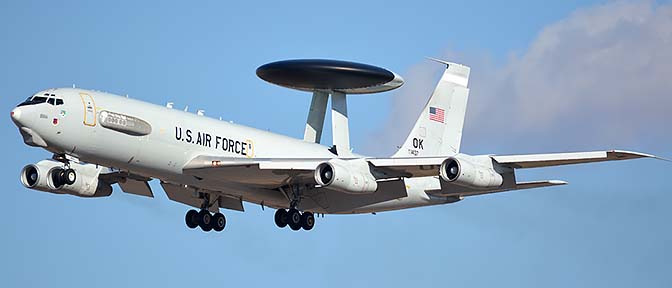 The Boeing 707 has been adapted to many military functions. The United States Air Force and Navy operate 707s under the designations C-137, C-18, E-3 Sentry, E-6 Mercury, and E-8 J-STARS. The E-3 Sentry is also operated by NATO and the Royal Air Force. Several other nations operate 707s as VIP transports and tankers.
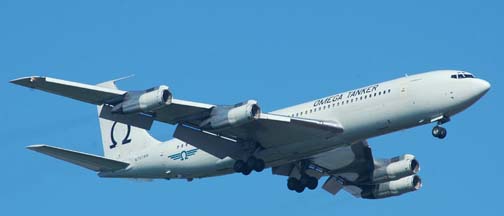 Omega Tanker 707-321C, N707AR was at Naval Air Station Pt. Mugu in June and July 2005.
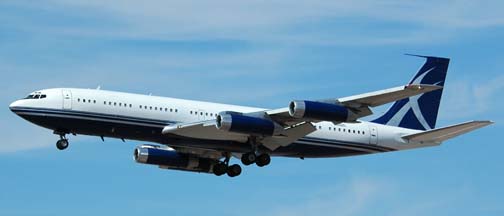 Here's a collection of pictures of some of the oldest examples of Boeing jet airliners that still fly.
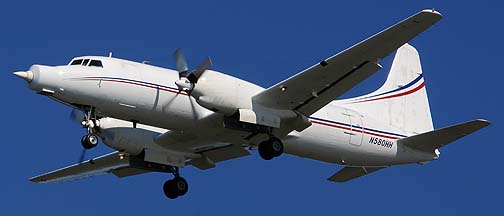 Raytheon's Convair 580 N580HH arrived at Naval Air Station Pt Mugu From Tucson, Arizona on February 25, 2008.
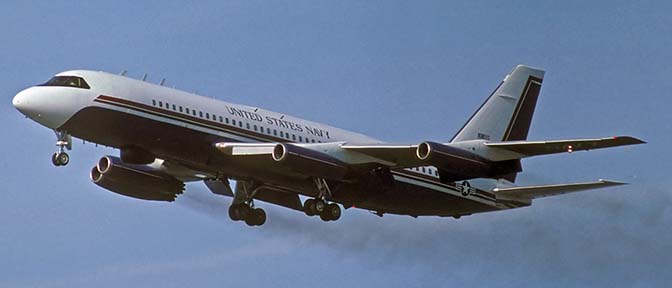 The Convair 880 was produced as a faster, smaller jet airliner in competition with the Boeing 707 and Douglas DC-8. Seating 88 to 110 passengers, only 65 Cv-880s were manufactured from 1959 to 1962. TWA and Delta Airlines were
the primary U.S. customers for the Cv-880.
The Convair 880 was produced as a faster, smaller jet airliner in competition with the Boeing 707 and Douglas DC-8. Seating 88 to 110 passengers, only 65 Cv-880s were manufactured from 1959 to 1962. TWA and Delta Airlines were
the primary U.S. customers for the Cv-880.
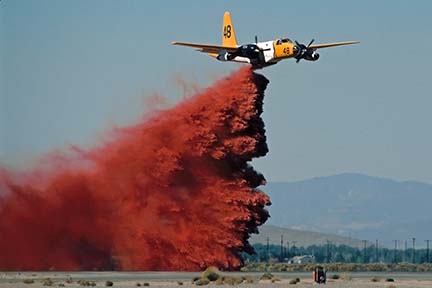 A variety of vintage aircraft are used as aerial tankers for fighting wildfires.
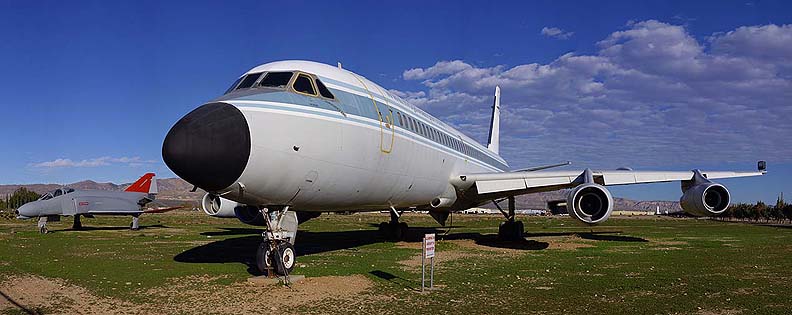 The Convair 990 was a stretched version
of the Convair 880 with room for 139 passengers. Only 37 Cv-990s
were manufactured from 1961 to 1963.
The Convair 990 was a stretched version
of the Convair 880 with room for 139 passengers. Only 37 Cv-990s
were manufactured from 1961 to 1963.
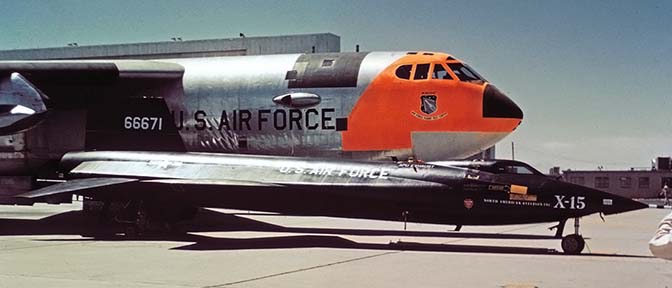 North American X-15.
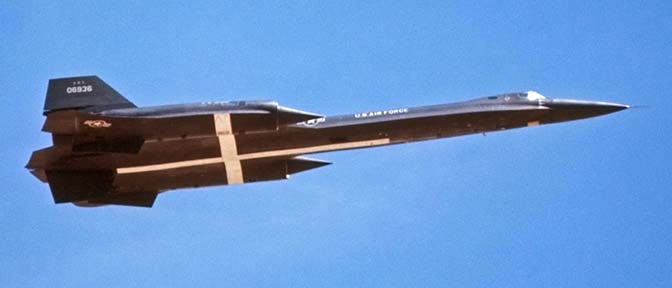 Lockheed A-12, YF-12, and SR-71 Blackbirds
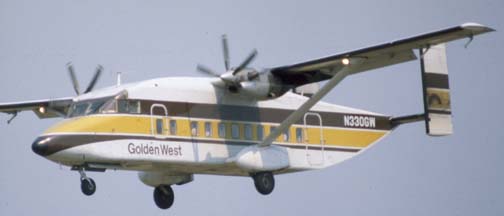 Short Brothers and Harland Limited introduced the Skyvan Turboprop STOL light transport in 1963. Short Brothers PLC stretched the Skyvan by 12 feet 5 inches to create the Model 330 in 1974. The cabin of the 330 was stretched an additional seven feet to create the Model 360 in 1981. The 360 is easily distinguished by its single vertical stabilizer.
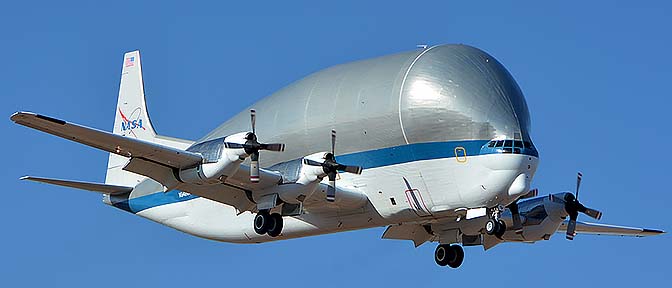 Until Airbus developed the Beluga, the Pregnant and Super Guppies were the airplanes with the largest volume in the world.
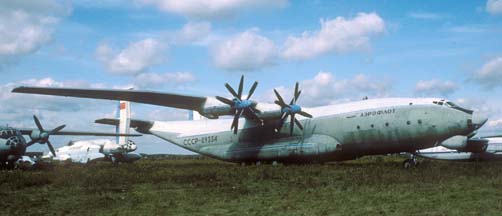
The Antonov An-22 Antheus was the largest production airplane in the world from 1965 until the introduction of the Lockheed C-5A Galaxy in 1969.
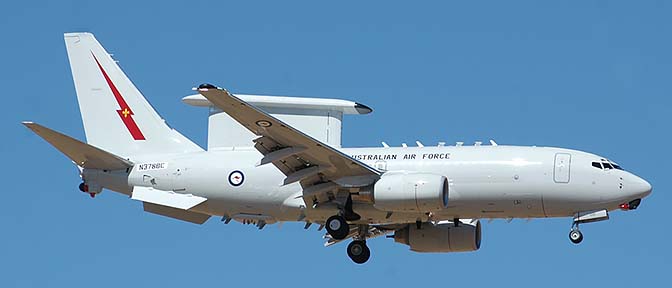 The Royal Australian Air Force Boeing 737-7ES Wedgetail AEW&C prototype flew from Boeing Field, Washington to the Boeing's facility at the Southern California Air Logisitics Center at Victorville on Saturday July 9, 2005.
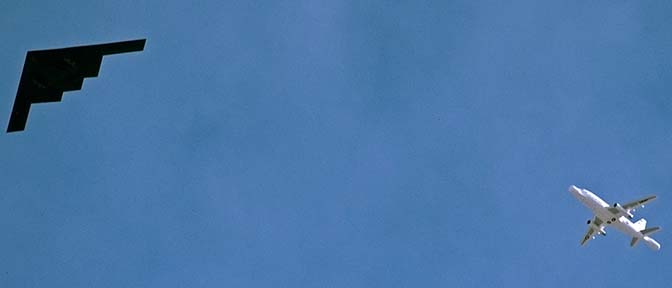 The Air Force operates a modified T-43A (737-200) as a Radar Test Bed (RTB) with radar imaging gear on its nose and tail in radomes that are 9 feet long and over 6.5 feet in diameter.
The RTB is used to make radar images of stealthy aircraft. The images are used to evaluate the effectiveness of their stealth characteristics, to reveal the rate of degradation of the radar deflecting and absorbing components as the aircraft age, and to determine the effectiveness of maintenance and repair methods.
T-43A, 73-1155 carries Boeing construction number 20702. It first flew on July 2, 1974 and was delivered to the Air Force ten days later. It served initially as a navigation trainer. It was retired from that role and delivered to AMARC on September 25, 1997. Identified as TH002, it was sealed with spraylat and sat in the desert sun for over two years. 73-1155 was selected for modification as the Radar Test Bed. It was pulled out of storage at AMARC and delivered to the Ogden Air Logistics Center (OO-ALC) at Hill Air Force Base, Utah for refurbishment on November 19, 1999.
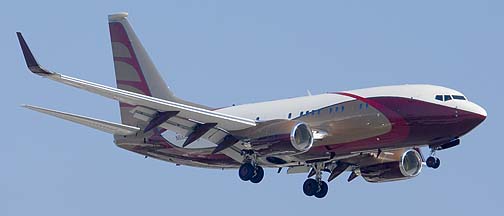 Boeing Business Jet 737-7AH N888TY is a regular vistor to the Santa Barbara Airport.
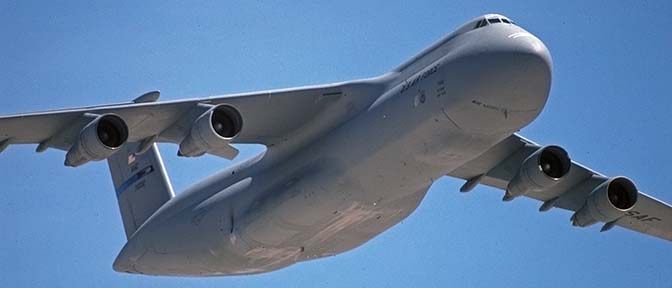 The Lockheed C-5 Galaxy was the largest airplane in the world from its debut in 1968 until the Antonov 124 took to the air in 1984.
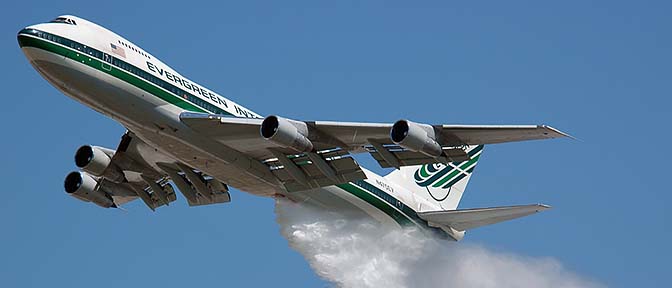 The Boeing 747 is a four-engine, wide-body airliner. The Boeing 747 prototype made its maiden flight on February 9, 1969. The Boeing 747-100 and 200 are 231 feet 10 inches long and has a wing span of 195 feet 8 inches. The long range 747SP variant is 184 feet 9 inches long. The 747SP first flew on July 4, 1975. The 747-100 was equipped with four Pratt and Whitney JT9D-3 or JT9D-7 turbofans ranging from 43,500 pounds to 47,000 pounds thrust each. Two classic 747s wee modified to carry and launch Space Shuttles. Some are used as engine testbeds. One served as the prototype of a fire fighting aerial tanker.
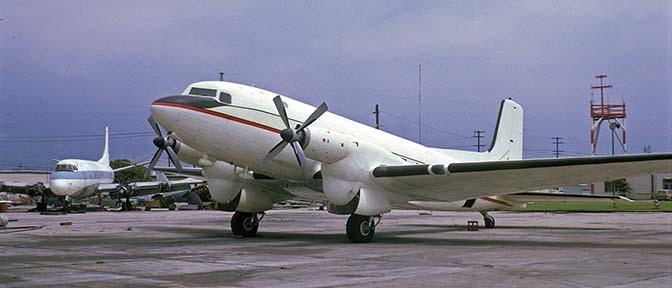 Conroy Aircraft of Santa Barbara, the developer of the Aero Spacelines Guppy oversized cargo planes, also produced a series of turboprop DC-3 conversions.
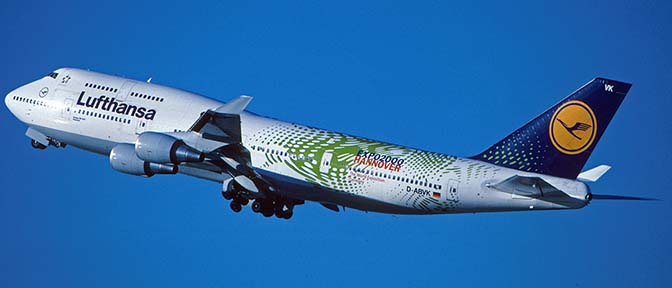 On January 6 and 7, 2000, I shot
pictures of the operations at Los Angeles International Airport.
Here, in ascending gross weight, are representatives of the widebody airliners that frequent LAX.
On January 6 and 7, 2000, I shot
pictures of the operations at Los Angeles International Airport.
Here, in ascending gross weight, are representatives of the widebody airliners that frequent LAX.
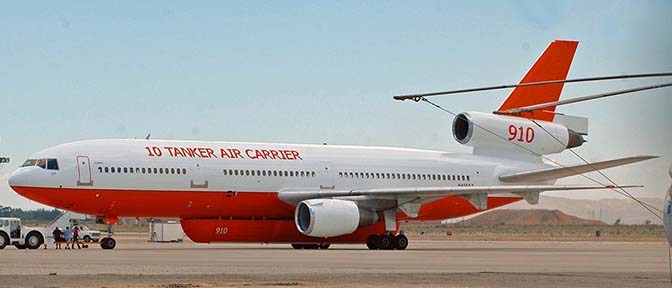 DC-10 Tanker Air Carrier, N450AX is the first DC-10 modified to fight wildfires. It can carry up to 12,000 gallons of water.
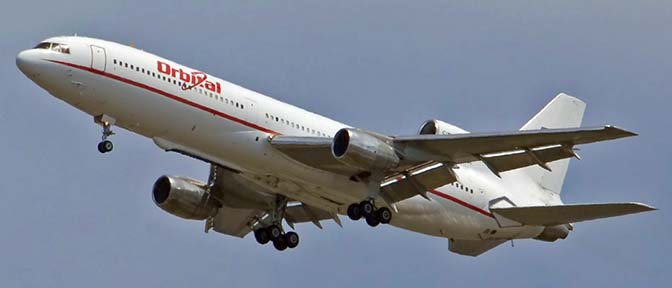 The Orbital Sciences Corporation L-1011, N140SC Stargazer launches satelites into orbit on Pegasus-XL boosters.
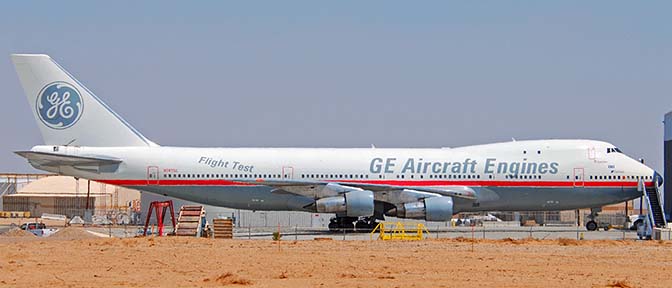 For a number of years, General Electric has used a former Pan Am 747-121 as an engine testbed.
General Electric's 747-121 Engine Testbed carries construction number 19651 and was the 25th 747 off the production line. It first flew on March 3, 1970. It was delivered to Pan Am as N744PA Clipper Star of the Union on March 21, 1970. It was later rechristened Clipper Ocean Spray. Pan Am retired it on December 4, 1991.
General Electric leased it and registered it as N747GE on March 9, 1992. A variety of engines have been tested on its number-2 pylon, including the GE90-115 and the CF34. It was based at the Mojave Airport for several years before its operations were transferred to the Southern California Air Logistics Center at Victorville in 2002. It is the oldest 747 that is still flown.
On Wednesday May 31, the Evergreen International 747-273C Supertanker flew from Boise, Idaho to the San Bernardino Airport with a load of 20,000 gallons of water that it dropped in a demonstration of its potential as a firefighter. This was the final demonstration in a tour that took the Supertanker to Sacramento California, the Aberdeen Proving Ground Maryland, Scott Air Force Base Illinois, Tallahassee Florida, and Boise.
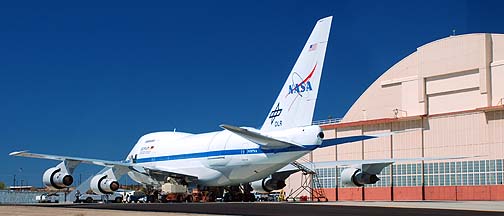 NASA's Stratospheric Observatory for Infrared Astronomy (SOFIA), a Boeing 747SP modified to carry a 2.5 meter diameter infra-red telescope, arrived at Edwards Air Force Base early in the afternoon on May 31, 2007. It will conduct infra-red astronomical observations above most of the water vapor in the Earth's atmosphere.
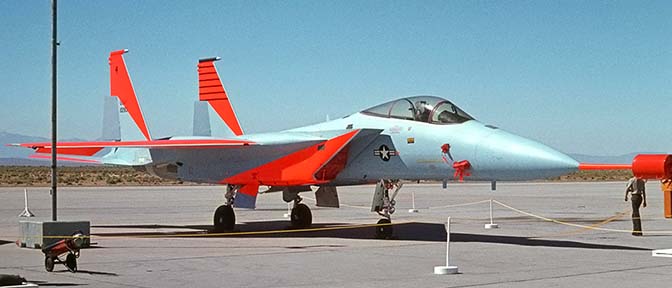 Pre-production McDonnell-Douglas F-15 Eagles
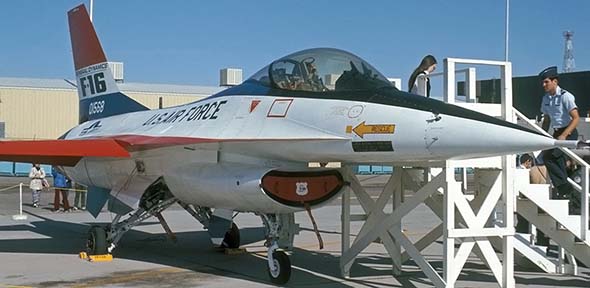 Pre-production General Dynamics F-16 Fighting Falcons
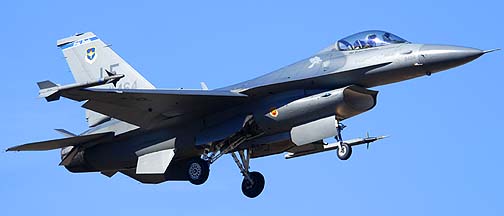 F-16 Fighting Falcons at Luke AFB: US Air Force fighter pilots have been training in General Dynamic F-16 Fighting Falcons at Luke Air Force Base since 1983. Luke is home to the 56th Fighter Wing. Elements of the 56th Fighter Wing include the 62nd Fighter Squadron Spike, 308th Fighter Squadron Emerald Knights, 309th Fighter Squadron Wild Ducks, and 310th Fighter Squadron Top Hats. Pilots of the Taiwanese Air Force 21st Fighter Squadron GamblersGamblers and the Singapore Air Force 425th Fighter Squadron Black Widows also train at Luke.
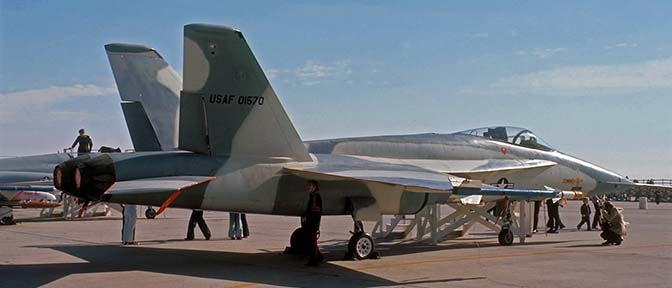 Pre-production Northrop YF-17 Cobras
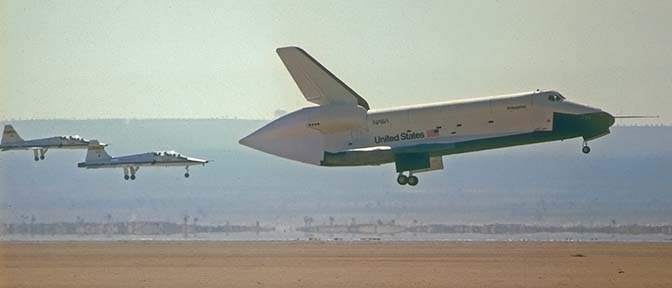 North American Rockwell Space Shuttle.
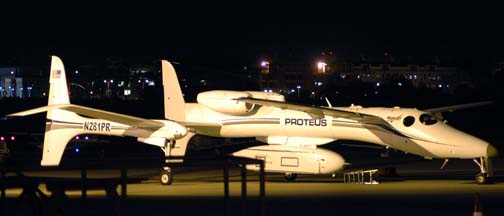 Burt
Rutan and Scale Composites have been responsible for
producing many novel and innovative aircraft. This display features
several of his designs and
products of Scale Composites.
Burt
Rutan and Scale Composites have been responsible for
producing many novel and innovative aircraft. This display features
several of his designs and
products of Scale Composites.
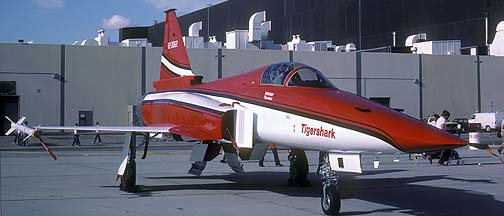 Northrop F-5G/F-20 Tigershark
The prototype 757 has been modified to serve as the testbed of F-22 radar and avionics.
The F-22 Avionics testbed has the nose of an F-22 mounted on its forward fuselage. A sensor wing is mounted above the cockpit. F-22 electronic warfare (EW) and communication, navigation and identification (CNI) sensors are mounted on the sensor wing. A simulated F-22 cockpit is installed in the cabin.
The F-22 Avionics testbed carries construction number 22212. It first flew on February 18, 1982. It first flew after modification on March 11, 1999.
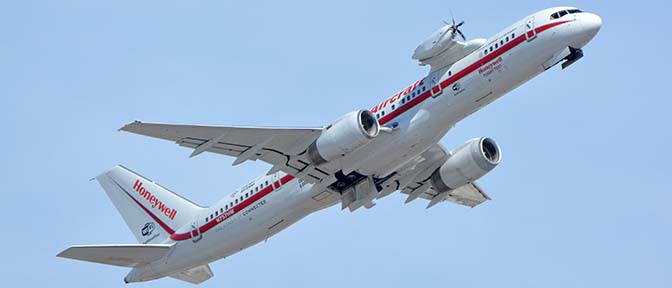 Honeywell operates Boeing 757-225 N757HW as an engine testbed at Phoenix Sky Harbor Airport. It is powered by a pair of Rolls royce RB211-535E4B37 turbofans. It carries a third jet engine on the right side of the forward fuselage. The construction number of N757HW is 22194. It first flew on February 4, 1983. It was delivered to Eastern Airlines as N504EA on February 28, 1983. It was withdrawn from use at McCarren Airport, Nevada in January 1991. Airtours International Airways registered it as G-JALC on February 1, 1995. Airtours International Airways changed its name to MyTravel Airways on May 1, 2002. Honeywell International Incorporated gave it its current registration on October 4, 2005. It was flown to Pinal Airpark for painting on October 24, 2005. It made its first flight with three engines on December 20, 2008.
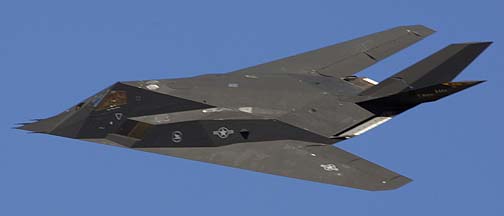 The Lockheed F-117A Nighthawk fleet is being retired. Here's a retrospective of photos of the Stealth Fighter.
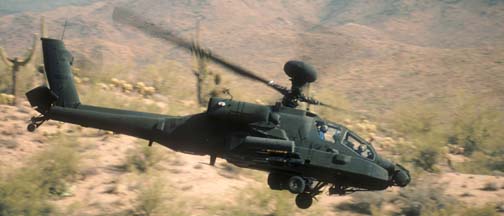 Boeing Helicopter at Mesa, Arizona treated the second annual
International Symposium of Aviation Photographers to an AH-64D Longbow Apache
photo session in the foothills of the Mazatzal Mountains on March
1, 2002.
Boeing Helicopter at Mesa, Arizona treated the second annual
International Symposium of Aviation Photographers to an AH-64D Longbow Apache
photo session in the foothills of the Mazatzal Mountains on March
1, 2002.
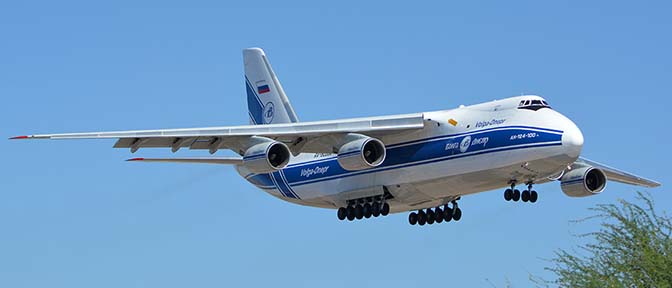 The Antonov An-124
Ruslan is the largest production airplane in the world. It
was introduced to the west at the Paris Airshow of 1985. It
succeeded the C-5A Galaxy in the role of world's biggest
airplane. Construction continues in Kiev, Ukraine and Ulyanovsk,
Russia.
The Antonov An-124
Ruslan is the largest production airplane in the world. It
was introduced to the west at the Paris Airshow of 1985. It
succeeded the C-5A Galaxy in the role of world's biggest
airplane. Construction continues in Kiev, Ukraine and Ulyanovsk,
Russia.
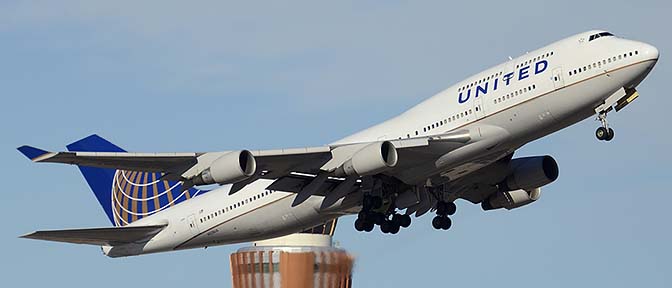 The Boeing 747-400 is a four-engine, wide-body derivative of the classic 747. The Boeing 747-400 made its maiden flight on April 29, 1988. The Boeing 747-400 is 231 feet 10 inches long, the same as the classic 747, and has a wing span of 211 feet 5 inches, 16 feet more than the classic 747. The upper deck is 23 feet 4 inches longer than on the classic 747.
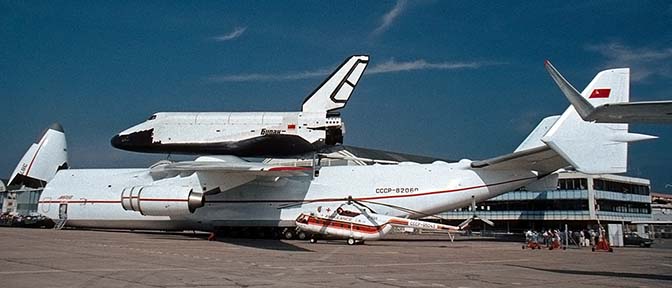 An-225
Mriya has been stretched fifty feet compared to the An-124.
An entirely new wing root was designed to add fifty feet to the
span of the smaller giant.
An-225
Mriya has been stretched fifty feet compared to the An-124.
An entirely new wing root was designed to add fifty feet to the
span of the smaller giant.
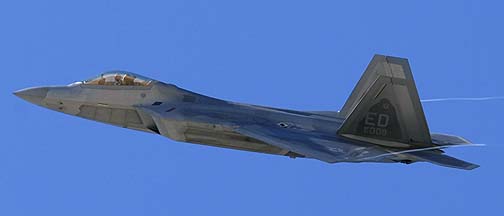 Most of the pre-production Lockheed-Martin F-22 Engineering, Manufacture, and Development Raptors have appeared at the Edwards Air Force Base Open House. Production Representative Test Vehicle F/A-22A Raptors and early production F/A-22A Raptors were first assigned to Nellis Air Force Base in 2003.
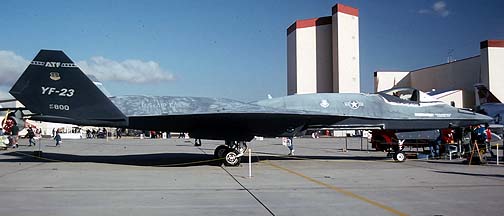 Northrop YF-23
Stealth Bombers have been regular participants at the Edwards Air Force Base Open House and other airshows since 1992. They are sometimes seen in the pattern at Air Force Plant 42 and other remote locations in the Mojave Desert.
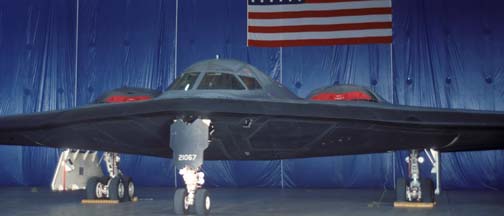 B-2A Spirit photos from 1992 to 1997.
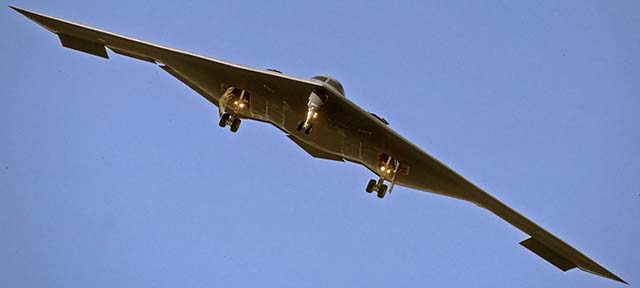 B-2A Spirit photos from 1998 to the present.
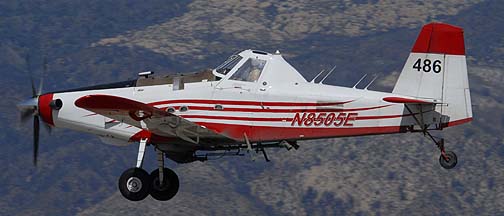 Air Tractor AT-802A turbo-props are used for crop spraying, firefighting, and hydromulch distribution.
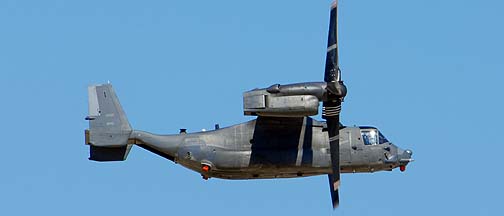 The Air Force CV-22 Osprey flight test program at Edwards Air Force Base is coming to a conclusion. For seven years, CV-22s have plied the skies over the Mojave Desert, testing the Forward Looking Infra-red and Terrain Following Radar that will be used for nap of the earth flying in bad weather and at night. The final flight of the test program was flown on Wednesday, September 26.
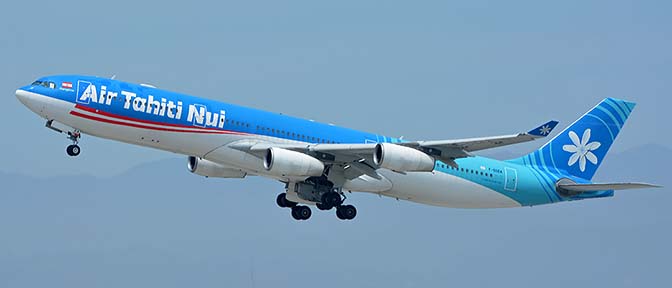 The Airbus A340 is a four-engine, wide-body derivative of the A300. The A340-300 made its maiden flight on October 21, 1991. The A340-300 is 209 feet long and has a wing span of 198 feet. The A340-200 made its maiden flight on August 13, 1997. It has the same wing span as the A340-300 and is 195 feet long. The A340-600 made its maiden flight on April 23, 2001. The A340-600 is 247 feet long and has a wing span of 208 feet. The A340-500 made its maiden flight on February 11, 2002. It has the same wing span as the A340-600 and is 223 feet long.
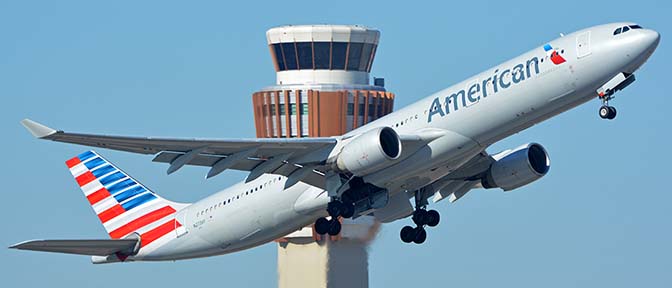 The Airbus A330 is a twin-engine, wide-body derivative of the A300. The A330-300 made its maiden flight on November 2, 1992. The A330-300 is 208 feet 10 inches long and has a wing span of 197 feet 10 inches. The A330-200 made its maiden flight on August 13, 1997. It has the same wing span as the A330-300 and is 193 feet long. It also has a taller vertical stabilizer.
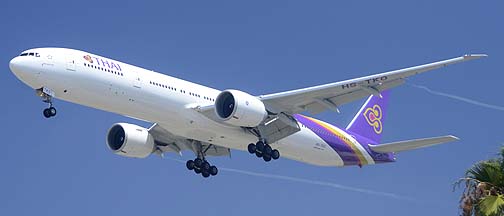 The Boeing 777 is a twin-engine, wide-body airliner. The Boeing 777-200 prototype made its maiden flight on June 12, 1994. The Boeing 777-300 made its maiden flight on October 16, 1997. The Boeing 777-200 is 199 feet 11 inches long and has a wing span of 209 feet 1 inch. The Boeing 777-300 is 242 feet 4 inch long and has a wing span of 209 feet 1 inch. The 777-300 Extended Range and 777-200 Long Range have a wing span of 212 feet 7 inches.. The Boeing 777-300ER made its maiden flight on February 24, 2003.
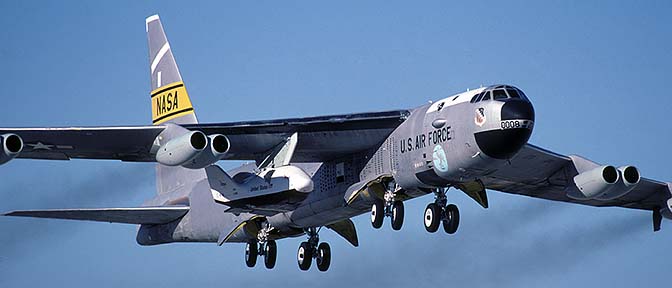 The X-38 was a lifting body test vehicle for the International Space Station Crew Return Vehicle (CRV).
The CRV was intended to be used to provide a means of returning from the space station to Earth without the need for a Space Shuttle launch.
The X-38 was a lifting body test vehicle for the International Space Station Crew Return Vehicle (CRV).
The CRV was intended to be used to provide a means of returning from the space station to Earth without the need for a Space Shuttle launch.
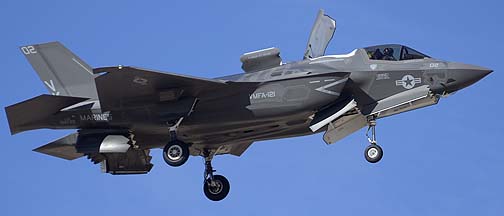 The Lockheed-Martin X-35 Joint Strike Fighter demonstrator took off on its first flight from Air Force Plant 42 at Palmdale, California on the morning of October 24, 2000. It returned to Palmdale on November 22. It was then equipped with a lift fan and vectored thrust nozzle for short take-off/vertical landing tests as the X-35B. The Lockheed-Martin X-35B vertical take-off prototype flew from Palmdale to Edwards AFB on July 3, 2001. The first Lockheed-Martin F-35A Lightning II, AA-1 completed air-start and noise tests at Edwards Air Force Base on Thursday October 23. It returned to Fort Worth on October 24.
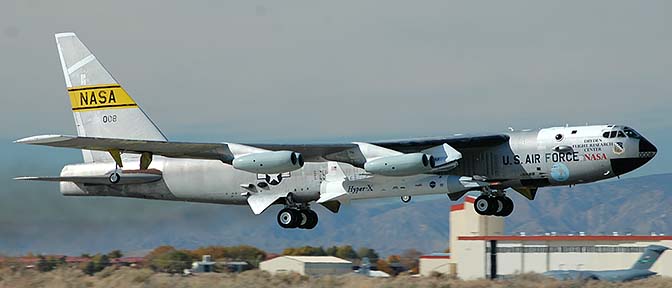 The X-43A Hyper-X
supersonic combustion ramjet testbed was launched three times. It successfully demonstrated Scramjet operation at Mach 7 and Mach 9.6
The X-43A Hyper-X
supersonic combustion ramjet testbed was launched three times. It successfully demonstrated Scramjet operation at Mach 7 and Mach 9.6
The Boeing T-43A Radar Test Bed (RTB) was sighted over Death Valley in January 2003.
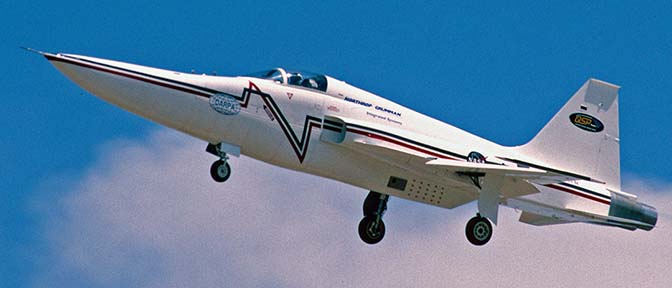 The F-5 Shaped Sonic Boom
Demonstrator (SSBD) has been conducting tests aimed at reducing
the impact of sonic booms. It made a series of flights from Air
Force Plant 42 at Palmdale, California during the week of August
25 - 29, 2003.
The F-5 Shaped Sonic Boom
Demonstrator (SSBD) has been conducting tests aimed at reducing
the impact of sonic booms. It made a series of flights from Air
Force Plant 42 at Palmdale, California during the week of August
25 - 29, 2003.
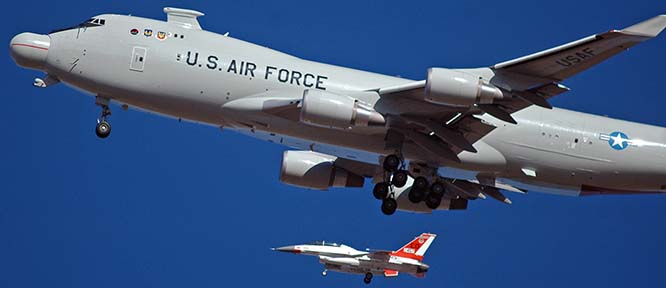 The Boeing YAL-1A Airborne Laser testbed was recently retired to AMARG following the cancellation of the program. During the early phases of the program, it flew out of Edwards Air Force Base as Boeing Company Flight BOE1.
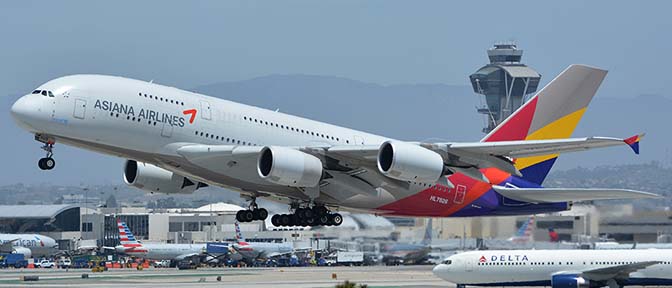 Airbus A380.
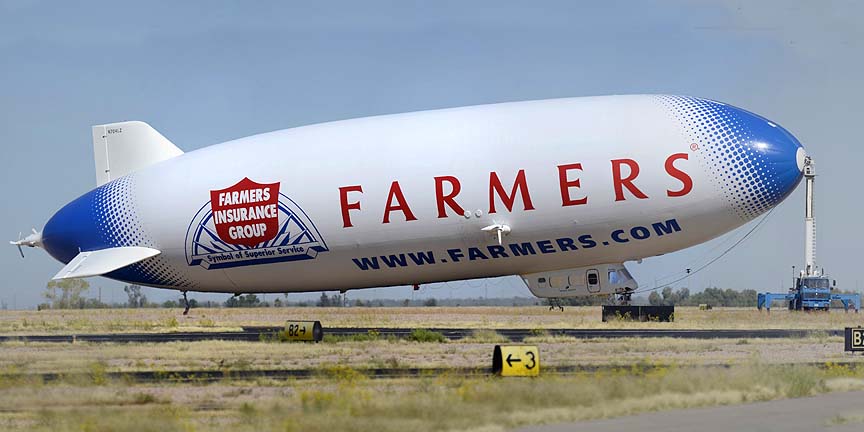 The Airship Ventures Zeppelin N704LZ Eureka travels around the country offering rides to the public.
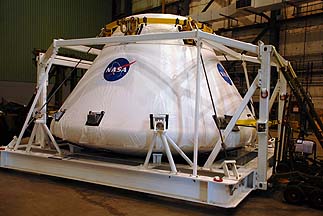 Boilerplate Orion Crew Module PA-1 was loaded aboard an Air Force Boeing C-17A Globemaster III at the NASA Dryden Flight Research Center on August 18, 2009. It will be flown to Holloman Air Force Base and then trucked to the White Sands Missile Range for the first Launch Abort System (LAS) Pad Abort Test.
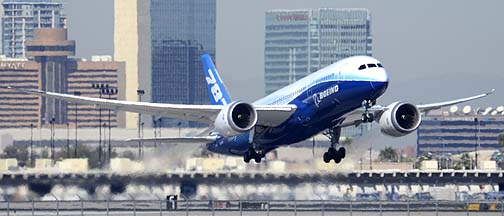 Boeing 787s are still infrequent visitors to the Valley of the Sun.
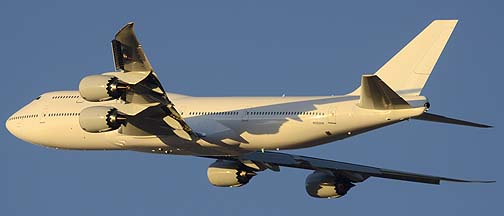 The 747-8 is the largest airplane made in the United States. They occasioannlly visit Phoenix-Mesa Gateway Airport.
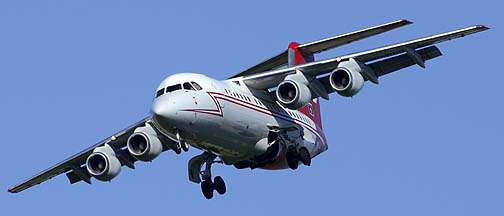 On Friday, June 15, BAE-146-200A N146FF Tanker 40 arrived at the Phoenix-Mesa Gateway Airport from Albequerque. It dropped a load of fire retardant on the Poco Fire near Payson on its way. It joined Lockheed P2V-5E Neptune N69278 Tanker 05 and 10 Tanker Air Carrier McDonnell-Douglas DC-10-30 N17085 Tanker 911.
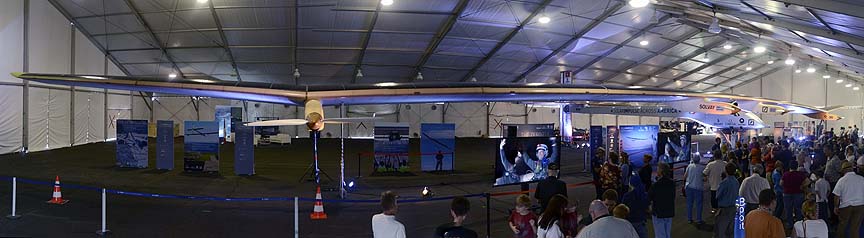 The solar-powered Solar Impulse flew from San Francisco to Phoenix on Friday, May 3, 2013 on the first leg of its flight across the United States. It was placed on public display during its visit to Sky Harbor International Airport. It departed from Phoenix at 4:47 AM on Wednesday, May 22.
Send a message to Brian.
Go to home page of the Goleta Air and
Space Museum.