Flying Aircraft Carriers of the USAF:
|
The great size of the B-36 Peacemaker made it possible for the behemoth to carry, launch, and retrieve other airplanes. The McDonnell XF-85 Goblin program was intended to provide the B-36 Peacemaker with a fighter for self defence which could be carried entirely within the bomb bay of the bomber. The constraints were that the fighter had to be only sixteen feet long, and only five feet wide when stowed. The wings of the Goblin were designed to fold up alongside each side of the fuselage to fit into the Peacemaker. Due to the unavailability of a B-36 for the flight tests, they were conducted using an EB-29B, serial 44-84111, which was named Monstro, after the whale that swallowed Pinochio.
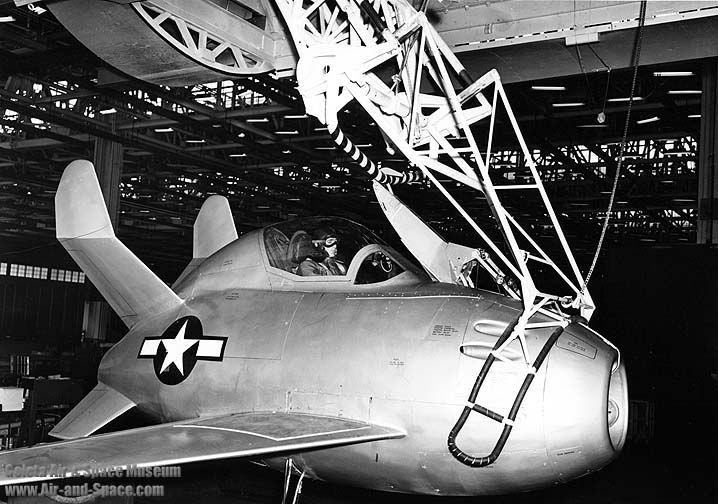 Republic assembled a mockup of the XF-85 Goblin and its trapeze. (McDonnell Corporation negative D4E 5281)
 Goblin 46-0524 was tested in the 40-foot by 80-foot wind tunnel at the Ames Research Center. The Goblin's ventral speed brake is extended below the rear fuselage. (NASA Dryden Fllight Research Center technical library)
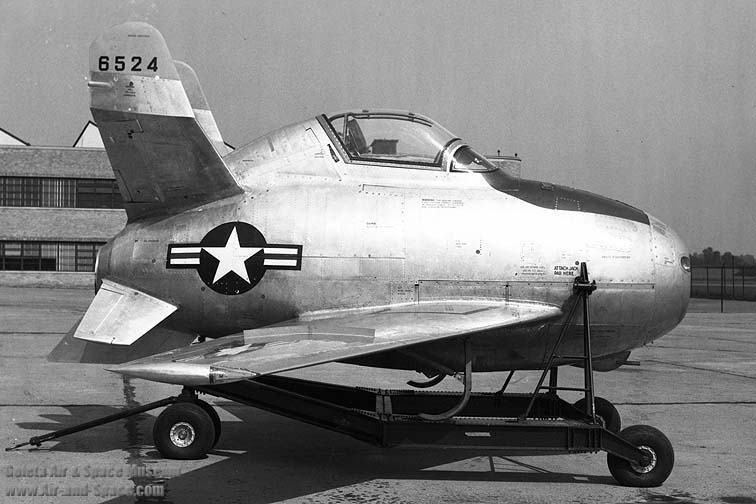 Goblin 46-0524 at the McDonnell plant in St. Louis before delivery to Edwards AFB. It was the first to fly on August 23, 1948. It made six of the seven free flights flown by the Goblins. (McDonnell Corporation negative D4E 10112)
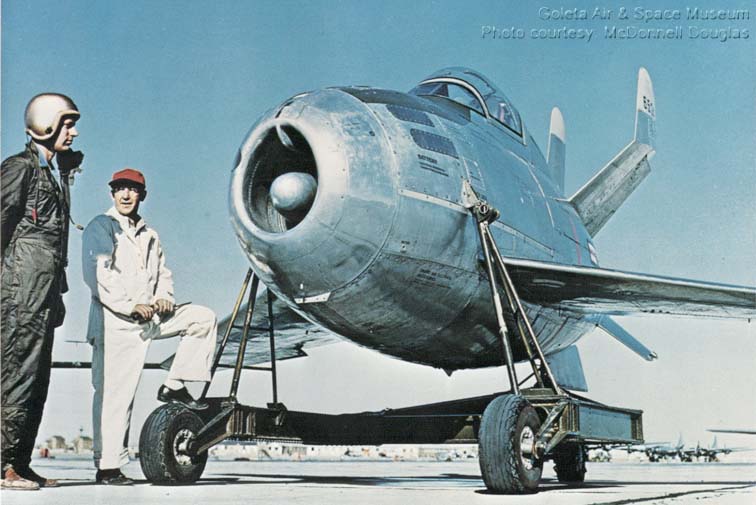 The pilot for all XF-85 Goblin flights was Ed Schoch. (McDonnell Douglas).
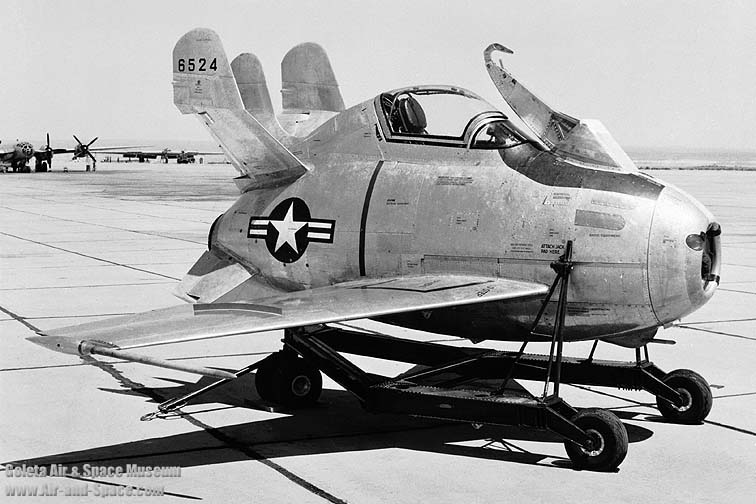 XF-85 46-0524 with its hook extended on the Edwards Air Force Base flight line.(Air Force Flight Test Center History Office).
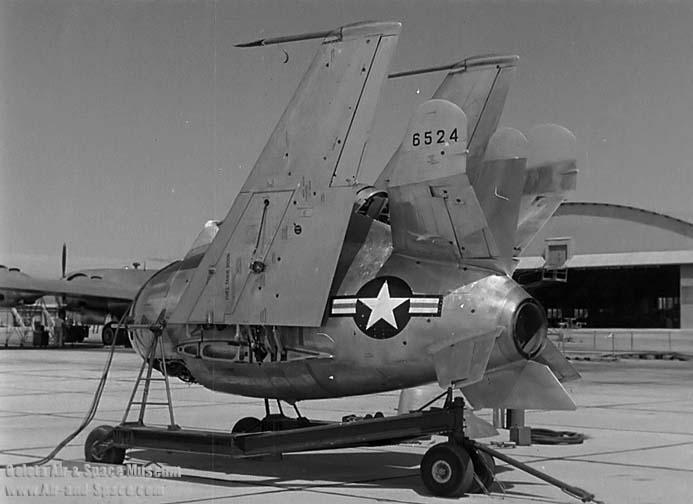 The XF-85 is only five feet wide with its wings folded. (still frame from US Air Force film 17593 XF-85 Initial Flight)
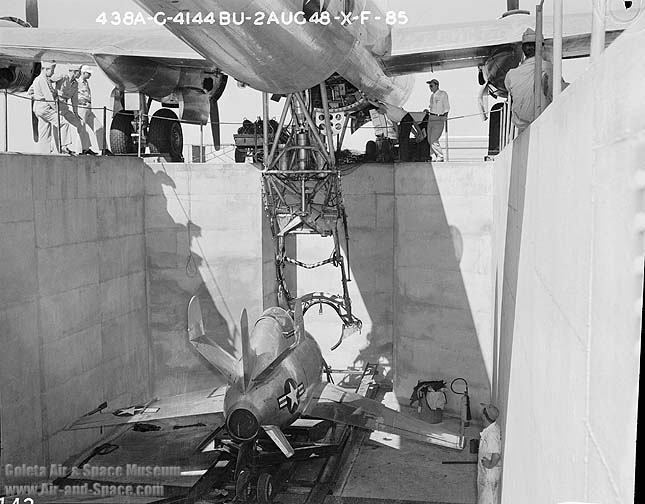 A special pit was dug into the tarmac at South Base for loading the XF-85 into the EB-29B. XF-85 46-0524 is seen in the loading pit on August 2, 1948. The complexity of the folding trapeze is evident. Note the "horse collar" at the end of the trapeze which served to secure the nose of the Goblin after it had engaged the cross bar. (AFFTC/HO)
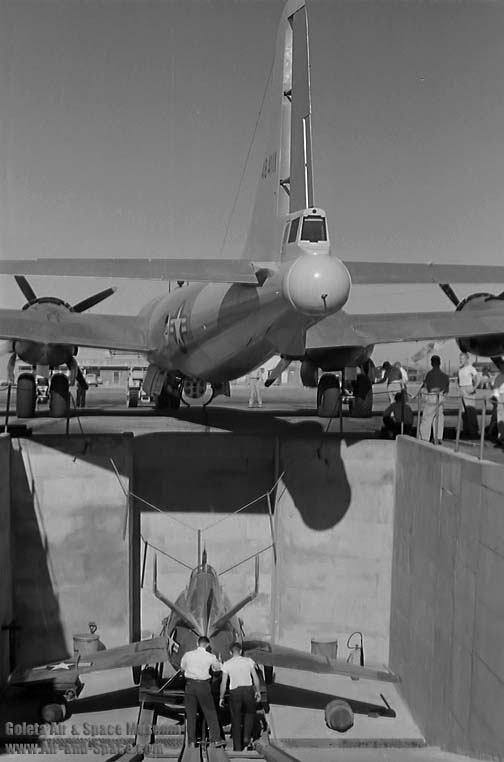 Preparing the Gobiln to be loaded into Monstro. (still frame from XF-85 Initial Flight)
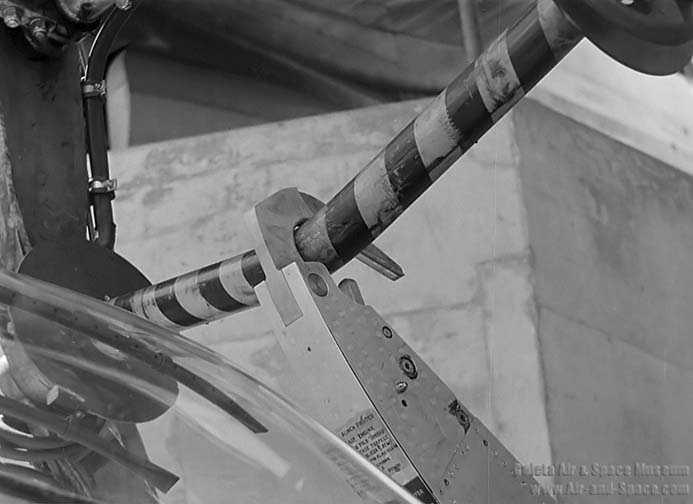 Close up of the XF-85 hook and the trapeze receiving bar. (still frame from XF-85 Initial Flight)
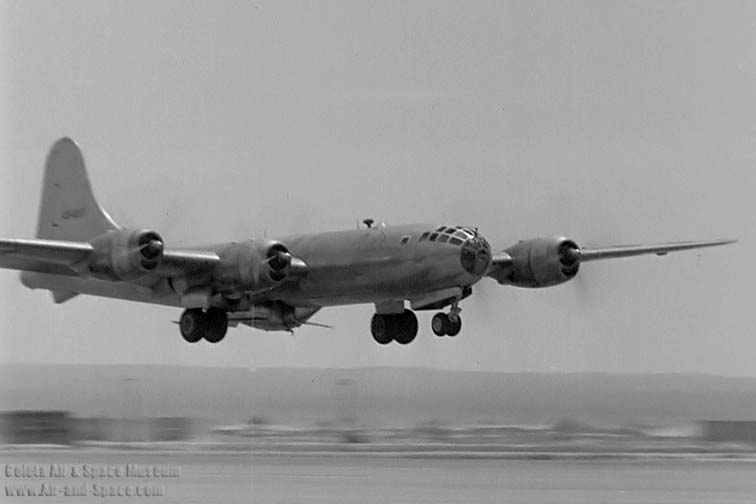 Monstro takes off with the Goblin. (still frame from XF-85 Initial Flight)
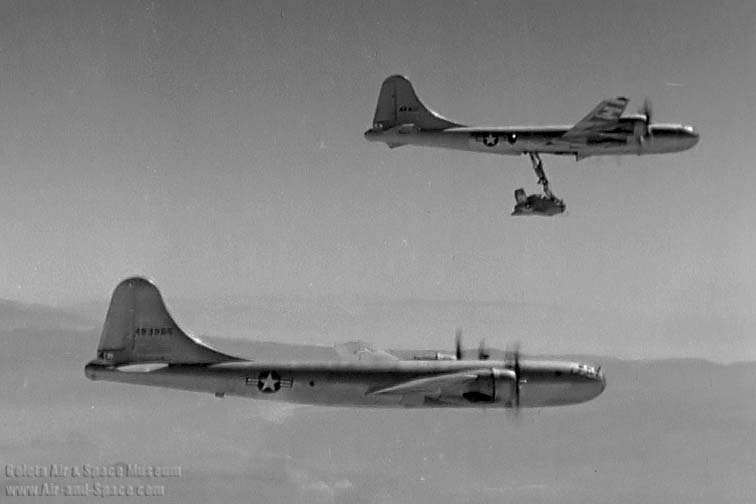 The trapeze is extended but the horse collar is still grasping the nose of the Goblin as a Boeing B-29 Sup0erfortress flies chase. (still frame from XF-85 Initial Flight)
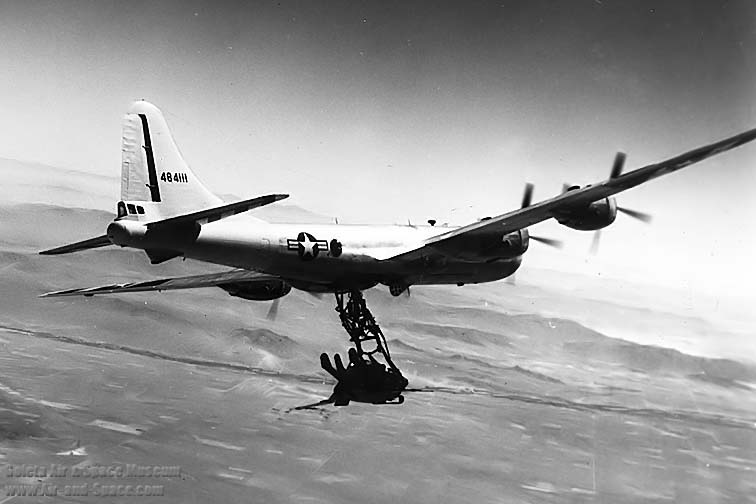 Monstro and the Goblin in flight on August 23, 1948. (McDonnell Corporation negative D4E 10095)
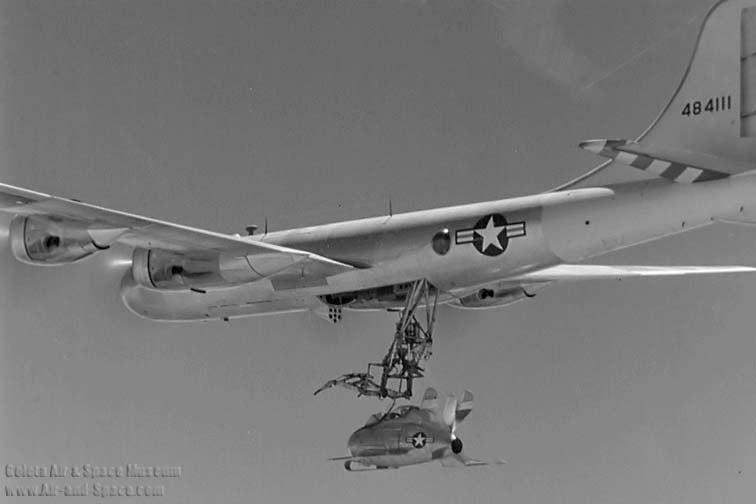 The horse collar is raised beore launching the XF-85. (still frame from XF-85 Initial Flight)
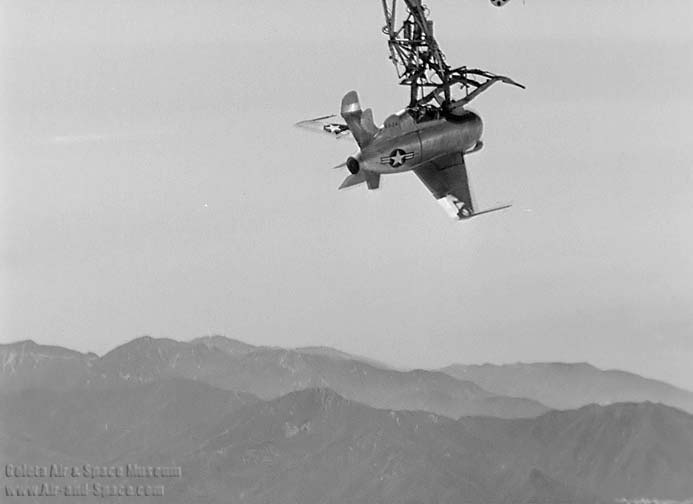 Because of the turbulence encountered as the XF-85 appproached the trapeze, only three of the seven free flights ended in a successful hookup. The other four flights ended in skid landings on Rogers dry lakebed at Edwards AFB. During the first flight on August 23, 1948, Ed Schoch missed the trapeze with the hook and hit it with the cockpit canopy of the Goblin. The trapeze broke the canopy and knocked off his helmet. Schoch was forced to land on the dry lakebed. (still frame from XF-85 Initial Flight)
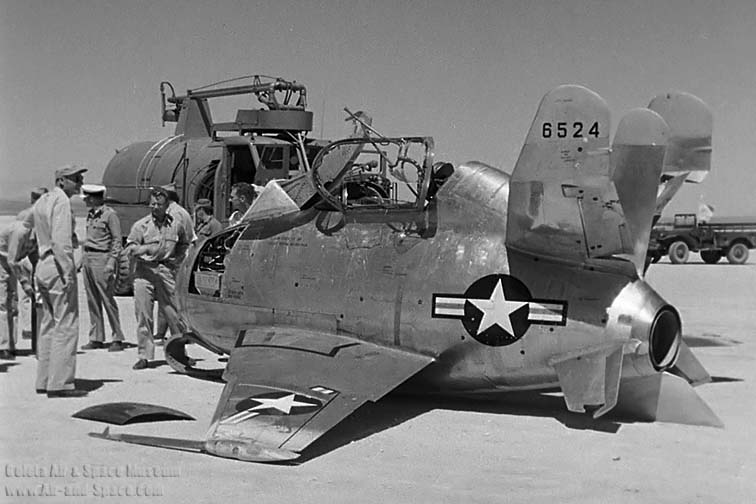 XF-85 46-0524 sits on Rogers Dry Lake after the first flight. (still frame from XF-85 Initial Flight)
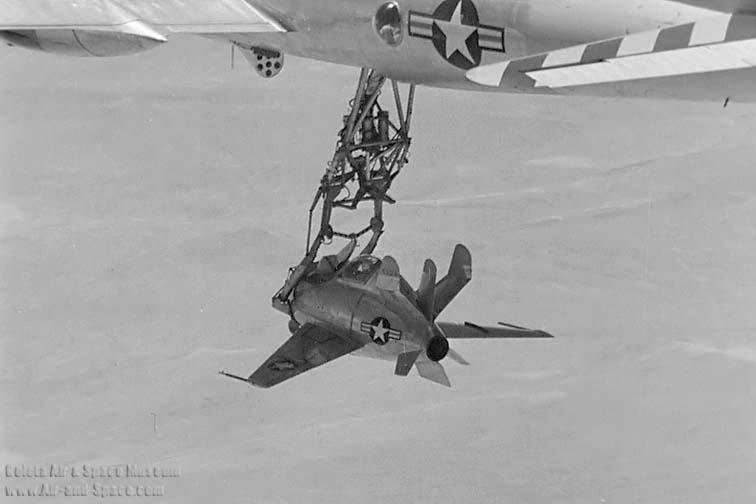 XF-85 on the extended trapeze. (still frame from XF-85 Initial Flight)
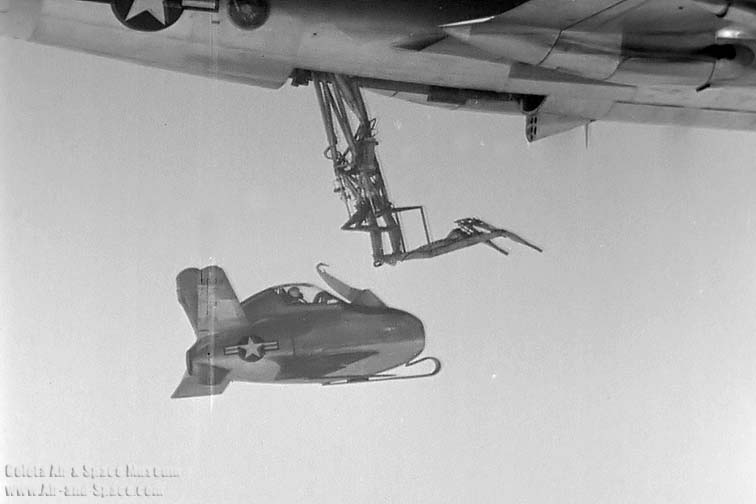 Schoch approaches the trapeze on one of three successful contacts. (still frame from XF-85 Initial Flight)
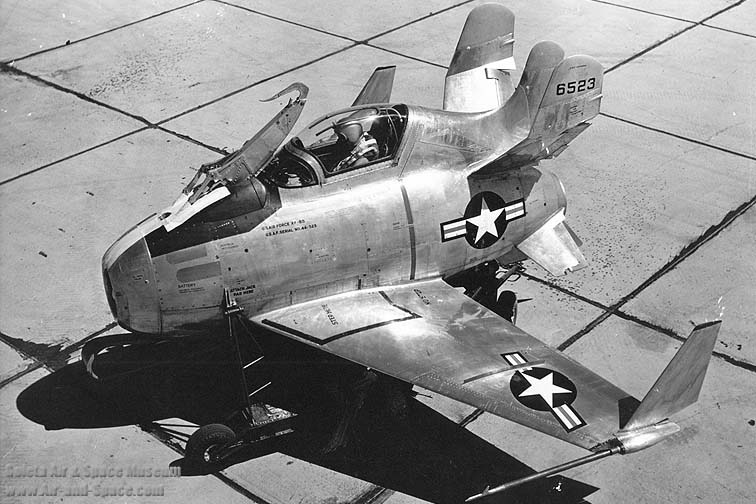 XF-85 46-0523 on the South Base flightline at Edwards AFB. This Goblin was equipped with vertical surfaces at the wingtips to augment the six vertical surfaces clustered around the tail. (McDonnell Corporation negative D4E 13188).
 XF-85 46-0523 posed in front of Monstro on the South Base flightline. The loading pit can be seen behind them. (McDonnell Corporation negative D4E 13137).
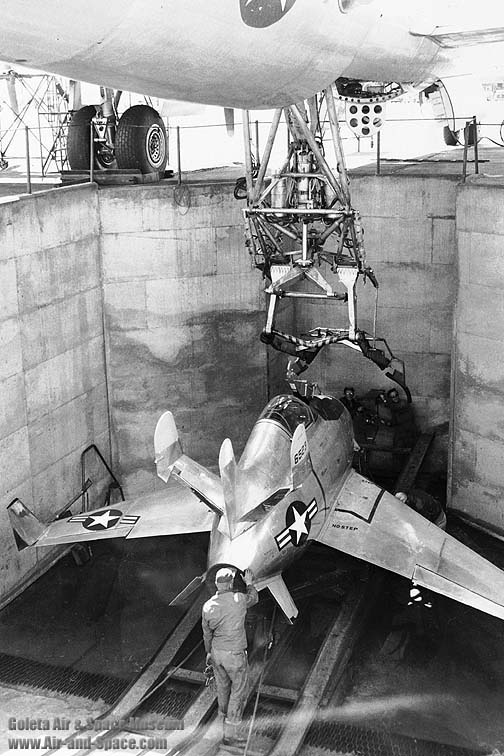 XF-85 46-0523 was the second Goblin to fly. It made its only captive flight on March 19, 1949 and its only free flight on April 8, 1949. (AFFTC/HO).
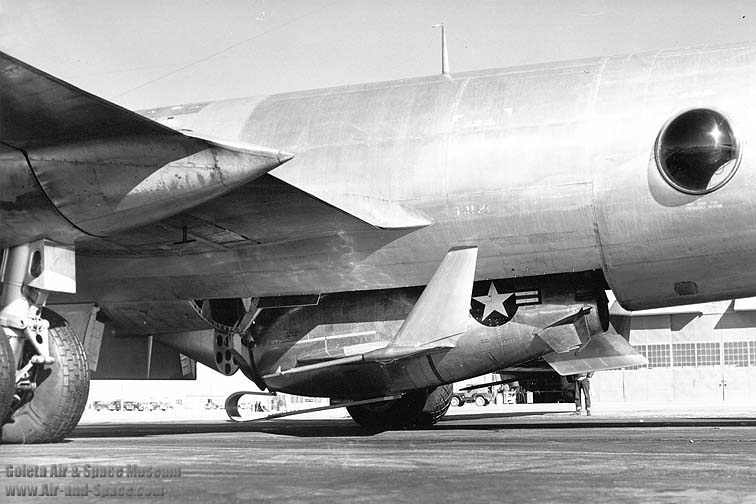 Ground clearance was limited while carrying the XF-85. (McDonnell Corporation negative D4E 13006)
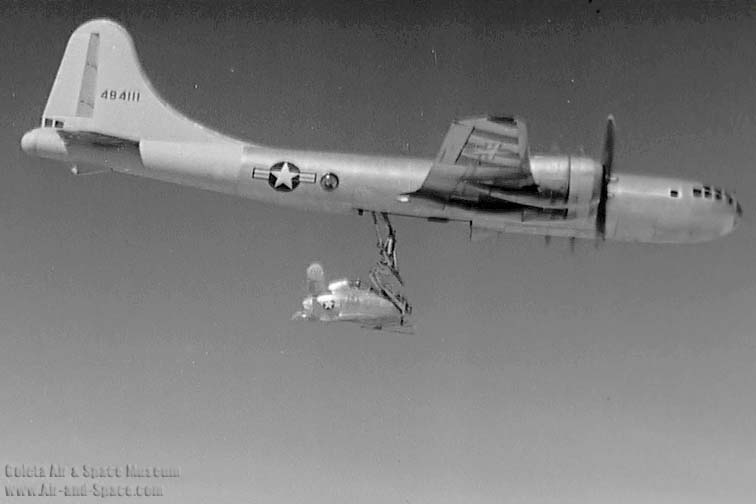 Monstro's outer wing panels and horizontal stabilizers had yellow and black stripes. Its rear fuselage and vertical stabilizer were painted yellow. The control surfaces and leading edges were unpainted.(still frame from XF-85 Initial Flight)
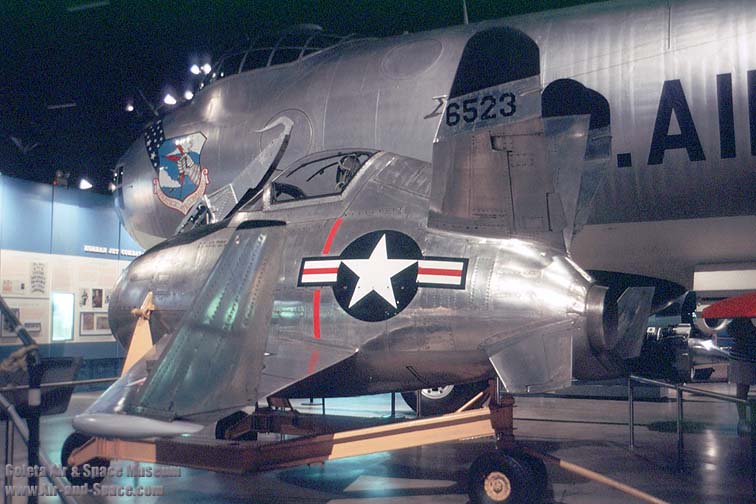 Goblin 46-0523 seen on display next to the B-36J at the Air Force Museum on August 17, 1998. (Brian Lockett).
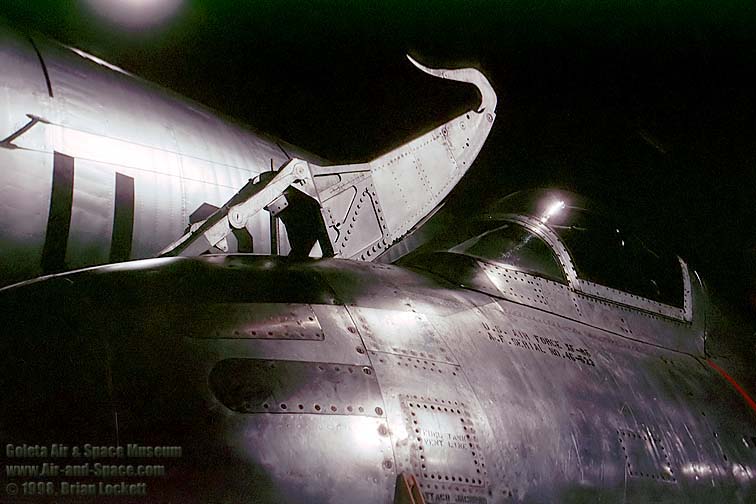 Detail of the retractable hook. The tip of the hook was extended late in the flight program of the Goblin. On one occasion, the tip of the hook was snapped off in an attempt to attach to the EB-29B. Photographed at the Air Force Museum on August 17, 1998. (Brian Lockett).
McDonnell XF-85 GoblinWingspan: 21 feet 1-1/2 inches, folded: 5 feetLength: 16 feet 3 inchesWing Area: 90 square feetMaximum Unhook Weight: 4550 poundsProposed Armament: 4x 50 caliber machine gunsPowerplant: 3,000 pound J34-WE-22 turbojet |
Boeing B-29 SuperfortressWingspan: 141 feetLength: 99 feetWing Area: 1740 square feetMaximum Take-Off Weight: 140,000 poundsMaximum Bomb Payload 20,000Powerplant: 4x 2,200 hp Wright R-3350 two bank radial engines |
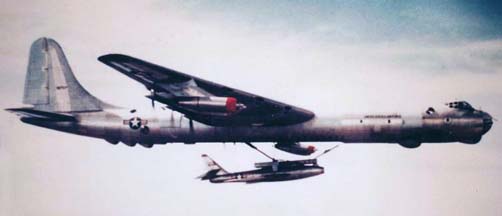 Flying Aircraft Carriers of the USAF
eBook editions of Flying Aircraft Carriers of the USAF |
||
|
My books in the Flying Aircraft Carriers of the USAF series are now available as eBooks, at a considerably reduced price compared to the print editions. Following World War II, the US Air Force was faced with the need to extend the range of fighter escorts for bomber airplanes. Several programs explored the feasibility of carrying, launching, and retrieving jet fighters from Convair B-36 bombers. In 1948 and 1949, the Air Force tested the McDonnell XF-85 Goblin, which was intended to fit inside the bomb bay of the B-36, in a series of launches from a modified Boeing B-29 Superfortress. From 1949 to 1956, the Air Force explored wing tip coupling, attaching smaller airplanes to the wing tips of larger airplanes, first with a Culver PQ-14 coupled to a Douglas C-47 Skytrain, then with a pair of Republic F-84E Thunderjets coupled to a Boeing B-29 Superfortress, and concluding with tests of Republic RF-84F Thunderflashes coupled to the wing tip of a Convair B-36. From 1952 to 1956, Project FICON (Fighter Conveyer) evaluated carrying Republic F-84s partially enclosed in the bomb bay of a B-36, concluding with the establishment of squadrons of modified Republic RF-84F Thunderflashes and Convair B-36s in Washington State. Each volume is profusely illustrated with vintage photographs and diagrams. They can be dowloaded directly from Lulu.com. |
||
|
|
|
|
|
Flying Aircraft Carriers of the USAF: McDonnell XF-85 Goblin
|
Flying Aircraft Carriers of the USAF: Wing Tip Coupling
|
|
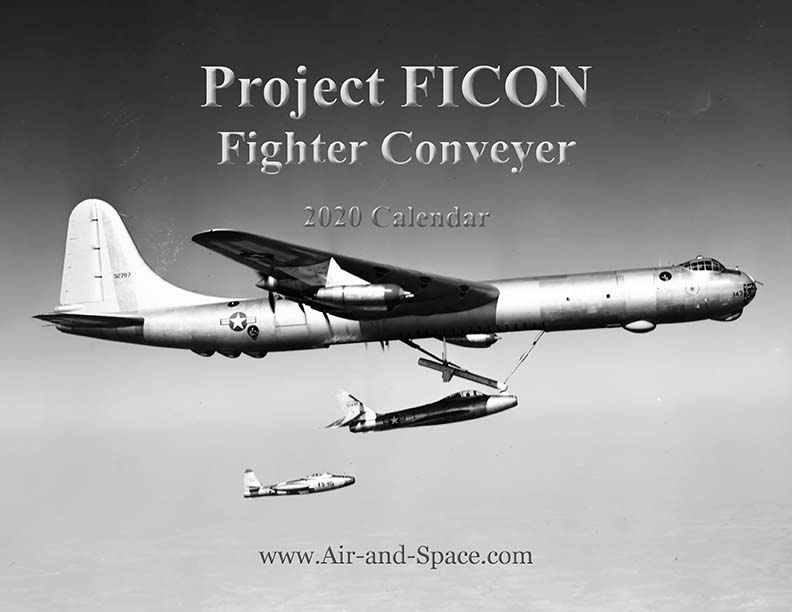
You can buy a 2020 calendar featuring historic Air Force and Convair photographs of Project FICON Convair GRB-36 carrier aircraft and Republic F-84 parasites.
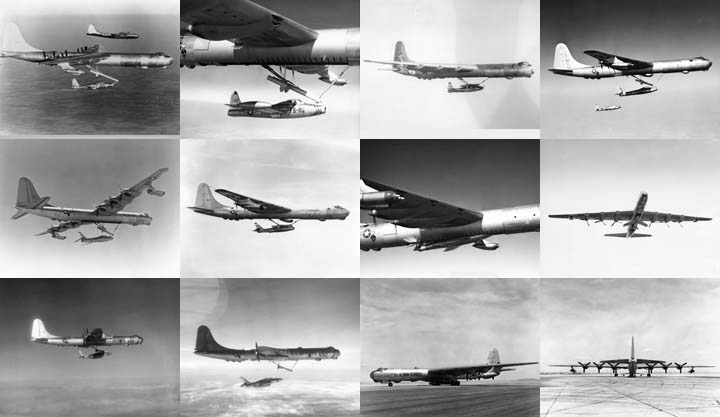
A dozen Air Force and Convair photographs of Project FICON Convair GRB-36 carrier aircraft and Republic F-84 parasites from 1952 to 1956:
Convair GRB-36F 49-2707 and Republic F-84E Thunderjet 49-2115 at Forth Worth, Texas and Eglin Air Force Base, Florida
Convair GRB-36F 49-2707 and Republic YRF-84F Thunderstreak 49-2430 at Fort Worth, Texas and Dayton, Ohio
Convair GRB-36D 49-2962 and Republic RBF-84F Thunderflash 52-7266 over Washington State
Convair GRB-36D 49-2694 and Republic RF-84K Thunderflash 52-7258 at Edwards Air Force Base, California
 Put a copy of the Project FICON - Fighter Conveyer: 2020 calendar in your Lulu.com shopping cart for $14.95.
You can buy a 2020 calendar featuring photographs of Air Force projects investigating the coupling of smaller airplanes to larger airplanes' wing tips.
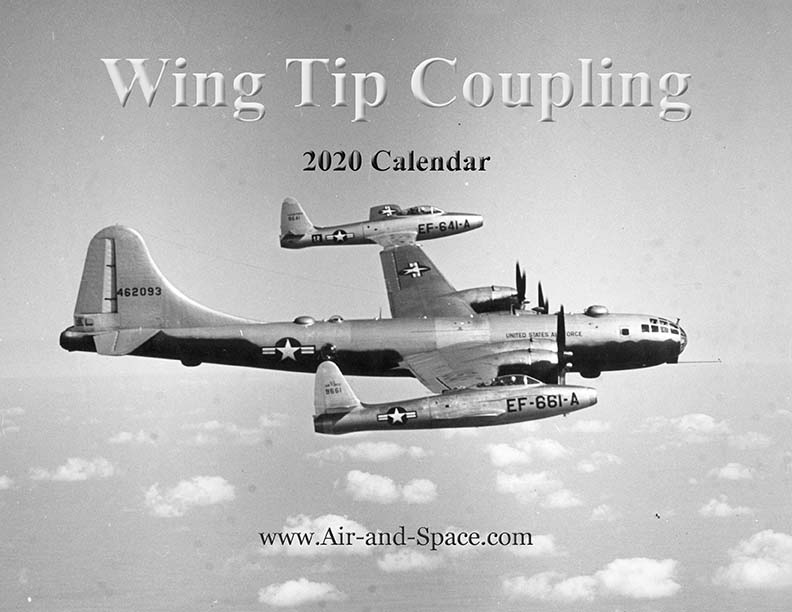
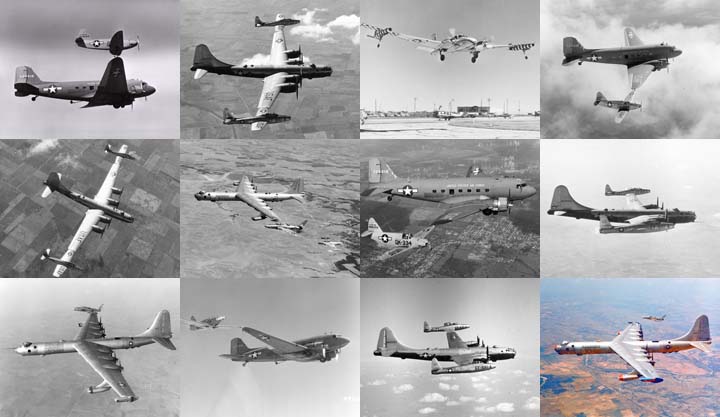
In the early years of the cold war, the US Air Force attempted to increase the range of airplanes by carrying fuel in hinged wing panels that supported themselves attached to their wing tips. The initial tests used a piloted light plane to simulate the hinged panels. Soon the scope of the experiments expanded to include towing a pair of jet fighters on the wing tips of a giant bomber. Photo sources: Bud Anderson, Air Force, General Dynamics, Lockheed-Martin:
Douglas C-47A 42-23918 and Culver Q-14B 44-68334
Project Tip-Tow: Boeing EB-29A 44-62093 and Republic EF-84D Thunderjets 48-0641 and 48-0661
Project Long Tom: Beechcraft XL-23C
Project Tom-Tom: Convair JRB-36F 49-2707 and Republic RF-84F Thunderflashes 51-1848 and 51-1849
Put a copy of the Wing Tip Coupling: 2020 calendar in your Lulu.com shopping cart for $14.95.
Books about the Convair B-36 from Amazon.com |
||||||
Visit the Lockett Books Amazon Webstore for a selection of aviation and space related books and DVDs. |
||||||
Go to the home page of the Goleta Air and Space Museum.
Send a message to Brian.