Flying Aircraft Carriers of the USAF:
|

Project Tom-Tom flight tests began in 1955. They were intended to evaluate the difficulty of approaching the wing tip of the JRB-36F. RF-84F 51-1848 was fitted with a jaw capture mechanism on its right wing tip. The JRB-36F was equppped with a retractable scissors unit on its left wign tip. These light weight mechanisms were not intended to support the load of towing the Thunderflash.
Convair test pilots in the project included "Doc" Witchell, Raymond Fitzgerald, and Beryl Ericson.
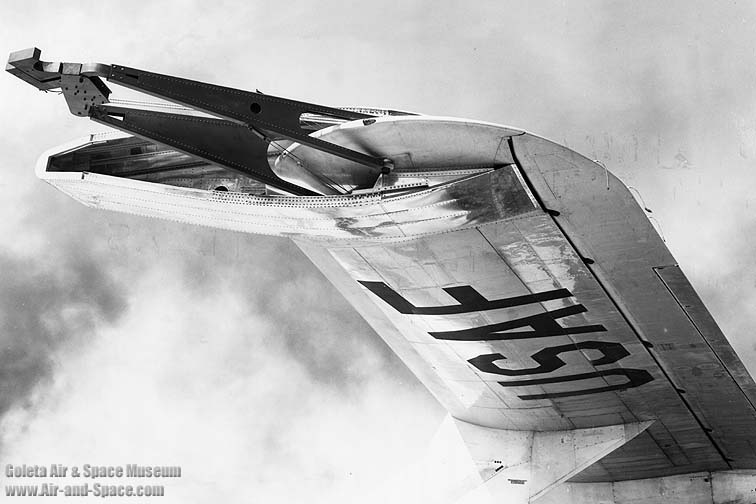 Close-up of the left wing tip coupling on the JRB-36F. (Lockheed Martin Tactical Aircraft Systems negative 26-1807)
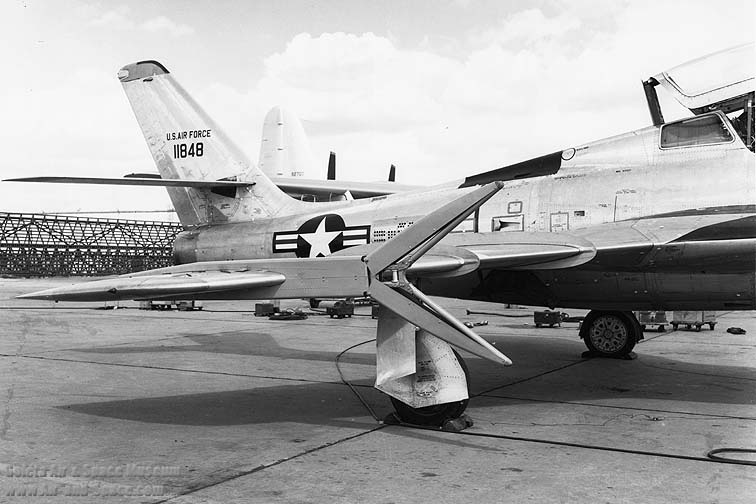 Jaw capture mechanism on the right wing of RF-84F 51-1848. (LMTAS negative 26-1804)
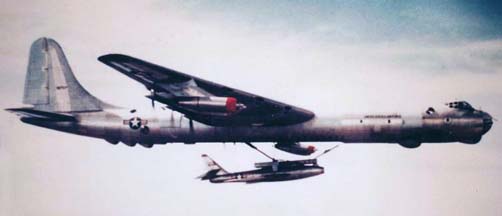
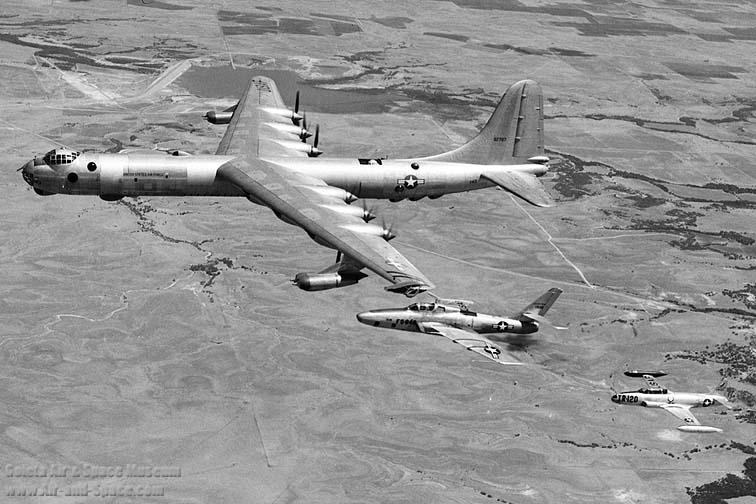 RF-84F 51-1848 approaches the left wing tip of the JRB-36F as a Lockheed T-33A flies chase over the Texas countryside in 1955. (LMTAS negative 26-1817)
Project Tom-Tom flight tests continued in 1956 with more substantial wing tip coupling mechnisms. RF-84F 51-1849 received a jaw capture mechanism on its left wing tip. The JRB-36F received a pair of wing tip coupling mechanisms that incorporated adjustable rear pitch locks. All contacts in this phase of Project Tom-Tom were to the right wing tip of the JRB-36F.
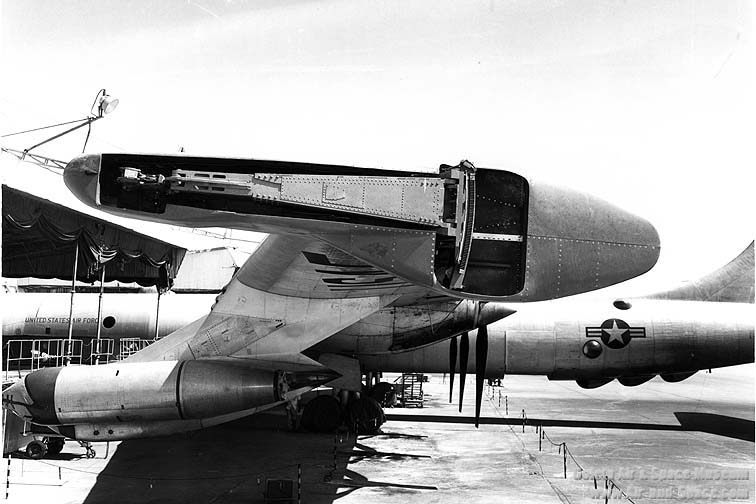 Close-up of the left wing tip coupling on the GRB-36F. (LMTAS negative 26-2294)
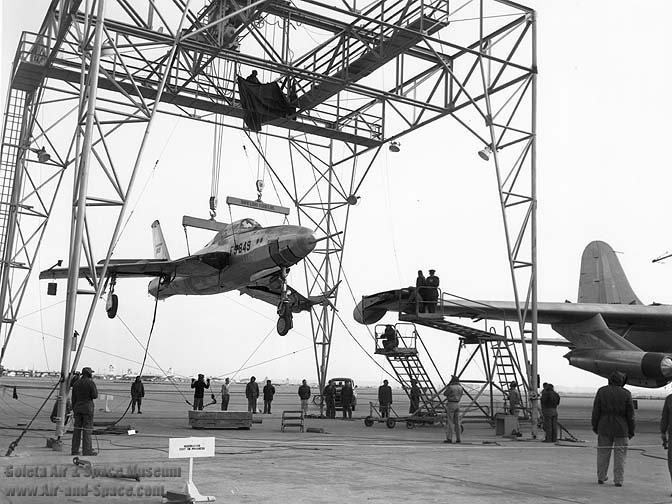 RF-84F 51-1849 suspended from a ground test rig to evaluate the functioning of the capture mechanism. Note the man under the Thunderflash holding the cables that are used to control its yawing. (LMTAS negative 26-2152)
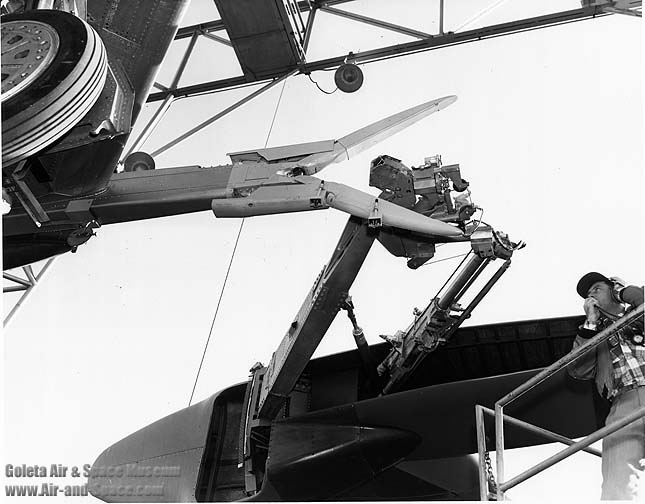 Detail of the capture mechanism on RF-84F 51-1849 about to grab the right wing tip coupling of the GRB-36F during a ground test. (LMTAS negative 26-2160)
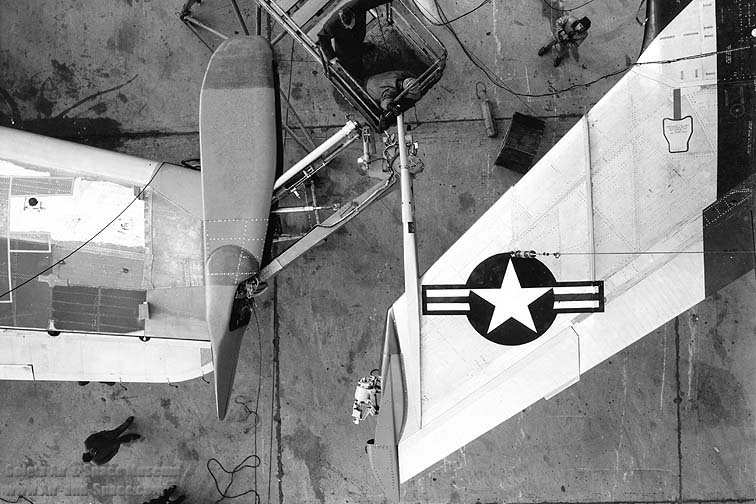 Overhead view of the wing tip coupling mechanism. Project Tom-Tom relied on a "skewed" hinge that was set at an angle. As the Thunderflash rolled around the wing tip, changes in its angle of attack generated restoring forces to keep it flying level with the wing of the JRB-36F. This eliminated the need for an electronic autopilot system. (LMTAS negative 26-2154)
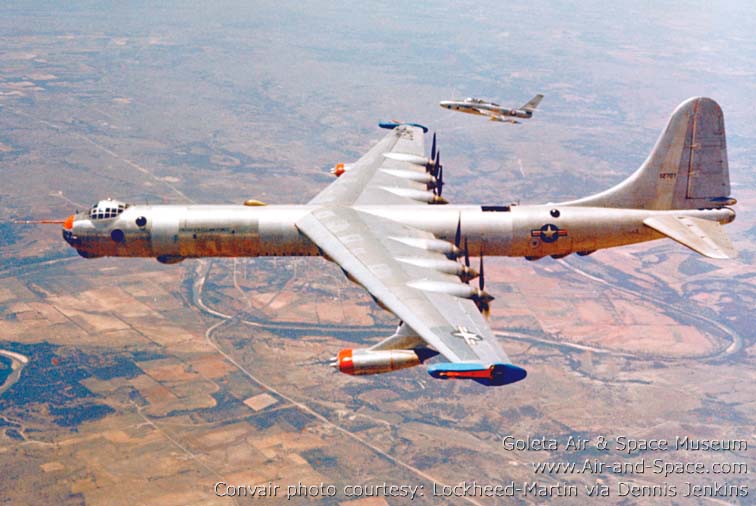 RF-84F 51-1849 approaching the wing tip of the JRB-36F, 49-2707 late in the summer of 1956. (LMTAS negative 90-3082).
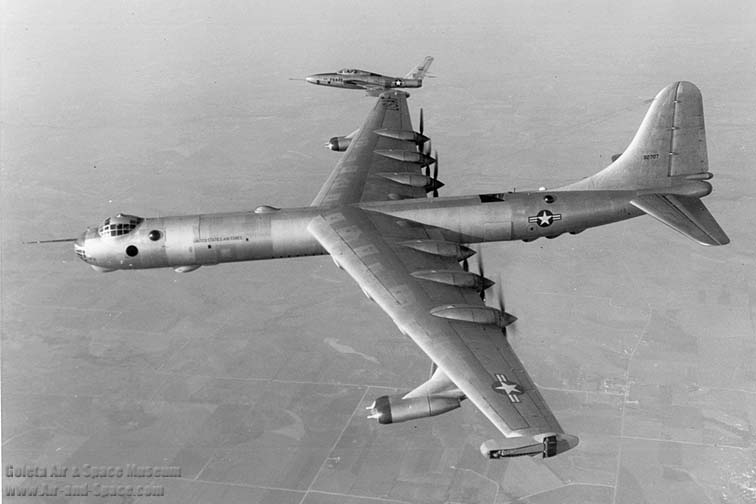 The JRB-36F tows RF-84F 51-1849. (General Dynamics negative 26-2290)
On Septemver 23, 1956, Beryl Ericson made contact with the wing tip of the JRB-36F with a small angle of yaw. Immediately, his Thunderflash started to flap up and down with increasing violence. There were no explosive squibs to break the connection between the airplanes, so the RF-84F escaped from the wing tip when the coupling mechanism failed. Part of the JRB-36F scissors mechanism remained stuck in the jaws on the Thunderflash wing tip. The incident ended Project Tom-Tom flight tests.
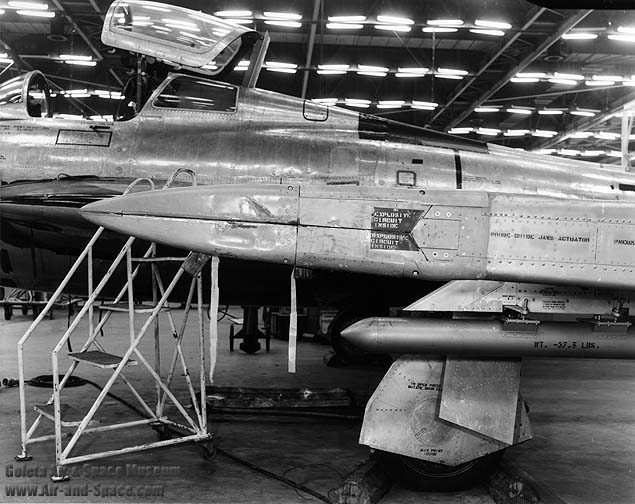 Damage to the Thunderflash was limited to some dents and scraping on the coupling mechanism.(LMTAS negative 26-2295)
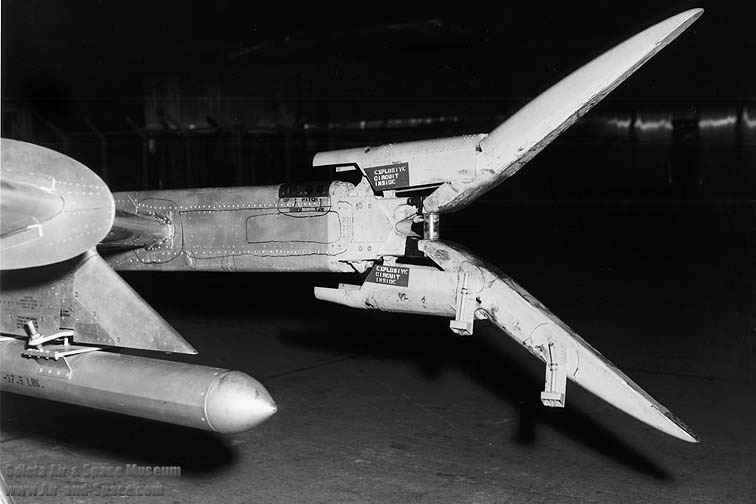 Ver little damage is visible on the inboard side of the jaws.(LMTAS negative 26-2316)
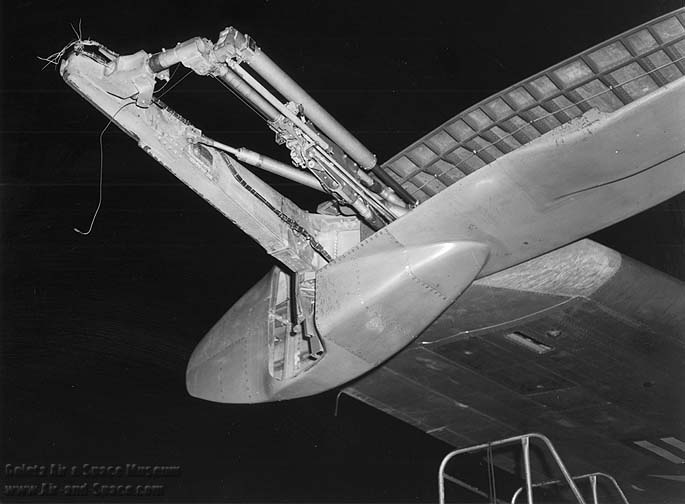 The JRB-36F lost part of its wing tip couplilng mechanism. (LMTAS negative 26-2325)
 Six turning and sixteen burning. Illustration from a NACA Research Memorandum written at the Langley Aeronautical Laboratory entitled, Calculated Lift Distributions of a Consolidated Vultee B-36 and two Boeing B-47 Airplanes Coupled at the Wing Tips. The memorandum is dated November 30, 1950. If the feat had ever been attempted, the wingspan of that monster would have exceeded 460 feet.
 Flying Aircraft Carriers of the USAF
eBook editions of Flying Aircraft Carriers of the USAF |
||
|
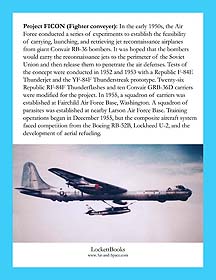
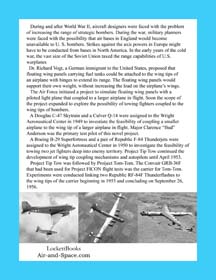
My books in the Flying Aircraft Carriers of the USAF series are now available as eBooks, at a considerably reduced price compared to the print editions. Following World War II, the US Air Force was faced with the need to extend the range of fighter escorts for bomber airplanes. Several programs explored the feasibility of carrying, launching, and retrieving jet fighters from Convair B-36 bombers. In 1948 and 1949, the Air Force tested the McDonnell XF-85 Goblin, which was intended to fit inside the bomb bay of the B-36, in a series of launches from a modified Boeing B-29 Superfortress. From 1949 to 1956, the Air Force explored wing tip coupling, attaching smaller airplanes to the wing tips of larger airplanes, first with a Culver PQ-14 coupled to a Douglas C-47 Skytrain, then with a pair of Republic F-84E Thunderjets coupled to a Boeing B-29 Superfortress, and concluding with tests of Republic RF-84F Thunderflashes coupled to the wing tip of a Convair B-36. From 1952 to 1956, Project FICON (Fighter Conveyer) evaluated carrying Republic F-84s partially enclosed in the bomb bay of a B-36, concluding with the establishment of squadrons of modified Republic RF-84F Thunderflashes and Convair B-36s in Washington State. Each volume is profusely illustrated with vintage photographs and diagrams. They can be dowloaded directly from Lulu.com. |
||
|
|
|
|
|
Flying Aircraft Carriers of the USAF: McDonnell XF-85 Goblin
|
Flying Aircraft Carriers of the USAF: Wing Tip Coupling
|
|
LockettBooks Bookshelf |
|||
BooksMy books are printed on demand by Lulu.com. When you select one, it is placed in your Lulu.com shopping cart. When you place your order, the items are produced, packaged, and shipped directly to you. Books are 8.5" x 11" with perfect binding, white interior paper (60# weight), white exterior paper (100# weight), and full-color exterior ink. |
|||
|
|
|
|
|
|
Flying Aircraft Carriers of the USAF: Project FICON Preview the first several pages of the paperback book. Flying Aircraft Carriers of the USAF: Project FICON |
Flying Aircraft Carriers of the USAF: Wing Tip Coupling |
||
|
|
|
||
|
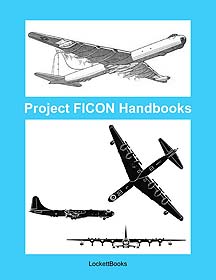
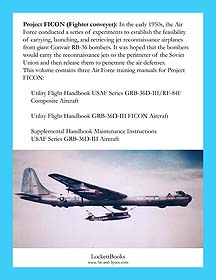
Project FICON Handbooks |
|||
You can buy a 2020 calendar featuring historic Air Force and Convair photographs of Project FICON Convair GRB-36 carrier aircraft and Republic F-84 parasites.
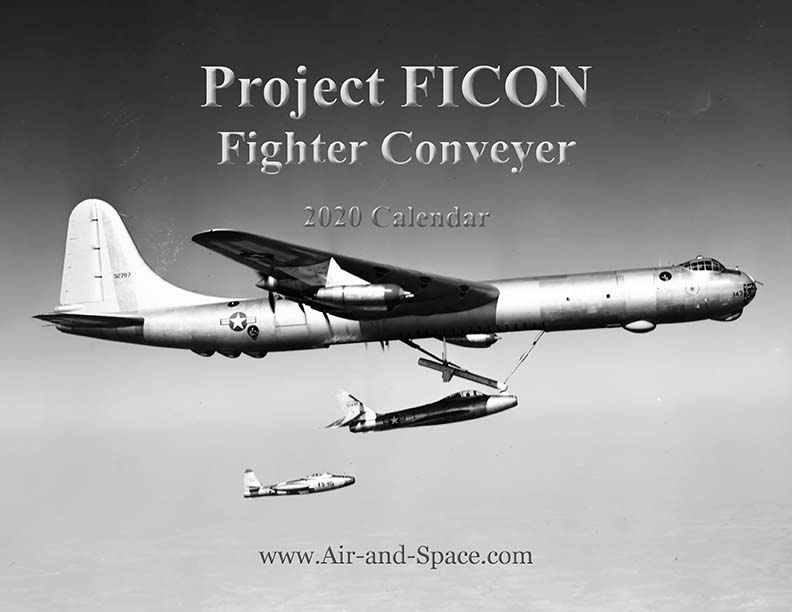
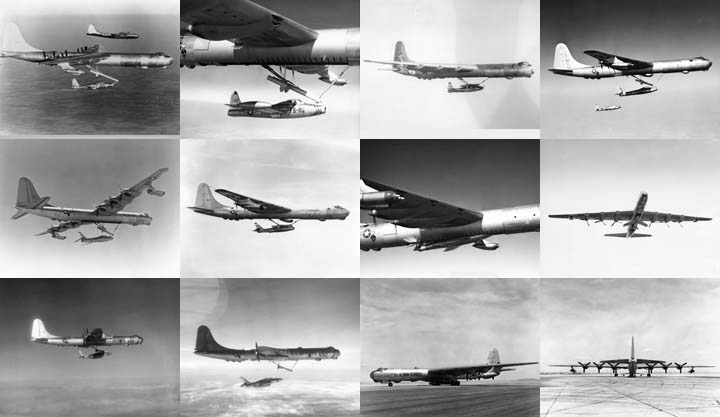
A dozen Air Force and Convair photographs of Project FICON Convair GRB-36 carrier aircraft and Republic F-84 parasites from 1952 to 1956:
Convair GRB-36F 49-2707 and Republic F-84E Thunderjet 49-2115 at Forth Worth, Texas and Eglin Air Force Base, Florida
Convair GRB-36F 49-2707 and Republic YRF-84F Thunderstreak 49-2430 at Fort Worth, Texas and Dayton, Ohio
Convair GRB-36D 49-2962 and Republic RBF-84F Thunderflash 52-7266 over Washington State
Convair GRB-36D 49-2694 and Republic RF-84K Thunderflash 52-7258 at Edwards Air Force Base, California
 Put a copy of the Project FICON - Fighter Conveyer: 2020 calendar in your Lulu.com shopping cart for $14.95.
You can buy a 2020 calendar featuring photographs of Air Force projects investigating the coupling of smaller airplanes to larger airplanes' wing tips.
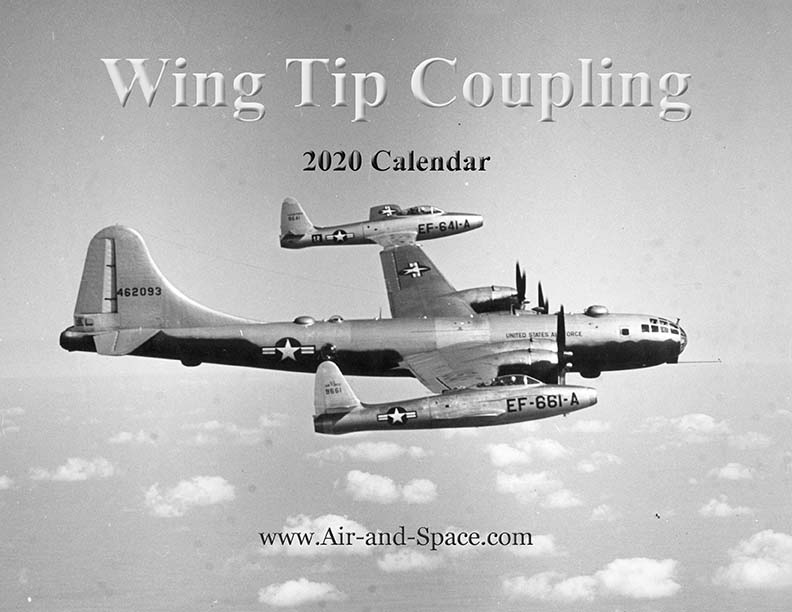
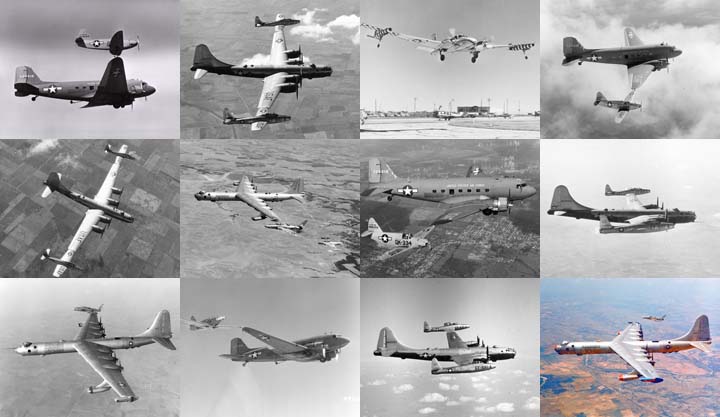
In the early years of the cold war, the US Air Force attempted to increase the range of airplanes by carrying fuel in hinged wing panels that supported themselves attached to their wing tips. The initial tests used a piloted light plane to simulate the hinged panels. Soon the scope of the experiments expanded to include towing a pair of jet fighters on the wing tips of a giant bomber. Photo sources: Bud Anderson, Air Force, General Dynamics, Lockheed-Martin:
Douglas C-47A 42-23918 and Culver Q-14B 44-68334
Project Tip-Tow: Boeing EB-29A 44-62093 and Republic EF-84D Thunderjets 48-0641 and 48-0661
Project Long Tom: Beechcraft XL-23C
Project Tom-Tom: Convair JRB-36F 49-2707 and Republic RF-84F Thunderflashes 51-1848 and 51-1849
Put a copy of the Wing Tip Coupling: 2020 calendar in your Lulu.com shopping cart for $14.95.
Books about the Convair B-36 from Amazon.com |
||||||
Visit the Lockett Books Amazon Webstore for a selection of aviation and space related books and DVDs. |
||||||
Send a message to Brian.