Convair XC-99 and Model 37 |
(Download a higher resolution picture by clicking on any
picture below.) 
The XC-99, serial 43-52436, is a double deck transport variant of the B-36. It has a considerably larger fuselage, but was never fitted with jet pods. The wingspan is the same 230 feet, but the fuselage is 23 feet longer at 185 feet. The payload of the XC-99 was 101,000 pounds or 400 fully equipped troops.
Updated April 6, 2008
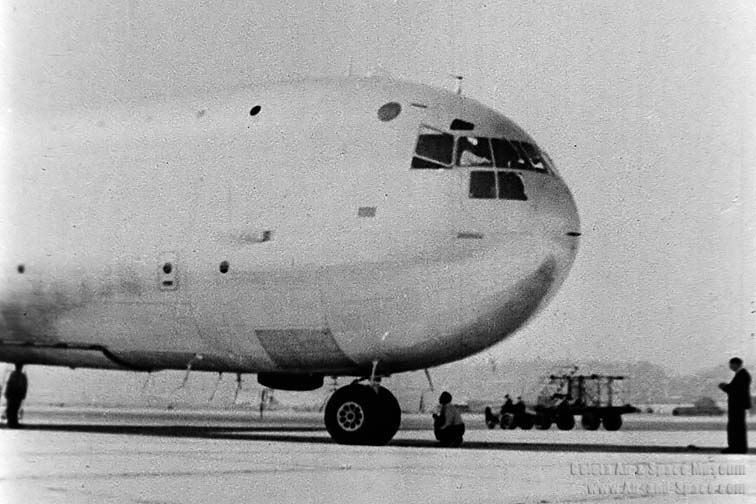
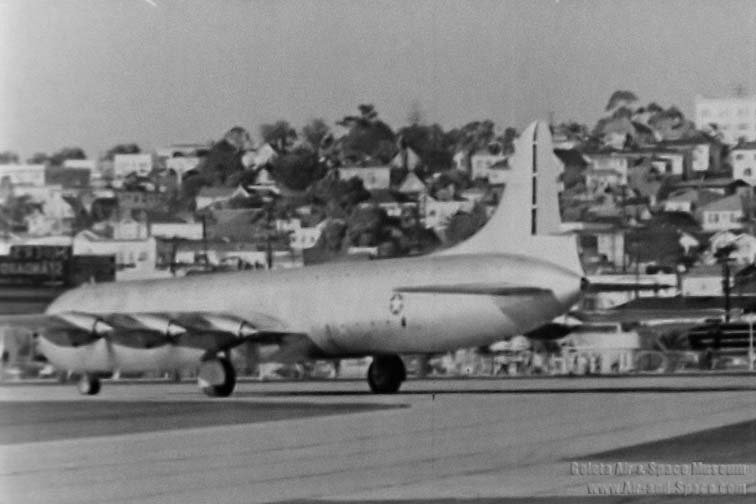
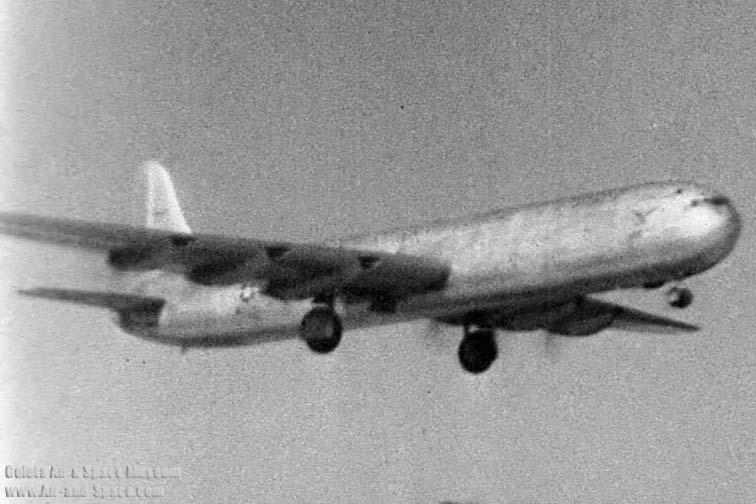
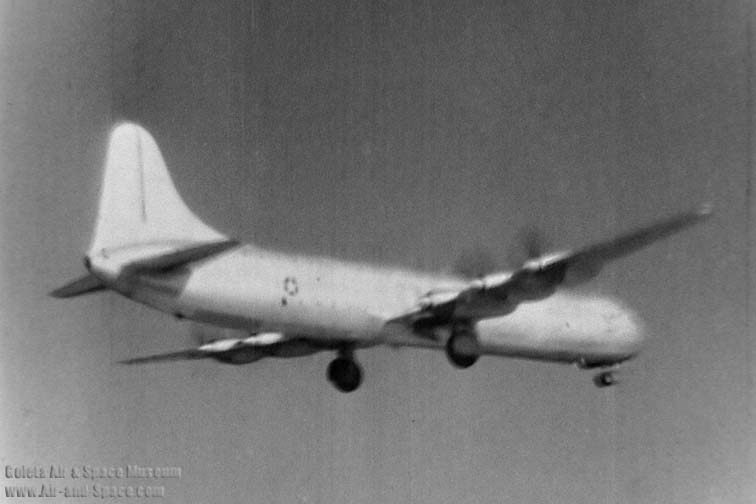
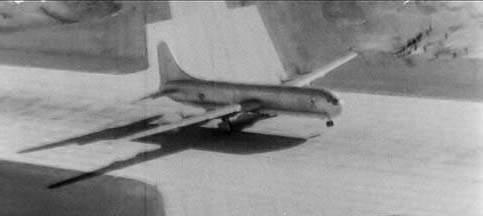
Excerpt from the Air Force Engineering Division film report: Experimental and Research Aircraft featuring the first flight of the Convair XC-99 at San Diego, California on November 23, 1947.
Here's a series of still frames from the video:
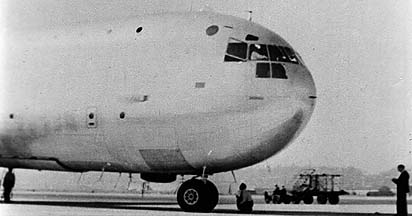
The XC-99 taxis out for its first flight.
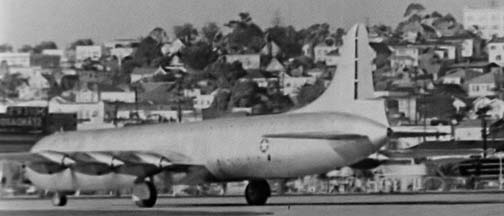
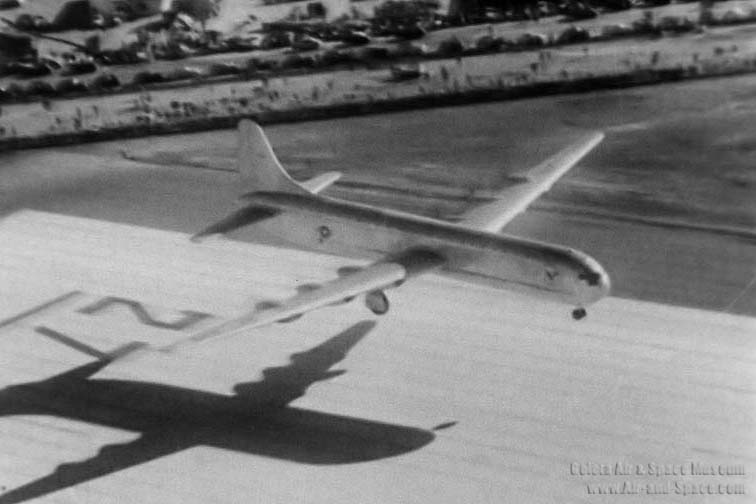
The XC-99 lines up on Runway 27.
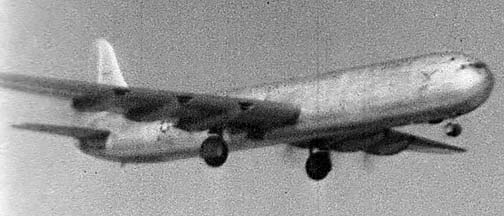
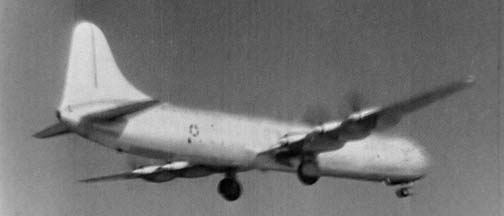
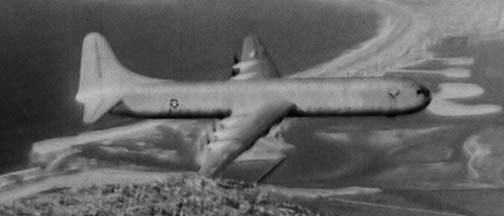
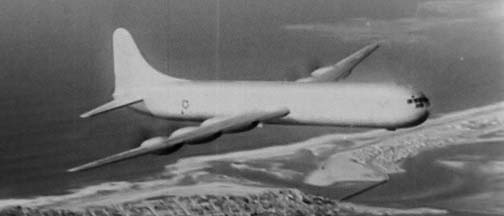
The XC-99 flares out to land on Runway 27.
The XC-99 is being disassembled and shipped to Wright Patterson Air Force Base for restoration. The upper fuselage of the XC-99 has arrived at the Museum of the Air Force. It will all be there soon. No schedule for the re-assembly has been announced.
A friend in Ohio sent this status report about the XC-99 components at the National Museum of the Air Force in October 2006:
Major fuselage sections are now here. Looks like they removed all the flooring and sliced the fuselage both vertically and longitudinally, so each section looks like a short jet blast deflector like they have installed on the parking areas for the B-52s at SAC bases. The insides of the pieces look to me like all plumbing, wiring, control cables and insulation have been removed. I guess the good news here is that every inch of the plane will be protected from corrosion when all is said and done.
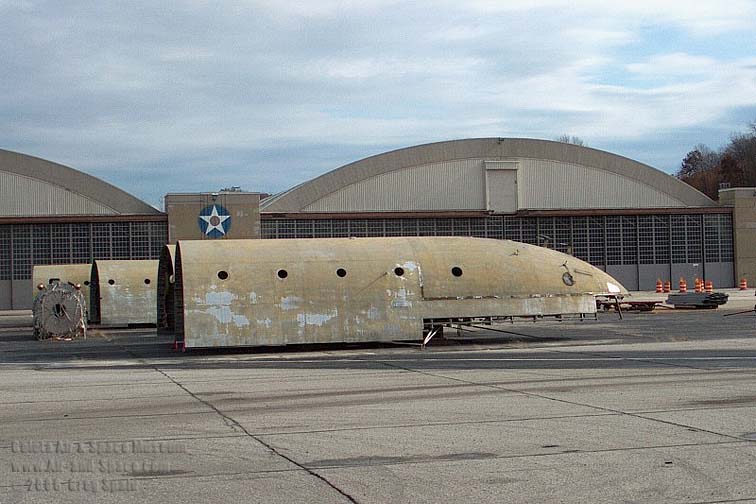 Components of the upper fuselage of the XC-99 are now at the Museum of the Air Force. Photo courtesy: Greg Spahr.
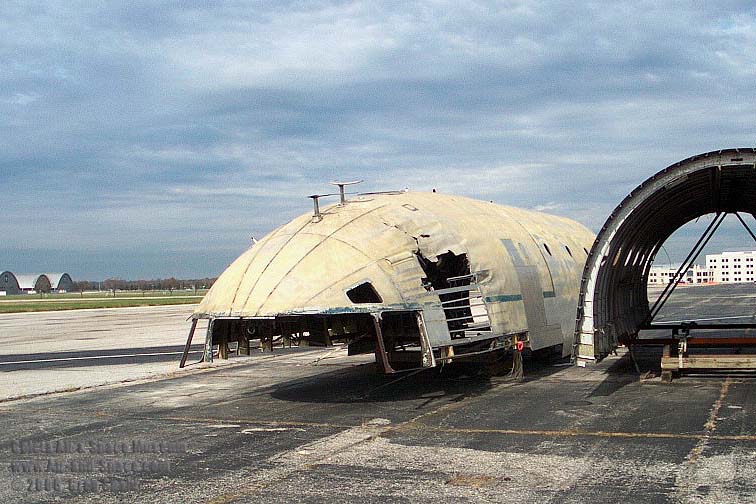 Photo courtesy: Greg Spahr.
 Photo courtesy: Greg Spahr.
 Photo courtesy: Greg Spahr.
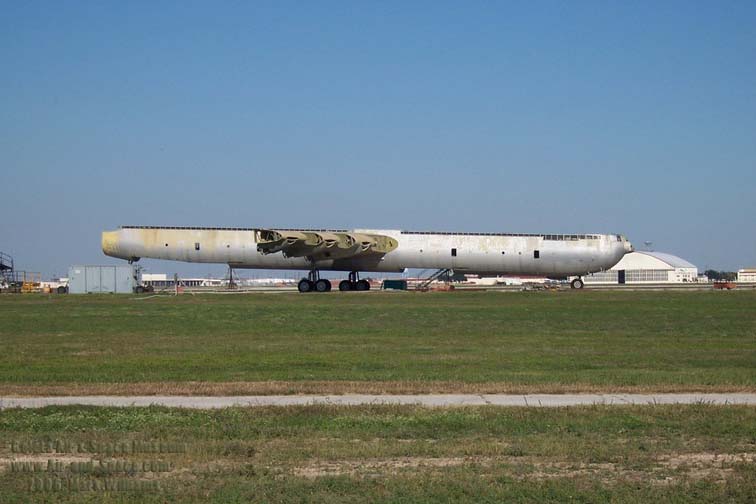 Tsgt. Mark Williams took this picture of the partially disassembled XC-99 at Kelly Air Force Base in November 2006.
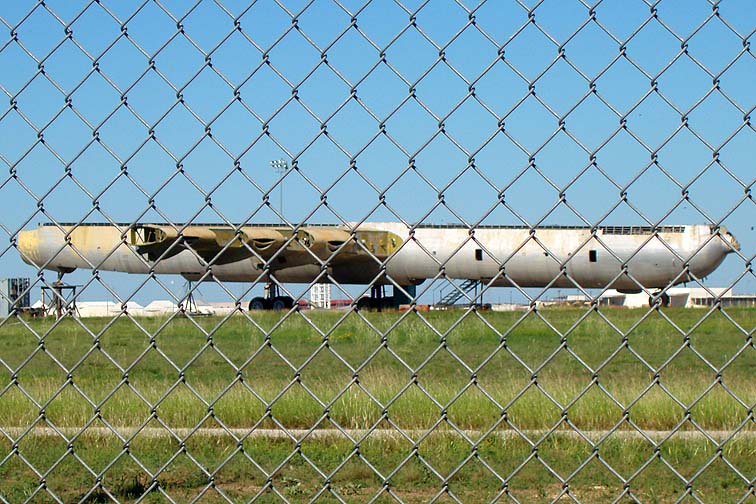 April Hight took this picture of the partially disassembled XC-99 at Kelly Air Force Base in October 2006.
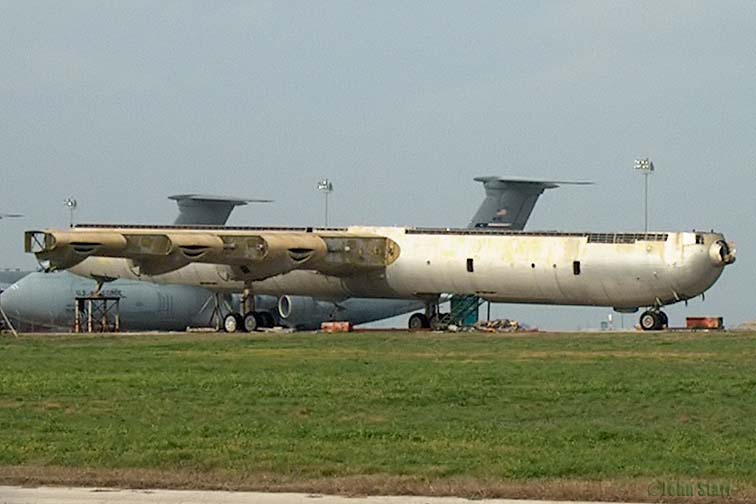 John Starr took this shot of the partially disassembled XC-99 on February 28, 2007.
See the partially disassembled Convair XC-99 on Google Earth.
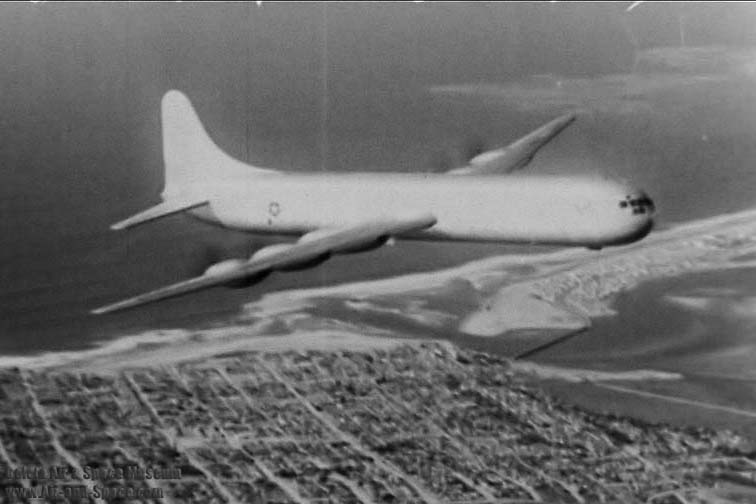
 Consolidated Vultee XC-99 on an
early flight off the coast of Southern California. Consolidated
Vultee company print A1268.
Consolidated Vultee XC-99 on an
early flight off the coast of Southern California. Consolidated
Vultee company print A1268.
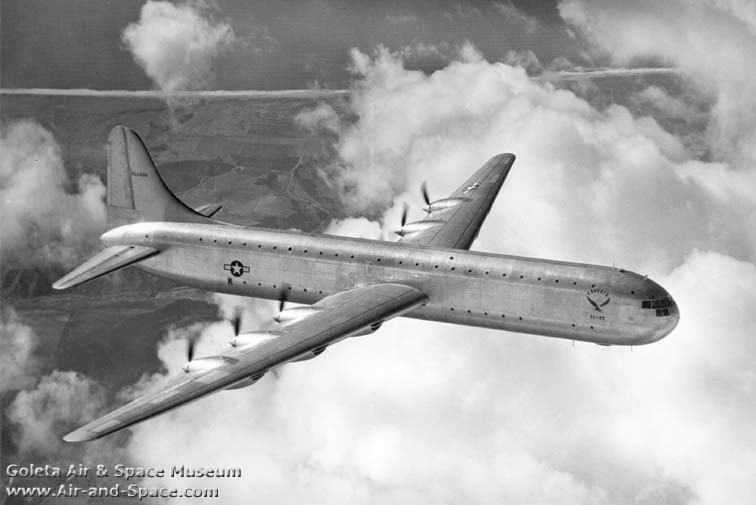 Consolidated Vultee company print A1277.
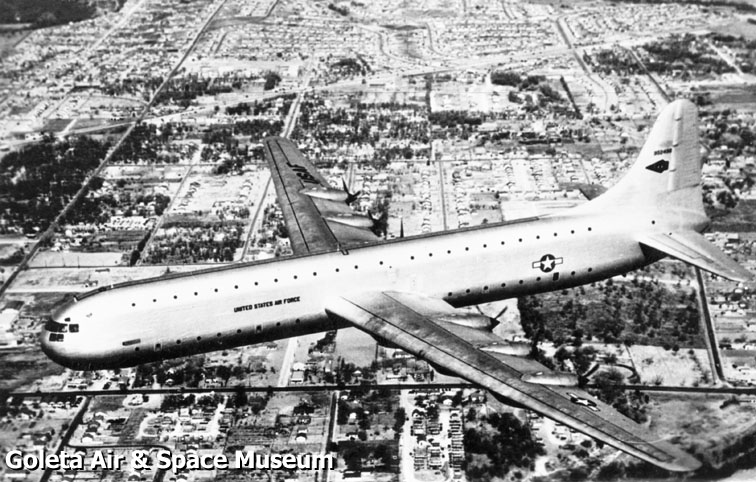 The Wright Field arrow has been
applied to the vertical stabilizer of the XC-99 and United States
Air Force has been painted on the side of the fuselage. The lack
of a bulge over the landing gear well indicates that the XC-99 is
still equipped with the single wheel main landing gear.
The Wright Field arrow has been
applied to the vertical stabilizer of the XC-99 and United States
Air Force has been painted on the side of the fuselage. The lack
of a bulge over the landing gear well indicates that the XC-99 is
still equipped with the single wheel main landing gear.
Convair XC-99 and Model 37Wingspan: 230 feetLength: 185 feetWing Area: 4770 square feetMaximum Take-off Weight: 320,000 poundsMaximum Cargo Payload: 101,000 poundsPowerplant: 6x 3500 hp R4360 radial engines |
 The XC-99 has been retrofitted with
four wheel main landing gear bogies like those used on production
B-36s, but it has not yet had its nose radar installed. Photo
courtesy AFFTC/HO.
The XC-99 has been retrofitted with
four wheel main landing gear bogies like those used on production
B-36s, but it has not yet had its nose radar installed. Photo
courtesy AFFTC/HO.
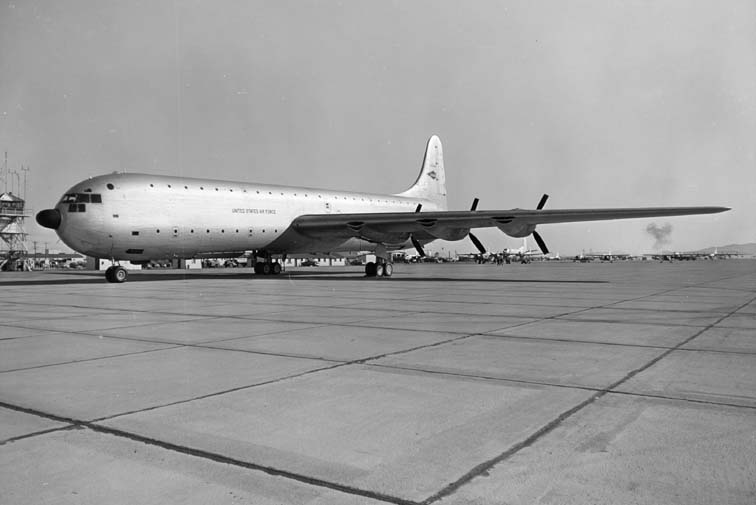 The XC-99 on Edwards AFB ramp. It has acquired a radar
installation under the cockpit since the photo above was taken.
Photo courtesy AFFTC/HO.
The XC-99 on Edwards AFB ramp. It has acquired a radar
installation under the cockpit since the photo above was taken.
Photo courtesy AFFTC/HO.
 People have started gathering around the XC-99
at Edwards Air Force Base, and the photographer has switched to a
longer lens.
People have started gathering around the XC-99
at Edwards Air Force Base, and the photographer has switched to a
longer lens.
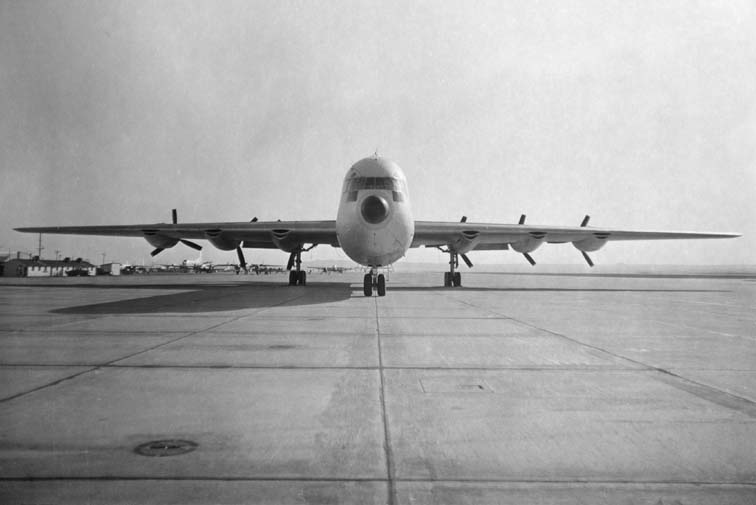 XC-99 on Edwards AFB ramp. Photo courtesy AFFTC/HO.
 Crew of the XC-99 sometime between November 1951 and February 1952.
Dale J. Green, the former Chief Electrician of the XC-99 has provided the identities of most of the crew: From left to right, with rank and duty assignment, if known.
Crew of the XC-99 sometime between November 1951 and February 1952.
Dale J. Green, the former Chief Electrician of the XC-99 has provided the identities of most of the crew: From left to right, with rank and duty assignment, if known.
1. Unidentified but position 1 or 4 may be Col. Albert L. Neuhauser who was often the Co-Pilot.
2. Unidentified.
3. Mr. Ken Smith, Convair Technical Representative.
4. Unidentified. See position 1.
5. M SGT Melford W. Miller, Flight Engineer.
6. T SGT Charles W. Fox, Asst. Flight Engineer.
7. August Kuentz, Loadmaster.
8. (Behind) Capt. James M. Pittard, Jr., Pilot.
9. SGT Dale J. Green, Chief Electrician.
10. SGT Garlen H. Brown, Mechanic.
11. ? T SGT Douglas E. Camp.
12. CPL Pete Prado.
13. SGT Alfred F. Wojcik, Electrician.
14. Troy Lee Hill
15. SGT James F. Beam.
16. S SGT Robert J. Baxman.
17. T SGT Howard C. Gramling.
18. ?? S SGT Maurice R. Paulin.
19. SGT Joe D. Mattison, Mechanic.
(Question marks indicate the degree of identification uncertainty.)
Melissa Pittard has identified the fourth man from the left as her father, Jim Pittard. Dorothea Krivenko has identified the tall man standing fourth from the right as her father, Robert Baxman. Dee Ann Hargrove believes that #14 is her grandfather, Troy Lee Hill. Photo courtesy Alan Kuentz.
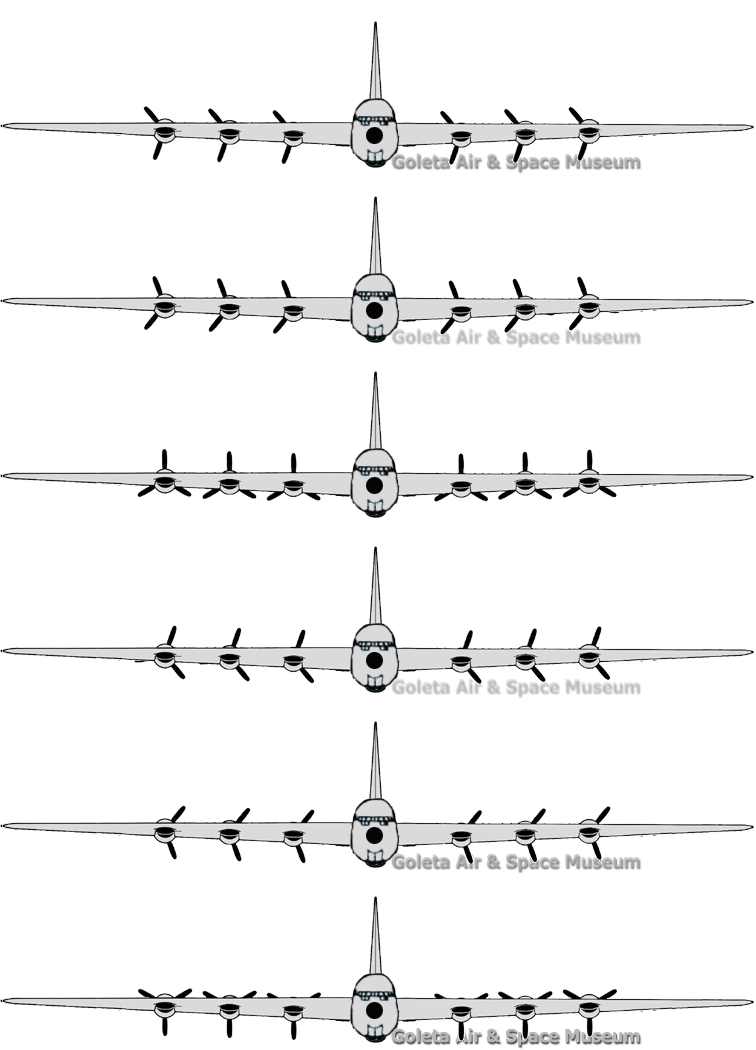
 The Convair model 37 was a proposed
a 204-seat airliner version of the XC-99.
The Convair model 37 was a proposed
a 204-seat airliner version of the XC-99.
 Craig Hansen has provided this rendering of a
Convair Model 37 in the livery of Pan Am. Some of the details
were derived from Nova Development Corporation clip art.
Craig Hansen has provided this rendering of a
Convair Model 37 in the livery of Pan Am. Some of the details
were derived from Nova Development Corporation clip art.
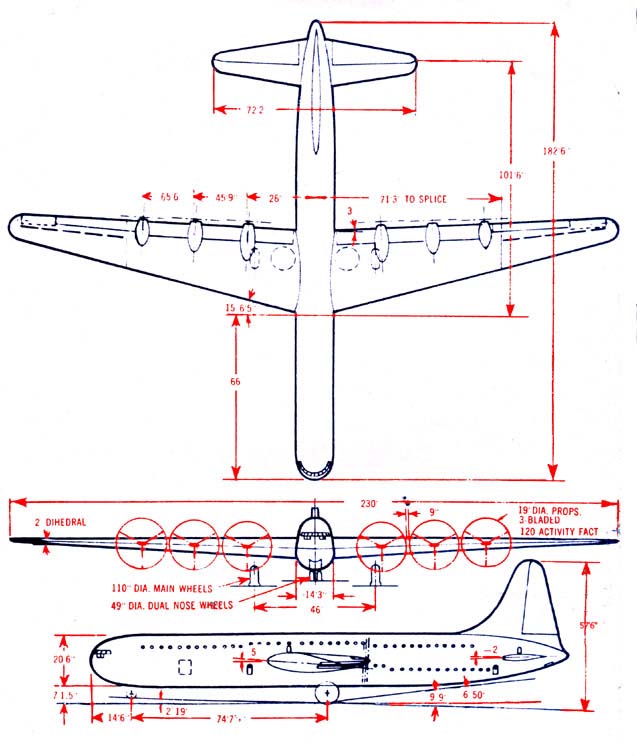 Plans
for the Convair Model 37 airliner.
Plans
for the Convair Model 37 airliner.
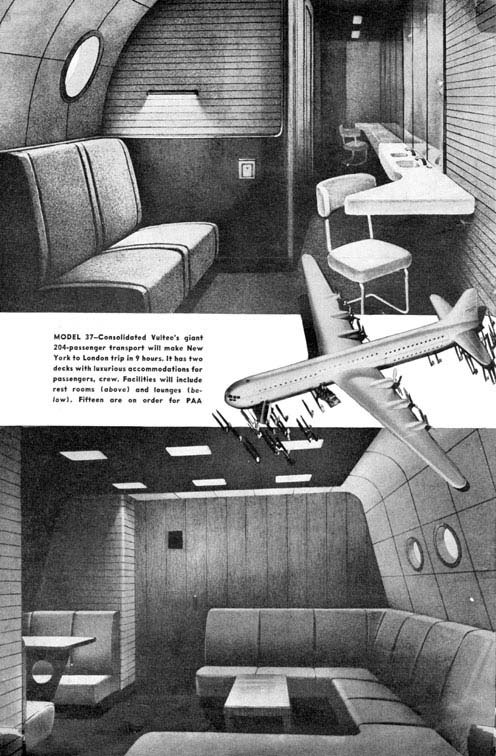 Pan American Airlines ordered fifteen Model 37 twin-deck
airliners. They would have provided capacious restrooms and
lounges for their transatlantic passengers.
Pan American Airlines ordered fifteen Model 37 twin-deck
airliners. They would have provided capacious restrooms and
lounges for their transatlantic passengers.
No one knows when or where the legend of Pegasus first became popular. Nor does the date really matter. For as long as history records, men of the world have seen the flying beast of burden as the epitome of mortal ambition. Now Consolidated-Vultee has come forward with a single vehicle which moves through the air on the power of 30,000 winged horses-to prove conclusively that the sky alone is the limit where practical airplane size is concerned.
That the recently announced Model 37 is far and away the largest flying machine on the immediate post-war docket is obvious. Although size alone does not spell greatness in aviation, it is interesting to note that the single slender wing of the Model 37 would outreach a 21-story building if upended on a metropolitan street corner. Similarly, the single fin and rudder stands approximately five stories above the runway. Twice as large as the Consolidated-Vultee Liberator, the Model 37 has a wing span of 230 feet and measures 182 feet in length. Nearly ten Piper Cubs could be parked in the tarmac space occupied by a single Model 37.
Actually this new transport is something more than a very large airplane, with external lines and internal design unlike anything previously offered to the commercial airline operators of the world. It has, first of all, six engines buried in the wing to match the largest pre-war German, French and Russian commercial types in number of engines. Unlike the latter types, however, the Model 37 carries the engines in the trailing edge of the wing and becomes the first pusher type likely to see commercial service. Because the Model 37 is derived from a new Consolidated design, all information on power plants is necessarily restricted at the present time. However, the manufacturer has announced total power output equal to that of 353 automobiles-approximately 30,000 hp if we accept 85 hp as the average for American motor cars. It would be possible to obtain this output in one of two ways. The Model 37 may have a pair of inline engines in each nacelle, with a long uni-twin head and shaft driving the three-blade propellers. Or it may be fitted with individual engines each developing 5,000 hp for take-off. The former would seem impractical in the light of Consolidated's thin wing with maximum camber inadequate for accommodation of the Allison 3420, the only announced inline, which develops more than 2,500 hp. It is possible that wartime ingenuity has brought radial engines which develop considerably more than the 3,000 hp announced some time ago. However, air-cooled engines, never too successful in pusher mountings, could hardly obtain sufficient cooling on the ground while buried in the Model 37 wing. So this sky gargantua is probably powered by either a gas turbine or a diesel engine of 5,000 hp efficiency-a remarkable power plant if it exists.
In operation, the Model 37 follows a performance pattern which is more Or less general in projected multi-engine transports, although its load is obviously greater than that of the Boeing Stratocruiser, the Douglas DC-7, the Lockheed Constellation, and the Martin Mars. Cruising at speeds between 310-342 mph, the big ship will carry a payload of 50,000 pounds composed of 204 passengers and seven and one-half tons of mail or express. Operating above the weather at 30,000 feet, the Model 37 is designed for a range of 4,200 miles with the previously-mentioned load. A double-deck interior will embrace two-passenger staterooms, oversize berths, two lounges, and a number of rest rooms, with Henry Dreyfuss interiors assuring color and comfort for passengers on the long over-water routes.
The intended powerplant for the Model 37 was a 5,000 horsepower gas turbine engine which failed to materialize. The fuel and oil consumption of the 3,500 horsepower R-4360 radial engines made the design unprofitable. In addition, it was felt that the airplane provided too much capacity for the level of airline traffic that was forecast at the time.
Imagine what post-war airline travel would have been like if the Allison T-56 turbo-prop had been available at the time. Today, there would still be huge Model 37s carrying oversize cargo for Heavylift, dropping vast quantities of retardent on forest fires, and rotting on the backside of the Mojave Airport.
Delivered to the Air Force on November 23, 1949, the XC-99 was retired in 1957. Following its retirement, the XC-99 was on public display at Kelly Air Force Base near San Antonio, Texas until 1993. Initially, because it could not be put in private hands, it was donated to the organization of Disabled American Veterans.
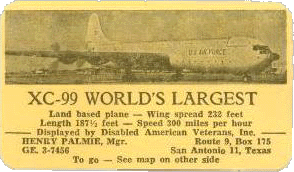 Ken
Gillespie, of San Antonio, Texas has provided these shots of the
souvenir card that advertised the XC-99.
Ken
Gillespie, of San Antonio, Texas has provided these shots of the
souvenir card that advertised the XC-99.
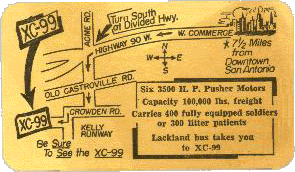 The
back of the card provided instructions for finding the location
of the twin-deck behemoth.
The
back of the card provided instructions for finding the location
of the twin-deck behemoth.
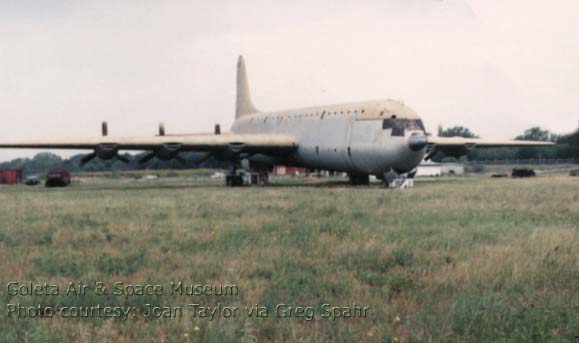
The aircraft was evaluated in the late 1960s for possible restoration and it was too deteriorated at that time, in part, because of the use of magnesium which is very prone to certain types of corrosion. At some point it was moved to a grassy field near Kelly AFB.
These pictures of the XC-99 at in its former storage location were taken on May 20, 1990 by Joan Taylor. They arrived at the museum via Greg Spahr.
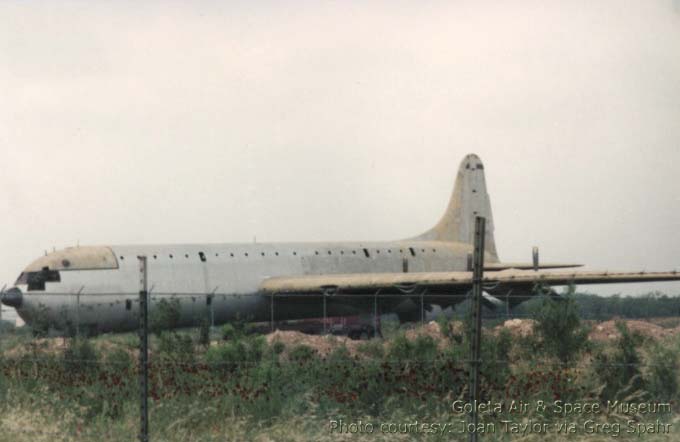 The XC-99 is open to the
elements and in need of major restoration.
The XC-99 is open to the
elements and in need of major restoration.
 Several years ago, the Air Force re-acquired the XC-99 and towed it to the tarmac
at Kelly AFB.
Several years ago, the Air Force re-acquired the XC-99 and towed it to the tarmac
at Kelly AFB.
Giant Airplanes of the 1940s |
||||||
| First Flight | Wing Span | Length | Wing Area | Gross Weight | Engines | |
| Bristol Brabazon | 1949 |
230ft,00in |
177ft,00in |
5,317 |
290,000 |
8 x 2,650hp Bristol Centaurus |
| Hughes Flying Boat | 1947 |
320ft,00in |
218ft,06in |
11,430 |
300,000 |
8 x 3,500hp R4360 |
| Convair XC-99 | 1947 |
230ft,00in |
185ft,00in |
4,772 |
320,000 |
6 x 3,500hp R4360 |
| Northrop YB-49 Flying Wing | 1947 |
172ft,00in |
53ft,01in |
4,000 |
194,000 |
8 x 3,700 lb J-35 |
| Convair B-36 | 1946 |
230ft,00in |
162ft,01in |
4,772 |
370,000 |
6 x 3,500hp R4360, 4 x 5,200 lb J-47 |
| Lockheed R6V Constitution | 1946 |
189ft,01in |
156ft,01in |
3,610 |
184,000 |
4 x 3,000hp R4360 |
| Douglas DC-6 | 1946 |
117ft,06in |
100ft,07in |
1,463 |
97,200 |
4 x 2,100 hp R2800 |
| Douglas C-74 Globemaster | 1945 |
173ft,03in |
124ft,02in |
2,506 |
145,000 |
4 x 3,000hp R4360 |
| Blohm und Voss BV-238 | 1945 |
197ft,05in |
142ft,8in |
3,930 |
176,400 |
6 x BMW 801 |
| Boeing C-97 Stratofreighter/Stratotanker | 1945 |
141ft,03in |
110ft,04in |
1,738 |
120,000 |
4 x 3,000hp R4360 |
| Lockheed 049 Constellation | 1943 |
123ft,00in |
95ft,02in |
1,650 |
86,200 |
4 x 2,000 hp R3350 |
| Martin JRM Mars | 1942 |
200ft,00in |
117ft,00in |
3,683 |
144,000 |
4 x 2,000 hp R3350 |
| Douglas DC-4 | 1942 |
117ft,06in |
93ft,10in |
1,460 |
73,000 |
4 x 1,350 hp R2000 |
| Douglas XB-19 | 1941 |
212ft,00in |
132ft,00in |
4,492 |
164,000 |
4 x 2,000 hp R3350 |
| Tupolev Ant-20bis | 1940 |
206ft,08in |
111ft,11in |
5,231 |
99,200 |
6 x 1,200 hp M-34FRNV |
| Blohm und Voss BV-222 | 1940 |
150ft,11in |
120ft |
2,744 |
108,000 |
6 x 1,000 hp BMW-Bramo Fafnir 323R |
 Books about B-36 Peacemakers available from
 Dennis Jenkins has produced another large B-36 book: Magnesium Overcast.
 Meyers Jacobsen has authored
another book about the Convair B-36 Peacemaker: A Photo Chronicle.
Meyers Jacobsen has authored
another book about the Convair B-36 Peacemaker: A Photo Chronicle.
 Convair B-36 : A Comprehensive History of America's
'Big Stick by Meyers K. Jacobsen. Mr. Jacobsen has been
compiling this history for at least a quarter of a century.
Convair B-36 : A Comprehensive History of America's
'Big Stick by Meyers K. Jacobsen. Mr. Jacobsen has been
compiling this history for at least a quarter of a century.
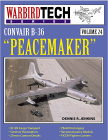 Warbird Tech: Convair B-36 Peacemaker . This volume by Dennis Jenkins contains a
surprising amount of information that did not get into "The
Big Stick".
Warbird Tech: Convair B-36 Peacemaker . This volume by Dennis Jenkins contains a
surprising amount of information that did not get into "The
Big Stick".
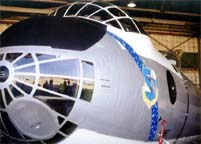 The history of the efforts to preserve B-36J, 52-22827 at Fort
Worth is well documented in "B-36: Saving the Last Peacemaker"; Second
Edition, an html book on CD.
The history of the efforts to preserve B-36J, 52-22827 at Fort
Worth is well documented in "B-36: Saving the Last Peacemaker"; Second
Edition, an html book on CD.
XC-99 Links:
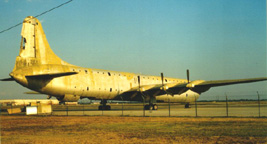 Larry Westin
has a selection of photos of the XC-99 at Kelly Air Force Base on
his web site.
Larry Westin
has a selection of photos of the XC-99 at Kelly Air Force Base on
his web site.
 The Air
Force Museum has an XC-99 photo gallery and a specifications
page.
The Air
Force Museum has an XC-99 photo gallery and a specifications
page.
Send a message to Brian.
 Go to
the Peacemaker page.
Go to
the Peacemaker page.
Go to home page of the Goleta Air and Space Museum.